These One-of-a-Kind Objects Are in the Wrong Museums
Recent years have seen increased public interest in provenance—where and how museum treasures came from—as the German Lost Art Foundation’s Gilbert Lupfer explained in The New York Times back in 2023. And the institutions under the most fire for fudging the details of provenance are generally those considered the world’s top museums. It’s sometimes claimed that the more well-established institutions are better equipped to take care of fragile, valuable artifacts, leading to debates over whether it’s proper for a single institution or museum to “own” valuable items from the past.
That’s a tough pill to swallow given recent events; Egypt and Nigeria have implemented major institutional upgrades, while the Louvre and British Museum have reported various thefts and security breaches. Even if an institution decides to send something back, the idea of sending a high-maintenance item thousands of miles away is a logistical nightmare. Then there’s this self-serving joint statement from the world’s “top” institutions: “Museums serve not just the citizens of one nation but the people of every nation.” At the same time, the idea of repatriation hasn’t been lost on officials, policymakers, museums, and other stakeholders. Eight years ago, France made a “radical commitment” to return artifacts to Africa. Following Pope Francis’s 2022 declaration to return Indigenous treasures to Canada, his successor, Pope Leo, delivered on that promise late last year.
Needless to say, there are a lot of moving pieces in this debate. Going forward, it’s very likely that we’ll continue to see shifts in how the public, museums, and relevant experts view the broader ethical implications of museums. Read on for (in)famous examples of culturally significant artifacts that arguably belong elsewhere—but live in a faraway museum to this day.
1. Jikji Digital photos of two pages from Jikji. © National Library of France via Wikimedia Commons I’d be remiss not to mention the biggest elephant in the room for my own country, South Korea. Jikji is the oldest known book in the world to be printed with a movable metal type—in 1377, 78 years before the Gutenberg Bible. This very important document, designated UNESCO’s Memory of the World, currently resides in the National Library of France (BnF). According to BnF, a French diplomat “acquired” Jikji, along with several hundred other ancient Korean books, in the early 20th century. The book entered the BnF collections in 1952 and was only officially identified by a Korean scholar who happened to be working at the East Asian section of the library in 1972. Despite government and private efforts from Korea to return Jikji, the BnF has declined on grounds that the document is a “treasure of humanity” and that, technically, it does not consider the French diplomat to have stolen it.
2. The bust of Nefertiti “Description is useless, must be seen.” So goes Egyptologist Ludwig Borchardt’s 1912 description of the bust of Nefertiti—a delicate limestone bust of the ancient Egyptian queen, caught in one of the most famous archaeological controversies to date. The nearly 3,400-year-old bust was first “unveiled” in 1913 at Berlin’s Neues Museum, where it has generally remained since. © Philip Pikart via Wikimedia Commons Understandably, Egyptian parties have long been dedicated to reclaiming the iconic sculpture, from at least 1933 to as recently as last year. Egypt has also disputed the legality of Nefertiti’s export to Germany, but to no avail. In 2023, German officials released a statement that the country had no intentions to return Nefertiti, citing the artifact’s fragility and popularity in Germany, with some critics calling the bust Berlin’s Mona Lisa.
3. Koh-i-Noor diamond Since the mid-19th century, this magnificent 105-carat diamond has adorned the crowns and displays belonging to various British monarchs, most recently the crown of the late Queen Elizabeth I. Written records suggest that the diamond originated in modern-day India around the 14th century, with the gemstone entering British possession when the United Kingdom annexed the Sikh Empire in 1849. According to a 2009 overview on the diamond’s historical significance, India, Pakistan, Iran, and Afghanistan have requested the diamond’s return. Then-prime minister David Cameron said in 2010, “If you say yes to one, you suddenly find the British Museum would be empty. I am afraid to say, it is going to have to stay put.”
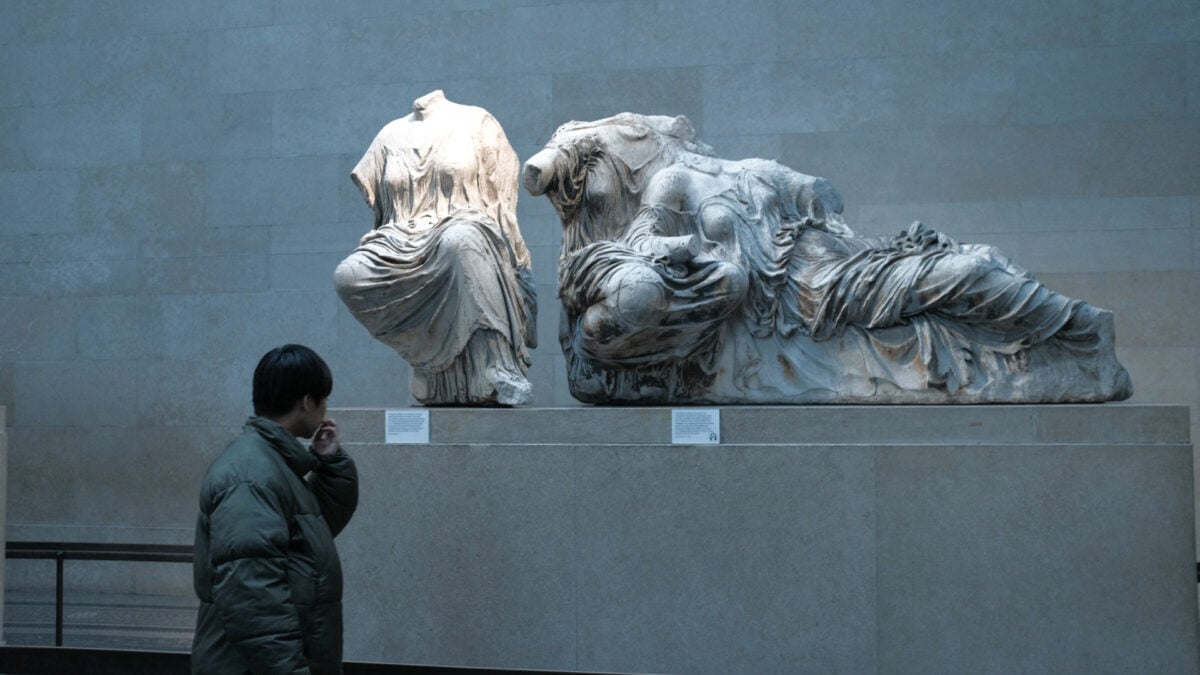
4. The Parthenon marbles Also known as the Elgin marbles after the British diplomat who brought them to the U.K. in 1801, the Parthenon marbles refer to a collection of Ancient Greek sculptures consisting of 15 metopes, 17 pedimental figures, and 247 feet (75 meters) of the original frieze. The collection currently resides in the British Museum, whose trustee statement maintains that Elgin’s actions were “thoroughly investigated by a Parliamentary Select Committee in 1816 and found to be entirely legal.” Well, Greece took issue with that, formally requesting in 1983 that the entire collection be returned and later rejecting the British Museum’s statement to UNESCO regarding the marbles’ legality. But the U.K. refused, citing the British Museum Act of 1963, which effectively forbids the museum from giving away its collections. Like the National Library of France, the British Museum has also insisted that there’s a “great public benefit to seeing the sculptures within the context of the world collection.” 5. Priam’s Treasure Schliemann’s wife, Sophia, wearing gold jewelry from Priam’s treasure trove excavated by her husband. © Author unknown via Wikimedia Commons Priam’s Treasure refers to a cache of gold and other artifacts excavated by European archaeologists Frank Calvert and Heinrich Schliemann at Homeric Troy, now part of Turkey, in 1873. According to the Berlin State Museum, Schliemann was convinced that he’d found the ornate gold-and-silver collections of Priam, the last king of Troy, described in Homer’s Iliad. (Later investigations suggested that the collection likely predates Priam’s era by a millennium, however.)
After a legal scuffle with Ottoman authorities, Schliemann smuggled the treasure out of the empire, later reaching a financial settlement, and ultimately donated his finds to museums in Berlin, according to the Berlin State Museum. The collection was hidden in Germany for safekeeping during World War II, then ended up in the Soviet Union as spoils of war. In 1998, the modern-day Russian state declared Priam’s Treasure to be Russian property, and the artifacts ultimately ended up at the Pushkin Museum in Moscow, where they remain to this day. 6. Artifacts from Cambodia’s Khmer Empire In 2023, the International Consortium of Investigative Journalists (ICIJ) published an exposé on at least 1,109 pieces of antiquities at the Metropolitan Museum of Art, previously owned by “people who had been either indicted or convicted of antiquities crimes.” This revelation sent ripples down the Met’s organization, and the institution has since had to create an entirely new webpage on repatriated objects. Notably, in the last five years the Met collaborated with the Cambodian government to return artifacts from the Khmer Empire. The collection was believed to be looted from Cambodia during a time of political instability from civil war, CNN reported in 2024. In February this year, Cambodia finally received 74 requested items from the Met.
To be fair, the Met has been making a concerted effort for repatriation (perhaps more than some others on this list). But as the museum admitted to The New York Times last year, they still have an enormous list of items—not just from Cambodia—acquired from commercial dealers to check for provenance. 7. Hoa Hakananai’a For people of Rapa Nui (often referred to as Easter Island), Hoa Hakananai’a, a type of moai statue, is said to embody the spirits of ancestors long gone. In 1868, a British crew unearthed two moai and lugged them on their ship. Upon the crew’s return to the U.K., the statues were offered to Queen Victoria and are now on display at the British Museum.
“The British taking the moai from our island is like me going into your house and taking your grandfather to display in my living room,” Anakena Manutomatoma, an Easter Island native and a member of Rapa Nui’s development commission, told the BBC in 2018. The Rapa Nui people, in collaboration with the Chilean government, were reportedly in discussions with the British Museum to have the statues returned, according to the BBC. In 2023, the island’s elders’ council reportedly wrote to King Charles to request the statues again but did not receive an answer as of 2024, The Guardian reported. 8. The Benin bronzes The Benin bronzes are perhaps the largest, fractured collection of artifacts on this list. According to The Loot Museum, the bronzes refer to up to 10,000 artifacts stolen by British troops from the Benin Kingdom, now Nigeria. From there, the bronzes ended up in the British Museum and other private and public collections across Europe and the U.S., with a survey by The Art Newspaper revealing that as many as 160 museums and institutions worldwide hosted Benin bronzes.
The Benin bronzes on display at the British Museum. © Geni via Wikimedia Commons That said, the Benin bronzes have been getting sent home occasionally. In 2022, the National Gallery of Art, the Smithsonian, and the Rhode Island School of Design in the U.S. jointly sent back 31 Benin bronzes. The year prior, the Metropolitan Museum of Art returned two bronzes out of 160 in its collection. As you can tell, there’s a long way to go. The two largest collections of the bronzes are still the Ethnological Museum of Berlin and the British Museum, the latter of which holds more than 900 pieces, because, of course, the bronzes—you guessed it!—offer a great public benefit “when displayed internationally.”