Italy denies use of Sicily airbase to US aircraft carrying weapons for Iran war – Europe live
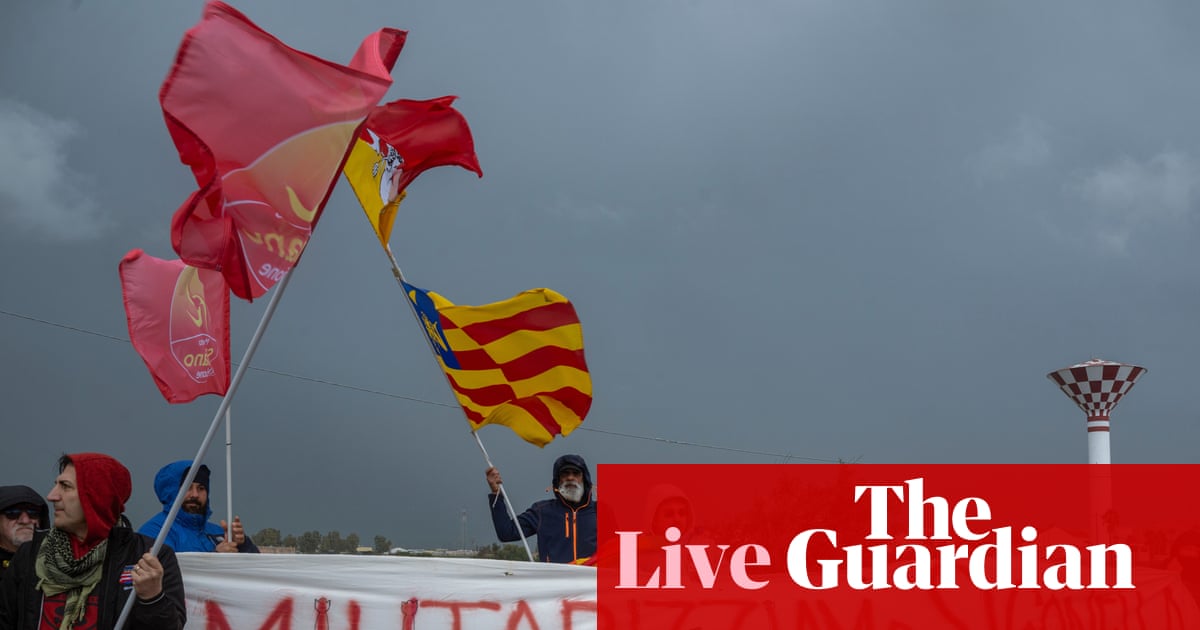
Italy denies use of Sicily airbase to US aircraft carrying weapons for IranAngela Giuffridain RomeItaly has denied use of an airbase in Sicily to US military craft carrying weapons for the war in the Middle East.Civil associations, unions, peace activists and members of No MUOS movement gather in front of the US naval airbase to protest against US and Israel’s attacks on Iran earlier this month. Photograph: Anadolu/Getty ImagesA source at the Italian defence ministry confirmed a report in Corriere della Sera that “some US bombers” had been due to land at Sigonella – a key US navy installation and Nato base – before heading to the Middle East.According to treaties signed in the late 1950s, the US navy can use the base for logistical and training purposes but not as a transit hub for aircraft used to transport weapons for war unless in an emergency situation, permission for which needs to be approved in parliament.The source said the US had only sought permission to land the aircraft while they were en route to Sicily, therefore failing to follow procedures that require authorisation to be approved in parliament. It is unclear when the aircraft had been due to land at the base but the source said there was no time to seek approval in parliament.For days, politicians in Sicily from Italy’s leftwing opposition parties have been urging Giorgia Meloni’s far-right government to clarify the situation at Sigonella after activity at the base increased since the start of the war in Iran and asked it to block the US from using bases in Italy for involvement in the conflict. Italy hosts seven US navy bases.ShareUpdated at 12.44 CESTKey eventsShow key events onlyPlease turn on JavaScript to use this featurePoland says will not relocate Patriot batteries to Middle East after media claims of US pressureMeanwhile, Poland’s defence minister Władysław Kosiniak-Kamysz said the country’s Patriot air defence batteries will not be relocated anywhere after a media report claimed that US officials had informally suggested to the Polish government they should consider redeploying one of them to the Middle East.The Rzeczpospolita newspaper reported that the US had been “sounding out” Poland about moving one of the two Polish-owned Patriot batteries to the Middle East.A Polish defence ministry spokesperson denied the newspaper’s report, saying “The Americans are not putting any pressure on [us] on these matters.”Wiesław Kukuła, Chief of the General Staff of the Polish Armed Forces, also denied it on X, saying “No one is asking for it.”The newspaper separately suggested that future deliveries of contracted US interceptor missiles to Poland could be hit by delays caused by the Iran war; again, a claim denied by an army spokesperson.In a post on X, Kosiniak-Kamysz said:
“Our Patriot batteries and their armament are used to protect Polish skies and Nato’s eastern flank. Nothing is changing in this regard, and we are not planning to relocate them anywhere! Our allies know full well and understand how important the tasks we have here are. Poland’s security is an absolute priority.”
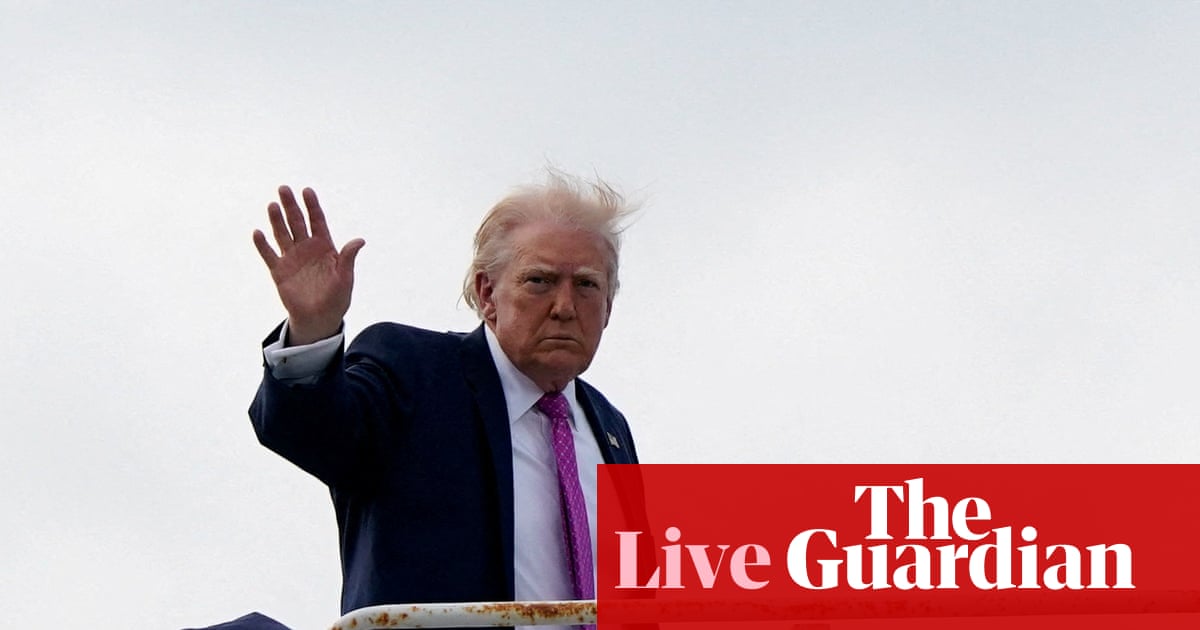
ShareUpdated at 13.41 CESTFrance 'very unhelpful' with Iran and US 'will remember' that, Trump says in latest outburstBack to Iran and the perceived lack of support from European Nato allies, US president Donald Trump has now turned to criticising France in his latest outburst on social media.In a post on Truth Social, he said:
“The Country of France wouldn’t let planes headed to Israel, loaded up with military supplies, fly over French territory. France has been VERY UNHELPFUL with respect to the “Butcher of Iran,” who has been successfully eliminated! The U.S.A. will REMEMBER!!! President DJT”
ShareEU 'reaffirm commitment' to making Russia accountable for war crimes in UkraineThe EU and 26 of its member states – no Hungary, unsurprisingly – have just issued a statement on Ukraine following their informal meeting in Bucha this morning.View image in fullscreenUkrainian foreign minister Andrii Sybiha, EU top diplomat Kaja Kallas and other EU officials attending a candle-lighting ceremony to commemorate the fourth anniversary of the Bucha massacre discovery, in Bucha, near Kyiv, Ukraine. Photograph: Ukraine Foreign Ministry Press Service Handout/EPAIn it, they said they wanted to “reaffirm our unwavering commitment to ensuring full accountability of the Russian Federation, for any violations of international law in or against Ukraine, including aggression in violation of the Charter of the United Nations.”They added:
“We honour the memory of all victims of the massacre in Bucha and other cities, towns and villages across Ukraine, where civilians were subjected to mass killings, torture, sexual violence, forced deportations, and other grave violations of international humanitarian and human rights law. The evidence collected following the withdrawal of Russian forces, underscores the imperative to ensure full and comprehensive accountability.”
They specifically welcomed the work on “operationalisation of the Special Tribunal for the Crime of Aggression against Ukraine and the establishment of the International Claims Commission for Ukraine.”
“We also express our support for investigations by the international criminal court into the situation in Ukraine and call for full cooperation by all State Parties.”
Finally, they also reiterated their “firm and unwavering” backing for Ukraine more broadly.The lack of Hungarian signature is not surprising given the continuing – and escalating – standoff between Viktor Orbán and Kyiv as the nationalist prime minister continues to use anti-Ukrainian rhethoric in his electoral campaign.ShareEU's top diplomat spoke to Hungarian foreign minister to remind him of confidentiality rules after reports on contacts with Russia, commission saysWe have just heard the EU’s response to the latest revelations about the close contacts between Hungary’s foreign minister Péter Szijjártó and Russian officials (11:10), but it was rather technical.The commission’s foreign spokesperson Anitta Hipper said the EU’s top diplomat, Kaja Kallas, spoke with Szijjártó earlier this week “reiterating, once more, the importance of confidentiality of closed doors discussion.”Kallas “also stressed that the council’s internal deliberations must not be disclosed to third parties,” she said.But pressed on the issue further, the commission’s deputy spokesperson Olof Gill shut it down saying:
double quotation markWe have nothing more to say on that topic for the moment.
ShareItaly denies use of Sicily airbase to US aircraft carrying weapons for IranAngela Giuffridain RomeItaly has denied use of an airbase in Sicily to US military craft carrying weapons for the war in the Middle East.View image in fullscreenCivil associations, unions, peace activists and members of No MUOS movement gather in front of the US naval airbase to protest against US and Israel’s attacks on Iran earlier this month. Photograph: Anadolu/Getty ImagesA source at the Italian defence ministry confirmed a report in Corriere della Sera that “some US bombers” had been due to land at Sigonella – a key US navy installation and Nato base – before heading to the Middle East.According to treaties signed in the late 1950s, the US navy can use the base for logistical and training purposes but not as a transit hub for aircraft used to transport weapons for war unless in an emergency situation, permission for which needs to be approved in parliament.The source said the US had only sought permission to land the aircraft while they were en route to Sicily, therefore failing to follow procedures that require authorisation to be approved in parliament. It is unclear when the aircraft had been due to land at the base but the source said there was no time to seek approval in parliament.For days, politicians in Sicily from Italy’s leftwing opposition parties have been urging Giorgia Meloni’s far-right government to clarify the situation at Sigonella after activity at the base increased since the start of the war in Iran and asked it to block the US from using bases in Italy for involvement in the conflict. Italy hosts seven US navy bases.ShareUpdated at 12.44 CEST'What is in it for the US?,' Rubio asks about Nato amid standoff over using Nato bases for Iran operationsAnother big story getting lots of attention in Europe today is the escalating standoff between the US administration and European Nato countries over their reluctance or refusal to support the US offensive operations in Iran.View image in fullscreenPeople, holding banners, flags and photos of those killed in the attacks, march as part of the 'no war' demonstrations held in many Spanish cities to mark the first month since the start of the US and Israeli attacks on Iran in Madrid, Spain last weekend. Photograph: Anadolu/Getty ImagesOver the past few weeks, Trump repeatedly criticised Nato countries, saying they “have done absolutely nothing,” labeling them as “cowards,” and saying the US would “never forget” their refusal to help.In the latest sign of tensions, US secretary of state Marco Rubio lashed out at Spain and other Nato allies overnight, telling Al Jazeera that it was “very disappointing” to see partners deny its request to use their airspace.On Monday, Spain said it has closed its airspace to US planes involved in the war, stepping up Pedro Sánchez’s opposition to the conflict.Rubio responded to the news by saying:
“I think it was very disappointing … and … look, the president and our country will have to re-examine all of this after this operation is over, but one of the reasons why Nato is beneficial to the United States is it gives us basing rights for contingencies.
It allows us to station troops and aircraft and weapons in parts of the world that we wouldn’t normally have bases, and that includes much of Europe.
And to see that in a time of need, [when] the United States has identified a grave risk to our national security and our national interests, and we needed to conduct this operation, we have countries like Spain, a Nato member that we are pledged to defend, denying us the use of their airspace and bragging about it, denying us the use of our of their bases – and there are other countries that have done that as well – and so you ask yourself, well, what is in it for the United States?”
ShareUpdated at 12.05 CESTJakub KrupaIt’s worth adding that similar incidents were recently reported in Lithuania, Latvia and Estonia as Ukraine continues targeting Russia’s Baltic Sea coastal areas, including the port of Ust-Luga.Estonia reported a number of suspected drones even last night, with a senior defence official telling media that “for the ninth consecutive day, military activity has been ongoing in Estonia’s neighboring Leningrad oblast at a level of intensity not seen since 1944,” Estonian broadcaster ERR reported.Share'The war has come close,' Finnish PM says after drones fell in FinlandMiranda BryantNordic correspondentMeanwhile, the Finnish prime minister, Petteri Orpo, has said the war in Ukraine has “come close” after two drones fell on Finnish territory, but insisted that it did not constitute a military threat.Two drones crashed in south-eastern Finland on Sunday – one north of Kouvola and one in Luumäki – in what is being treated as suspected territorial violations. One of the drones has been identified as Ukrainian.View image in fullscreenFinland reported a suspected territorial violation by unmanned aerial vehicles in the southeast of the country. Photograph: Sasu Jarnstedt/ReutersDefence forces say they are carrying out almost daily surveillance and reconnaissance flights in response to the situation and Ukrainian drone operations near Finland on Russian oil facilities.Orpo said in a press conference this morning: “The war has come close, and the effects have extended beyond our country’s borders”. But, he added, that Ukraine has right to defend itself and there is nothing to suggest that the drones were deliberately directed at Finland and therefore not a military threat.“On Sunday morning, two drones fell in Finnish territory,” Orpo said.
double quotation markLet’s remember what this is about: Russia is continuing its large-scale war of aggression for the fifth year, and Ukraine has the right to defend itself.
He added: “Last night, there were observations in the Baltic countries that drones had been seen nearby, meaning they were heading towards the Gulf of Finland.”Major General Timo Herranen, of the Finnish defence forces, said that last night Finnish fighter jets were “in the air almost the entire time”.On Sunday, the Finnish president Alexander Stubb said “there is no military threat to Finland”, adding that authorities responded immediately.Monitoring and investigations, he said, were ongoing. “Finland is prepared to monitor and secure our territory.”ShareUpdated at 11.57 CESTMore details emerge on Hungarian foreign minister's alleged links with RussiaSpeaking of the €90bn loan and EU sanctions against Russia, and Hungary’s role in all of this, more details have now emerged alleging close contact between Hungary’s foreign minister Péter Szijjártó and senior Russian ministers.View image in fullscreenRussian foreign minister Sergei Lavrov speaks with his Hungarian counterpart Peter Szijjártó before a meeting of Russian President Vladimir Putin and Hungarian prime minister Viktor Orbán in Moscow, Russia last November. Photograph: Alexander Nemenov/ReutersA joint investigation by The Insider and four regional media VSquare, DelfiEE, FrontStory and the Investigative Center of Ján Kuciak, published this morning, alleged that Szijjártó regularly discussed the EU’s confidential plans on sanctions with Russian officials, actively looking for ways to block or delay their adoption.In a series of conversations reported by the outlets, the Hungarian foreign minister reportedly told Russia’s foreign minister Sergei Lavrov that he is “always at your disposal” and offered help with removing certain individuals from EU sanctions.Former Lithuanian foreign minister Gabrielius Landsbergis confirmed the authenticity of one of the exchanges that Szijjártó reportedly relayed onwards to the Russians.One of the authors of the article, Szabolcs Panyi, one of the country’s most prominent investigative journalists, was last week accused by the Hungarian government of spying for Ukraine, a move widely condemned by media rights watchdogs.The five media outlets said Szijjártó did not reply to their request for comment.He has responded on X this morning seeking to ridicule the reporting by saying “they proved that I say the same publicly as I do on the phone. Nice work!”“For four years we have been saying that sanctions are a failure, causing more harm to the EU than to Russia. Hungary will never agree to sanction individuals or companies essential for our energy security, for achieving peace, or those with no reason to be on a sanctions list,” he said.Szijjártó had previously dismissed earlier reporting on this as fake news, but confirmed he held some calls with third-country partners, saying this was part of routine diplomacy.The report is likely to cause further frustration in Brussels and in EU capitals amid growing anger over Hungary’s close relations to Russia, with both prime minister Viktor Orbán and Szijjártó regularly visiting Moscow.The latest relevations come less than two weeks before the critical parliamentary election in the country, which could see Orbán ousted after 16 years in power.It’s safe to say we are very likely to see someone ask the Commission for their reaction at their midday briefing later today.ShareBucha 'symbolises cruelty of Russia's war' against Ukraine, EU's Kallas saysEU top diplomat Kaja Kallas said the Bucha massacre “has come to symbolise the cruelty of Russia’s war” against Ukraine as she vowed to bring Russia into account for its actions during the conflict.View image in fullscreenEU foreign policy chief Kaja Kallas standing next to Ukraine's foreign minister Andrii Sybiha as EU ministers attend commemorating ceremony in Bucha, Ukraine. Photograph: Eduard Khryzhanivsky/AP“Four years after these mass killings, we remember the victims. What happened here cannot be denied,” she stressed.She added the EU was “committed to ensuring that these crimes do not go unpunished, including by supporting the Special Tribunal for the Crime of Aggression, alongside the Claims Commission.”“Russia must be held accountable for what it has done to Ukraine,” she said.She earlier said the bloc “will keep providing military, financial, energy, and humanitarian support” to Ukraine.ShareMorning opening: Focus on UkraineJakub KrupaSeveral EU ministers are expected in Bucha, Ukraine, today to mark the fourth anniversary of the town’s liberation and the massacre that became one of the early symbols of the Russian aggression against Ukraine.View image in fullscreenPeople attend a ceremony at a memorial for killed civilians to mark the fourth anniversary of the liberation of Bucha, Ukraine. Photograph: Evgeniy Maloletka/APThe anniversary marks a rare moment in recent weeks when the EU’s attention focuses back on Ukraine amid growing concerns about fallout from the Iran war. The EU’s top diplomat, Kaja Kallas, leads the delegation.The ministers will discuss what needs to be done to ensure accountability for war crimes committed during the war through a special tribunal, which still needs more political backing and funding to come into existence.Ukraine’s foreign minister, Andrii Sybiha, said in a post on social media:
“The scale of Russian atrocities in the course of its aggression is unseen on European soil since WWII. The crime of aggression is the root cause of them all. There must be accountability and there will be no amnesty for Russian criminals, including the highest political and military leadership of the Russian Federation.”
He drew a comparison with the Nuremberg trials against leaders of defeated Nazi Germany, saying the new tribunal was needed to “prevent such horrible crimes from repeating again in the future.”But no progress is expected to be made on thorny issues of the EU’s €90bn loan to Ukraine and the 20th package of sanctions against Russia, both of which continue to be blocked by Hungary.Let’s see what the day brings.Separately, EU energy ministers are holding a call later today to discuss the impact of the crisis in the Middle East on energy prices as some countries push with unilateral measures that they argue are needed to limit the impact on their economies.I will also keep an eye on Denmark where the coalition talks continue after last week’s parliamentary election, which ended with a political deadlock.It’s Tuesday, 31 March 2026, it’s Jakub Krupa here, and this is Europe Live.Good morning.ShareUpdated at 12.58 CEST