Israel says it killed Iranian militia head, security chief amid 'wide-scale' strikes on Tehran
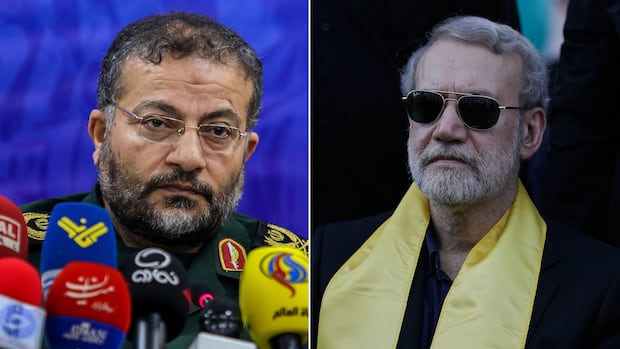
Israel's defence minister said that its military killed Iran's security chief and the head of its Basij militia in overnight airstrikes as it conducted a "wide-scale wave of strikes" across Tehran on Tuesday.Top Iranian security official Ali Larijani was killed in an overnight Israeli strike, according to Israel Katz, along with Gholam Reza Soleimani, the head of the Revolutionary Guard's all-volunteer Basij force — a key force used to suppress demonstrations within Iran. "Larijani and the Basij commander were eliminated last night and have joined Khamenei, the head of the annihilation program, along with all those eliminated from the axis of evil in the depths of hell," Katz said in a statement.Iranian state media published a handwritten note by Larijani commemorating Iranian sailors killed in a U.S. attack whose funeral was expected on Tuesday. Iran did not immediately confirm either death. Larijani would be the most senior figure assassinated since supreme leader Ayatollah Khamenei was killed on the first day of Israeli-U.S. airstrikes on Feb. 28.Larijani hails from one of Iran's most famous political families. A former parliamentary speaker and senior policy adviser, he was appointed to advise the late Khamenei on strategy in nuclear talks with U.S. President Donald Trump's administration. He also served as the secretary of Iran's Supreme National Security Council, its top security body.WATCH | Trump's timeline for the war keeps changing:U.S. President Donald Trump’s timeline for when the war in Iran could end keeps changing. For The National, CBC’s Ashley Fraser breaks down the inconsistent messaging and asks the experts what the shifting timeline reveals about the American military strategy.Larijani had been sanctioned by the U.S. Treasury in January as Tehran violently suppressed nationwide protests. It identified him as being "responsible for co-ordinating the response to the protests on behalf of the supreme leader of Iran."Soleimani was killed in a combat tent alongside other Basij commanders, according to an Israeli military official who spoke on condition of anonymity with The Associated Press. The official said commanders were using the tent as makeshift headquarters due to concerns their regular bases could be targeted.The U.S. Treasury lists Soleimani as having been born in 1965. He has been sanctioned by the U.S., the European Union and other nations over his role in helping suppress dissent for years through the Basij.Killing Soleimani would likely further strain the command and control of the Basij, which would be crucial in putting down any uprising against the theocracy. The Basij and other internal security forces have been a target of attack by both the Americans and the Israelis so far.On Tuesday, Israel reported two incoming salvos before dawn from Iran at Tel Aviv and elsewhere, and said Hezbollah targeted Israel's north.Meanwhile, Iran's attacks on Persian Gulf states continued. Dubai, a major transit hub for international travel, briefly shut its airspace as the military said it was "responding to incoming missile and drone threats" around the city, and a man was killed by the debris of a missile intercepted over Abu Dhabi. Pressure on oil marketsIran kept up the pressure on energy infrastructure in the region on Tuesday, hitting an oil facility in Fujairah, a city in the United Arab Emirates on the east coast with the Gulf of Oman that has been repeatedly targeted. State-run WAM news reported that no one had been injured in the blast from the drone strike.Iran's attacks on Gulf nations and its stranglehold on the Strait of Hormuz, through which a fifth of the world's oil is transported, has given rise to increasing concerns of a global energy crisis. Early Tuesday it hit a tanker anchored off the coast of Fujairah, one of about 20 vessels hit since Israel and the United States started the war with an attack on Iran on Feb. 28.WATCH | McGuinty won’t rule out defensive role:Defence Minister David McGuinty said Canada’s military may help defend Middle East countries from Iran’s attacks, but it has no intention of taking an offensive role. The comments came after Prime Minister Mark Carney said Ottawa hasn’t been asked to help secure the Strait of Hormuz. With Washington under increasing pressure over rising oil prices, Brent crude, the international standard, remained over $100 US a barrel, up more than 40 per cent since the war started.Trump said he had demanded that roughly a half-dozen countries send warships to keep the Strait of Hormuz open. But his appeals brought no immediate commitments, with many saying they are hesitant to get involved in a war with no defined exit plan and skeptical that they could do more than the U.S. navy.U.A.E. briefly closes airspace The U.A.E. shut down its airspace early Tuesday as its military reported it was "responding to missile and drone threats from Iran." The closure was soon lifted, and not long after the sounds of explosions could be heard as the military worked to intercept incoming fire.The snap announcement on its airspace showed the balancing act Emirati authorities face in trying to keep their long-haul carriers, Emirates and Etihad, flying as Iranian attacks continue to target the country.The U.A.E. says its air defences responded to a total of 10 ballistic missiles and 45 drones from Iran on Tuesday.Saudi Arabia's Defence Ministry, meanwhile, reported intercepting a dozen drones on Tuesday morning over the country's vast Eastern Province, home to oil infrastructure.In Qatar, the sounds of explosions boomed over the capital early in the day as defences worked to intercept incoming fire. Qatar's Defence Ministry said later that it had successfully thwarted a missile attack on the city, though a fire broke out in an industrial area from a downed projectile.Attacks from Iran-linked proxy forces continued in Iraq, as the U.S. Embassy in Baghdad was hit with shrapnel from drones that had been intercepted.WATCH | The challenges the U.S. faces in attempting to secure vital sea passage:U.S. President Donald Trump's pleas for support in the Strait of Hormuz are being dismissed by his allies, leaving the nation largely alone to fight Iran's tight grip on the key sea passage. Retired vice-admiral Mark Norman discusses the approach by U.S. allies and whether the U.S. could secure the strait by itself.
The embassy's air defences were able to shoot down all four drones targeting the facility, according to two Iraqi security officials, speaking on condition of anonymity to discuss intelligence matters.A separate strike targeted a house in the heavily fortified Presidential Compound in Baghdad's al-Jadriya area, the officials said. It wasn't clear who carried out either attack but Iran-allied militias have regularly been attacking American targets inside Iraq since the conflict began.Since the onset of the U.S.-Israeli strikes on Iran, which ignited a war in the region, a handful of ships have gotten through the Strait of Hormuz, primarily Iranian but also from other countries, including India and Turkey. Iranian Foreign Minister Abbas Araghchi said, "from our perspective, it is open" — just not for the United States, Israel and its allies.More than 1,300 people have been killed in Iran since the start of the conflict, according to the Iranian Red Crescent.