Who is Frankenstein’s Bride?
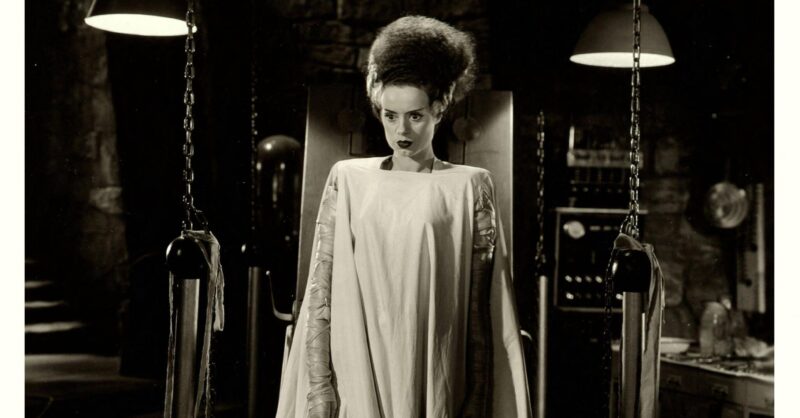
“She hates me…” So grieves the Monster at the end of Bride of Frankenstein, the 1935 sequel to the original Frankenstein film. The Monster’s bride, reanimated from a fresh corpse by the scientist Henry Frankenstein and his mentor Doctor Pretorius, appears in a billowing white gown, her lips painted black against porcelain skin, mirroring the lightning bolts zigzagging through her unkempt updo. The Monster is delighted, having found the Eve to his Adam. Yet as he caresses her hand she screams. Infuriated by her rejection, he destroys them both.
Elsa Lanchester plays the Bride as well as Frankenstein’s author, Mary Shelley, who appears at the beginning of the film to introduce the story. Lanchester is transformed from the glamorous writer into a defiant, wild figure; one who dares to say no. The Bride is not a character of Shelley’s making; in the novel, the Creature yearns for a mate, but Frankenstein, fearful of spawning a progeny of monsters, destroys the incomplete female. The film, on the other hand, brings her to life, and shows this Bride as the woman Shelley wished to be, able to rage against her misogynistic publishers and the peers who deliberately misunderstood her work.
The Bride!, a new, updated version directed by Maggie Gyllenhaal, employs the same conceit, casting the same actress – Jessie Buckley – as creature and creator. Buckley is furious as Shelley, her cackling British accent creating a schizophrenic divide with Ida, the American woman from 1930s Chicago she possesses at the start of the film. The name alludes to Ida Lupino, the most prominent female filmmaker working in the Hollywood studio system in the 1950s: a woman who, like Shelley, defied the social constraints of her gender. After Ida is killed, she is dug up by Dr Cornelia Euphronius (Annette Bening) on commission from the original Frankenstein’s Monster (Christian Bale), who has survived since his creation in 1819. As with all men compelled by the search for a “woman”, he cites loneliness as motivation.
If by creating a man Victor Frankenstein – in Shelley’s version – became “the modern Prometheus”, in fashioning a woman he is a modern Pygmalion – the mythological figure who carved Galatea out of ivory and implored Aphrodite to give her life. Men building men comes from a human drive to play God, while men who design women are motivated by sexual desire, to return woman to a tabula rasa and force her into unquestioning submission. The Bride in the 1935 version fights back, yet her appearance at the end of the film is brief; Gyllenhaal takes this premise and fleshes it out into a feature-length feminist exploration of the character. Shelley was angry in her own time, and in the film this anger erupts in the context of burgeoning women’s rights and the interwar sexual liberation of flappers and philosophers.
Subscribe to the New Statesman today and save 75%
Building a woman can go wrong. Not long before Bride of Frankenstein, the German expressionist director Fritz Lang made Metropolis (1927); it sees an inventor create a female robot which adopts the guise of a woman named Maria, played by Brigitte Helm, who poses a threat to the masculine, corporate régime that rules the dystopian city in which the film is set. Like Buckley’s Bride, the robot must discover its own sense of gender identity. This is a question absent from the journey of self-recognition undertaken by the male creature of Shelley’s novel and the 1931 film adaptation; the original Monster is a blank slate, learning the basics of human language and manners, albeit with unwittingly disastrous results. In the film, he meets a girl by a lake with whom he throws flowers onto the water. Observing that the pretty objects float, he throws in the child, who drowns. The Monster becomes perceived as a danger to society, especially to women and children. Buckley’s Bride also causes havoc – but female monsters, designed for different purposes, are perceived as inherently subservient and not truly frightening.
The director of the 1930s Frankenstein films, James Whale, was a closeted gay man; it has been suggested that this embedded in the film an alienation which other ostracised groups could identify with. Gender scholars, too, have found meaningful analogues in the Monster’s experience. In the essay “My Words to Victor Frankenstein above the Village of Chamounix”, Susan Stryker writes: “Like the monster, I am, too, perceived as less than fully human due to the means of my embodiment; like the monster’s as well, my exclusion from human community fuels a deep and abiding rage in me”. Gyllenhaal’s Bride does not know what her sexual identity was prior to her reanimation, allowing the male Monster to manipulate her into believing that she was enraptured by him before she died. As men repeatedly try to assault her, she grows violent against them – a behaviour which she struggles to reconcile with an innate sense of morality.
Men are always trying to bring women back from the dead in film. James Stewart’s Scottie is convinced that he can bring back his dead wife in Alfred Hitchcock’s Vertigo (1958) by dressing a woman who looks like her in the same clothing. Both women are played by Kim Novak, and when the latter appears in full costume Scottie is elated, until of course he realises that this woman has a distinct personality. Pedro Almodóvar’s The Skin I Live In (2011) goes further; in the film, a plastic surgeon sculpts his deceased spouse from a living man named Vicente, who is transformed into a woman through surgical, hormonal, and social intervention, much in the manner of a medical transition. The film explores the immutability of gender, forcing Vicente into a dysphoric state through his biological prison. It is the same mistake made by all mad scientists who dare to play with gender – overlooking the power of the individual.
Since Bride of Frankenstein, the Bride has reappeared in various guises – in Hammer’s Frankenstein Created Woman (1967), comically in Mel Brooks’s Young Frankenstein (1974), and in the sexual fantasies of Weird Science (1985) and Frankenhooker (1990). More recently, Yorgos Lanthimos’s Poor Things (2023) imagined a woman created as an adult with a desire for sexual self-discovery. Its protagonist is initially attracted to men before misogynistic injustice fuels in her a yearning for freedom. Filmmakers use cinema as a laboratory in which to experiment with the patriarchal desire to tame women for their own ends, an aspiration frequently rendered farcical or doomed.
For her version of this tale, Gyllenhaal has created a Frankensteinian cinematic mishmash of Golden Age and New Hollywood, bleeding Fred and Ginger with Bonnie and Clyde. Born in the chains of the past, the Bride must join the feminist revolution of the present. But the fundamental nature of the situation remains unchanged. Man might create woman as a sexual object. But she will always rebel.
[Further reading: Gisèle Pelicot is not your hero]
Content from our partners
Related