Disruption in the Strait of Hormuz is a global inflation, shipping and growth story
The Strait of Hormuz is critical to global oil and gas supplies, and to the conflict in Iran. Mohsen Khezri calls the Strait an “economic clock of war”: a short closure is an oil shock but a long closure becomes an inflation and growth shock. And while strategic oil reserves may buy time they will not make a long war economically harmless.
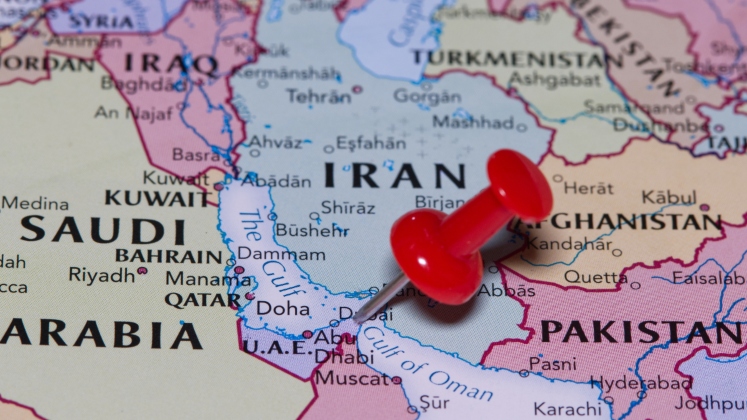
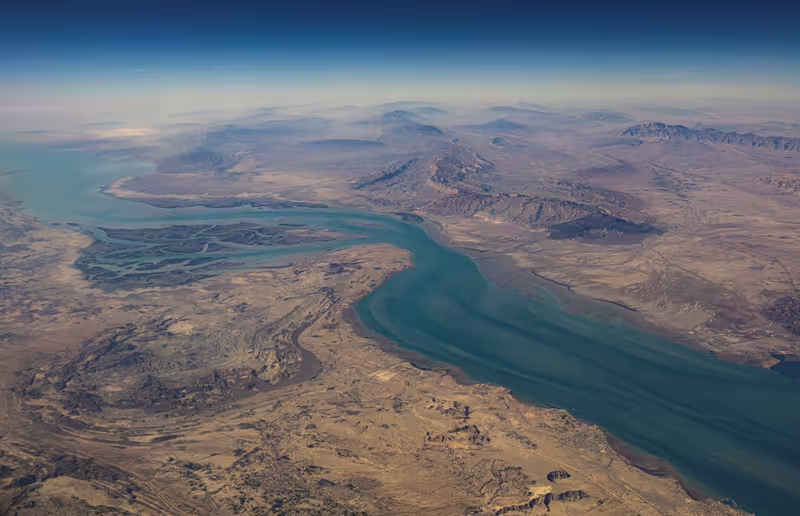
The Strait of Hormuz lies along Iran’s southern coast, between Iran and Oman. It was already one of the most important energy chokepoints in the world. And in recent weeks it has become central to the current conflict around Iran. President Donald Trump has publicly warned the government in Tehran over any attempt to close the strait and recent developments have focused heavily on whether commercial traffic through Hormuz can continue. Tankers and other vessels in the Strait, and in the Gulf, have been attacked. In that sense, Hormuz is no longer simply one theatre of the war. It is increasingly the place where the military and economic duration of the conflict intersect.
Why the Strait is important
The economic importance of this 100 mile stretch of water is straightforward. According to the US Energy Information Administration, around 20 million barrels per day of oil and petroleum liquids moved through the Strait of Hormuz in 2024, equivalent to about 20 per cent of global petroleum liquids consumption. The International Energy Agency (IEA), using a different denominator, estimates that in 2025 around 20 million barrels per day of crude oil and oil products moved through the strait, equal to about 25 per cent of world seaborne oil trade. The IEA also reports that roughly 19 per cent of global liquified natural gas (LNG) trade depends on Hormuz. These figures do not all measure the same thing, but they point in the same direction: disruption in Hormuz is not a regional oil story. It is a global inflation, shipping and growth story.
The burden is highly uneven. The EIA reports that 84 per cent of the crude oil and condensate moving through Hormuz in 2024 was destined for Asian markets, while the IEA estimates that around 80% of current flows through the strait are directed to Asia. This means the greatest direct exposure lies with major Asian importers, not with the America. Yet Europe is not insulated. Even where dependence on Gulf crude is lower, disruption in Hormuz still affects diesel, freight, aviation fuel and inflation expectations through global pricing.
This is why the central question is not simply whether lost Gulf oil can be replaced. A better question is how long the world can cushion a serious disruption before the political and macroeconomic costs become difficult to sustain. In that respect, Hormuz can be treated as an economic clock of war. If America and its partners can restore commercially credible traffic through the strait, the economic peak of the crisis may pass even if the conflict continues in other forms. If they cannot, then the duration of effective disruption at Hormuz becomes a rough guide to the economically tolerable length of the war itself. This is an inference rather than an official forecast, but it follows directly from the strait’s role in transmitting shocks to global markets.
Let it flow
There are two principal buffers against a prolonged disruption. The first is rerouting through pipelines that avoid Hormuz. But this option is much smaller than the volumes that normally cross the strait. The IEA estimates that only 3.5 to 5.5 million barrels per day can be redirected through Saudi and Emirati pipelines outside Hormuz. That matters, but it still leaves a very large gap if normal transit collapses. If one begins with a baseline of 20 million barrels per day and subtracts 3.5 to 5.5 million, the implied net shortfall is roughly 14.5 to 16.5 million barrels per day. That is the relevant figure for judging how much time strategic reserves can buy. This calculation is my own, but it is directly derived from the IEA’s stated throughput and bypass-capacity estimates.
The second buffer is emergency oil stocks. Here the world is better prepared than in the 1970s. The IEA says its member countries currently hold more than 1.2 billion barrels of public emergency oil stocks, in addition to about 600 million barrels of industry stocks held under government obligation. On 11 March 2026 the IEA announced a co-ordinated release of 400 million barrels, the largest in its history, precisely to respond to disruption stemming from the war in the Middle East.
Those figures sound very large, but they become less reassuring once put beside the scale of a Hormuz shock. On a purely volumetric basis, 1.2 billion barrels of public emergency stocks would cover around 73 to 83 days of a net supply loss of 14.5 to 16.5 million barrels per day. If one adds the roughly 600 million barrels of industry stocks held under government obligation, the theoretical upper bound rises to around 109 to 124 days. These are not operational forecasts; they are simple stock-to-flow ratios. But they clarify the issue. Even a very large reserve system does not imply that the world can comfortably absorb an effectively closed Hormuz for half a year or longer. At most, it suggests that the system can cushion the shock for weeks and perhaps a few months. That inference is based directly on IEA stock data and the implied net shortfall above.
Delayed reactions
What matters even more, however, is that countries are not equally resilient. Japan has emergency oil reserves equivalent to about 254 days of domestic consumption and South Korea holds stocks covering around 208 days. China’s reserves are less transparent, but analyst estimates place them at around 900 million barrels, equivalent to just under three months of imports. India appears more exposed, while officials refer to storage capacity that could cover around 74 days, refinery sources have suggested current inventories are closer to 20 to 25 days. The implication is that the economic and political pressure generated by a prolonged Hormuz closure would not arrive everywhere at the same time.
Japan and South Korea could absorb a much longer disruption than India; China has significant buffers, but not unlimited insulation.
For that reason, the likely economic limit of the war is not determined only by the total size of global emergency stocks. It is also determined by how long the most exposed major importers can tolerate high prices, rising freight and insurance costs and tighter diesel and fuel markets. In practice, the economically manageable window is probably closer to one to three months than to six months or more. That is not because the world would physically run out of oil after three months, but because the political and macroeconomic costs for vulnerable importers would likely intensify well before reserves were exhausted. This is an inference from the reserve arithmetic and the uneven distribution of vulnerability across Asia, rather than an official forecast.
If the war continues and Hormuz remains effectively closed, the likely price path would also change by phase. In a short disruption, strategic releases and market expectations of reopening can limit the rise. In a medium-duration disruption – several weeks into months – prices are more likely to rise because inventories are being used while future accessibility remains uncertain. In a long disruption, the binding issue is not just crude supply, but diesel, shipping insurance, transport costs and the credibility of replenishment. That is why the economic danger of Hormuz is cumulative. A short closure is an oil shock. A long closure becomes a broader inflation and growth shock. The EIA’s own outlook identifies an extended Hormuz disruption as the main upside risk to further oil price increases.
The ticking of the clock
The larger implication is therefore clear. Strategic reserves make a catastrophic immediate supply collapse less likely. They reduce the probability of a literal replay of the 1970s oil shock. But they do not make a long war economically harmless. President Donald Trump has repeatedly suggested in recent days that the war could end soon, even saying that there is “practically nothing left” to target, yet he has also at other points framed the conflict in much more maximalist terms, including demands for Iran’s “unconditional surrender.” These mixed messages are best read not as a reliable guide to a fixed long-term strategy, but as part of a short-term effort to shape expectations and limit the economic shock while military pressure continues. In practical terms, Mr Trump’s administration may be more willing to sustain the conflict so long as it believes the resulting oil shortfall can be cushioned through rerouting and emergency stocks. But that room for manoeuvre is not unlimited. If America succeeds in restoring commercially viable traffic through Hormuz, the most dangerous economic phase of the conflict may be shortened. If it does not, then the world will move from a short-term oil panic into a more persistent phase of higher energy prices, tighter fuel markets, renewed inflation and slower growth.
In that sense, the Strait of Hormuz is not just one consequence of the conflict around Iran. It is the clearest economic indicator of how long – and how expensively – that conflict can continue.
This article gives the views of the author, not the position of LSE Business Review or the London School of Economics. You are agreeing with our comment policy when you leave a comment.
Image credit: Below the Sky provided by Shutterstock.