Who bombed a girls' school in Iran? A visual investigation
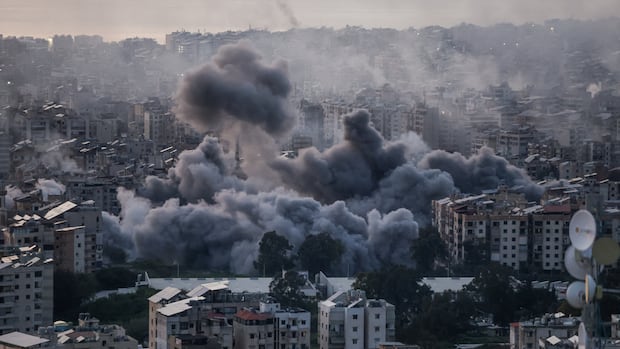
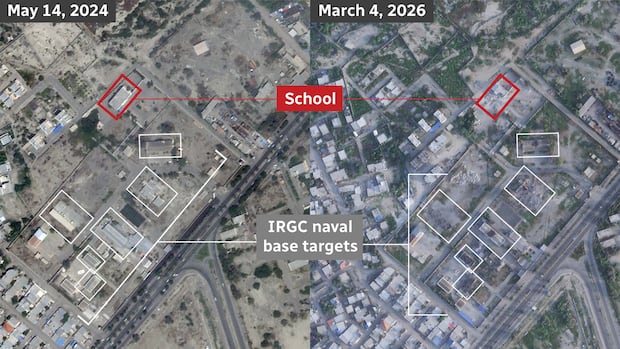
A CBC News visual investigation of new satellite imagery and social media footage suggests the bombing of an Iranian elementary school on Saturday was the result of a precision airstrike on a military complex immediately adjacent to the building. The strike, which killed at least 165 people, mostly children, according to Iranian state TV, occurred on Saturday, during the first wave of U.S. and Israeli operations against Iran. Shortly after, several videos appeared showing a girls' school in Minab largely destroyed. While the facility was functioning as a school, CBC News has confirmed a previous New York Times report stating the building was once part of an Islamic Revolutionary Guard Corps (IRGC) base that continued to operate adjacent to the school. Analysis of satellite imagery and experts consulted by CBC News suggest that the bombing of the school was targeted, deliberate, and part of a strike on the adjacent base. Experts suggested that the targeting could be based on faulty intelligence. People and rescue forces work following a reported strike on a school in Minab, Iran, on Saturday. (Abbas Zakeri/Mehr News/The Associated Press)Almost immediately after the bombing, there were competing narratives about who struck the school — and whether it was intentional — from people on social media and from official sources. Iranian state media said it was a "brutal attack by the American-Zionist enemy." Others suggested in social media posts it was a failed Iranian missile that hit the school.The post reads: 'Preparation of the bodies of martyrs from Minab School for burial. The pure bodies of 165 martyrs from the brutal attack by American-Zionist enemy will be carried for burial on Tuesday by the resilient and revolutionary people of Minab.' (IRNA_1313/Telegram)CBC's visual investigations team reviewed and verified multiple videos from the scene showing several distinct smoke plumes, indicating the area was hit more than once. This was confirmed by satellite imagery released Wednesday by Planet Labs, which revealed multiple impact craters within the complex. "It was precise targeting of a military facility for the IRGC," said a military researcher at Factnameh, an Iranian fact-checking group out of Toronto, whose identity CBC News has agreed to keep confidential. "According to satellite images, the impacts shows a pattern of precision guided munitions … there shouldn't be any mistakes."The researcher says the fact a school was struck shows it was "either the fault of a weapons system or a huge mistake [U.S. Central Command] made with intelligence gathering."Social media footage shows multiple plumes of smoke in the area around the school. The middle image shows the school shortly after the bombing. (Iran/X, Iranintl/X)According to the Washington-based Middle East Institute, the site houses the 16th Assef Coastal Missile Group, as well as the Martyr Absalan Specialized Clinic, a part of the Medical Command of the IRGC navy. The unit is a component of the Saheb al-Zaman 1st Naval District, a strategic command that monitors and controls traffic through the Strait of Hormuz."This missile complex belongs to the IRGC navy and operates in the field of offensive naval cruise and ballistic missiles," said another researcher at Factnameh. "This the [headquarters] of Asef Missile Group." Another expert consulted by CBC News, Wes Bryant, a U.S.-based military analyst and munitions expert, says the findings suggest that the strike on the school was not an accident. "This absolutely was deliberately targeted," said Bryant. "It is improbable that the strikes on the school and medical facility were merely misses.""All targets [were] hit at centre point or near centre point of the structures," Bryant said. "With a miss of a GPS munition, we'd expect more likely it would hit the dirt in the immediate vicinity closer to the IRGC building, not 100 metres or so away almost perfectly on the school. Same with the medical facility, that’s pretty much dead centre."Bryant says the strike may have been a result of target misidentification due to outdated intelligence or lack of vetting. CBC News has confirmed that both the school and the clinic within the same complex were walled off for civilian use over the past decade.This analysis was echoed by N.R. Jenzen-Jones, a U.K.-based technical intelligence specialist and the director of Armament Research Services (ARES). "Taken together, the satellite imagery and available videos suggest the school and adjacent IRGC compound were struck by multiple simultaneous or near-simultaneous strikes with explosive munitions, most likely air-delivered types," Jenzen-Jones told CBC News. WATCH | Unravelling how the strike unfolded and who was responsible:In the days following the deadly strike at a girls school in Iran, no country has claimed responsibility. But there are already many competing narratives about who struck the school, and whether it was intentional. CBC’s visual investigations team has analyzed and verified video moments after the strike and new satellite images to piece together what happened.Neither the Israeli nor U.S. military have claimed responsibility for the strike. An Israel Defence Forces spokesperson told CBC News that an IDF strike in the area was "not familiar" and told CBC to reach out to the U.S. Central Command (CENTCOM). CBC News shared its visual analysis with CENTCOM but did not receive a response by deadline.This sign is located nearby the school and is for the neighbouring navy base hospital. It says: Islamic Revolutionary Guard Corps, Navy Medical Command. (Google Earth)According to the International Institute for Strategic Studies (IISS), the location of the strikes corresponds with a clear "division of labour" in the ongoing campaign. The U.S. has primarily targeted missile bases and launchers in south and central Iran while Israel has focused its operations on the north.A satellite image from Monday shows a U.S. strike at Bandar Abbas military harbour, roughly 80 kilometres west of Minab. (Planet Labs)A satellite image from Sunday shows Konarak Naval Base after a U.S. strike, 400 kilometres southeast of Minab. (Planet Labs)Minab's location in the south, near the Strait of Hormuz, places it within the U.S. military's primary area of operations and lines up with other U.S. strikes on the Bandar Abbas Naval Base, about 80 kilometres west of Minab, and facilities in Konarak, which is 400 kilometres to the southeast. U.S. Secretary of War Pete Hegseth was asked about the strike that hit the school during a Wednesday news conference and confirmed the U.S. will be investigating. WATCH | Funeral held in Iran for students, staff killed in airstrike on school:Thousands of people gathered in Minab, Iran, for mass funerals for those killed on Saturday when a girls' elementary school was hit by airstrikes. Iranian media is reporting that 168 children and staff were killed and the UN's High Commissioner for Human Rights is calling for an 'impartial and thorough' investigation into the strike.On Tuesday, thousands of people gathered in Minab for mass funerals for the victims of the strike."What is clear is that elementary school children and teachers were killed," said Shiva Amelirad, a Canada-based representative of the Cooperative Council of Iranian Teachers Trade Associations, a network of teachers unions in Iran."The place that should be safe regardless of who carried out the strike," Amelirad said. "[We have a] human and legal obligation to protect the school and children."NOTE: This story has been updated to remove two names to protect their privacy because of security concerns.