Carney says Andrew Mountbatten-Windsor should be removed from line of succession
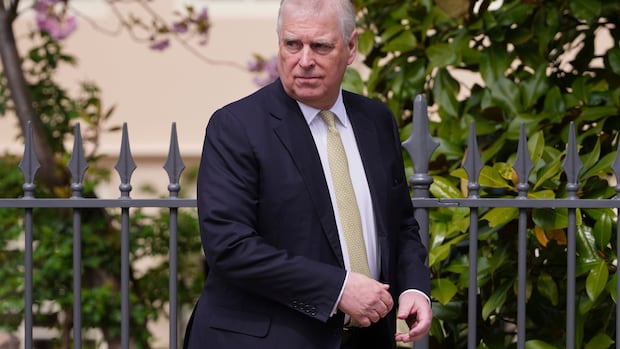
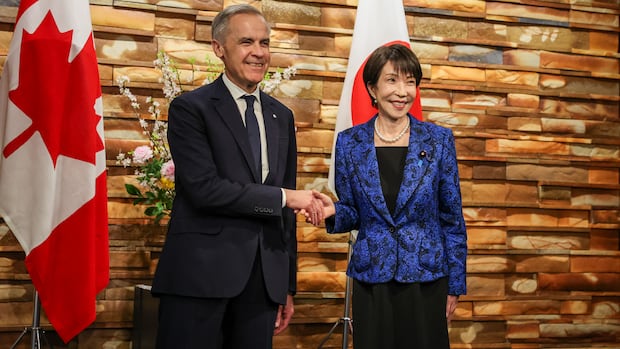
Listen to this articleEstimated 5 minutesThe audio version of this article is generated by AI-based technology. Mispronunciations can occur. We are working with our partners to continually review and improve the results.Prime Minister Mark Carney said Friday disgraced former prince Andrew Mountbatten-Windsor should be removed from the line of succession for his "deplorable" actions.Speaking to reporters in Tokyo on the tail end of his 10-day Indo-Pacific tour, Carney said the process should get underway.It would require working in tandem with other Commonwealth realms that share King Charles and his successors as their head of state, to avoid inadvertently seeing Mountbatten-Windsor ascend to the throne."I certainly think his actions are deplorable and have caused him to be stripped of his royal titles. It merits — necessitates is a better word — his removal from the line of succession. Even though he is well down the line, the point of principle stands," Carney said.WATCH | Carney says Andrew Mountbatten-Windsor should be removed from line of succession:Prime Minister Mark Carney says the "deplorable" actions of Andrew Mountbatten-Windsor "necessitate" his removal from the royal line of succession.The comments come a day after Carney met with his Australian counterpart, Anthony Albanese, who was the first prime minister of a realm after Mountbatten-Windsor's arrest to call for triggering the potentially complicated process of removing him from the list of Charles's possible successors. "These are grave allegations and Australians take them seriously," Albanese said in a letter to British Prime Minister Kier Starmer late last month, who is reportedly considering legislative changes."My government would agree to any proposal to remove him from the line of royal succession. I agree with His Majesty that the law must now take its full course and there must be a full, fair and proper investigation," Albanese said. He referenced the King's statement and said he has the "deepest concern" after the British monarch's brother was arrested for misconduct in public office.After his dealings with serial sexual predator Jeffrey Epstein were revealed — and later affirmed by the U.S. FBI's trove of documents that showed him looking for "inappropriate friends" — Mountbatten-Windsor was stripped of his titles, including Prince, Duke of York, Earl of Inverness, Baron Killyleagh and His Royal Highness.But that alone doesn't change the British and other Commonwealth legislation that dictates who has a chance at becoming King or Queen.As it stands, Prince William is next in line followed by his son, Prince George.Mountbatten-Windsor is eighth in line to the throne. That means all others before him must either die, abdicate or somehow be removed before he gets a chance at the title — and all realms must act to change that.That's what Carney said should be done in short order. "There is a process to define that process," he said, nodding to the potentially complicated nature of a change like this. The last time the line of succession was altered was in 2013 when the U.K.'s Succession to the Crown Act came into force, making significant changes to how monarchs ascend the throne.Canada then introduced its own legislation, the Succession to the Throne Act, which assented to the changes in British law — a constitutional necessity given that the Canadian crown is distinct from the one in the U.K. and the other realms even though it's the same person in all places.That legislative change ended the long-standing practice of barring anyone who marries a Roman Catholic from becoming monarch but it retained the ban on anyone of that faith from becoming King or Queen because the British sovereign serves as the supreme governor of the Church of England.But the law is best known for removing the male bias from the line of succession, putting male and female heirs on the same footing when the throne is handed down from one generation to the next.In order for that change to take effect, each of the Commonwealth realms had to agree. At the time of those changes, there were 16 realms, including the U.K.Six realms passed accompanying legislation to harmonize their laws on succession: Australia, Barbados, Canada, New Zealand, St. Kitts and Nevis and St. Vincent and the Grenadines. Nine additional realms decided they did not need legislation because their domestic laws already recognized the incoming U.K. monarch as their next head of state. Since that time, Barbados has become a republic, leaving 15 realms, including the U.K., in the Commonwealth.The finer details of the last change were hammered out when all of the affected countries were at the 2011 Commonwealth Heads of Government Meeting.That biennial summit, which King Charles will host as the head of the Commonwealth, will be held later this year in Antigua and Barbuda.