Stream It Or Skip It: ‘In the Blink of an Eye’ on Hulu, a Muddled Bit of Pseudo-Profound Sci-fi Mumbo-Jumbo from Director Andrew Stanton
In the Blink of an Eye (now streaming on Hulu) is Andrew Stanton’s second live-action directorial effort after 2012’s John Carter, which ain’t exactly glowing precedent. Having seen his new film, I’d much prefer to remember him as the ground-floor Pixar guy who helmed classics like WALL-E and Finding Nemo (and contributed creatively to a number of the studio’s all-timers), and a filmmaker who might want to stick to animation (we’ll see his next effort, Toy Story 5, pretty soon). Sort of like John Carter, In the Blink is what we in the crit biz call a “big swing,” a tangled narrative triptych about Neanderthals, present-day people and futurefolk that aims to make grand statements about life, death, the passage of time and what it means to be human. And despite the efforts of an excellent cast including Rashida Jones, Daveed Diggs and Kate McKinnon, the movie splats on the ground like dropped mashed potatoes.
The Gist: Any movie that opens with the Big Bang, DNA, cell division and the primordial soup has all-caps AMBITION. The beginning of Everything is a tough act to follow, but Stanton and screenwriter Colby Day (Spaceman – you know, the one with Adam Sandler and the psychic space spider) give it the ol’ college try. The linear nature of time dictates that the film begins in 45,000 B.C.E., when we meet a Neanderthal family clad heavily in furs and speaking an unintelligible language without subtitles, drawing inevitable comparisons to The Star Wars Holiday Special’s endless scenes of grunting and grumbling Wookiees: Oh boy. The only subtitles we get tell us who they are – Thorn (Jorge Vargas) is the father, Hera (Tanaya Beatty) is the mother, their daughter is Lark (Skywalker Hughes), and the baby doesn’t get a name. Poor baby. They hunt, gather, make fire, put handprints on rocks and the adults make ooping, acking lumps thrusting beneath a pelt made out of something they killed.
From there we transition to 2025 C.E., when Claire (Jones) and Greg (Diggs) make their own oop-ack noises from beneath a duvet whose acquisition most likely didn’t require killing anything. The more things change, etc. etc., right? The sex ain’t working for Claire, so she kicks Greg out and grabs her vibrator and the buzz prompts another “clever” transition, to the year 2417 C.E., when the buzzing is Coakley’s (McKinnon) alarm. She’s on a spaceship on a centuries-long journey to a new planet, and her only companion is an AI computer voice dubbed ROSCO (voiced by Rhona Rees). From here, the film will jump between these three timelines, in an attempt to be as profoundly existential in its observations as possible, thus giving us something to puzzle over.
Fate, wielded by the screenwriter’s hand, finds Thorn falling off a rock and seriously injuring himself, and his concerned wife and child nurse him as we worry that he might not survive. We learn Claire is an anthropologist studying for her doctorate, which involves taking a tiny brush and painstakingly dusting crumbs off Neanderthal bones. Are those Thorn’s bones? No spoilers, mack! Claire has to drop everything and go to Vancouver to nurse her dying mother, while pursuing a long-distance relationship with Greg, who turns out to be quite the dynamo in the sack. She wasn’t so sure about him at first, but now she has a wonderhumper to help her get through this difficult time.
Now, this being a movie that, having established death in two of its threads, needs to contrive a parallel scenario in the third. So who’s dying in 2417? A bunch of plants, that’s who. That might not normally be too much of a big whoop, but in this case it’s huge, since they’re the ship’s oxygen source. So Claire and ROSCO get to some serious problem-solving, because the mission is crucial: trucking embryos to a new planet in order to save the human race. And now we have to sit through births and parenting bits in all three storylines, because this is a bad movie, and that’s the true-true.
Photo: Kimberley French /© Searchlight Pictures / Courtesy Everett Collection
What Movies Will It Remind You Of? Toss In the Blink of an Eye in the bucket of recent high-concept, wannabe-philosophical stuff like Eternity and The Life of Chuck. It also jumbles together bits from a whole bunch of movies without ever forging its own identity: Quest for Fire, Out of Darkness, Spaceman, WALL-E, The Martian and, god help us all, Cloud Atlas came to mind, while Stanton and Day namedropped 2001: A Space Odyssey, Magnolia and Interstellar as influences.
Performance Worth Watching: The nagging sense that McKinnon, Jones and Diggs are all undervalued talents that should be seen in more movies is undermined by the depressing fact that they’re stuck in this misbegotten thing.
Sex And Skin: Sorry, everything’s covered by duvets or pelts.
Photo: Kimberley French /© Searchlight Pictures / Courtesy Everett Collection
Our Take: In the first act, I wondered exactly how long I had to sit there watching Rashida Jones compose text messages. By the third act, the film stomps on the gas and becomes one big montage racing through decades of narrative. That’s In the Blink of an Eye in a nutshell: Lost, muddled, wildly uneven and uncertain of its thematic objectives. It’s as if the filmmakers failed to realize that less scenes of texting early on means more room to address the fate of the human race later. Priorities!
History may eventually reveal what went wrong during the bumpy production of the film, assuming history is very bored and has nothing better to do. The screenplay is choppy and jumbled and could use serious rewrites, and there’s somewhat obvious evidence of budgetary limitations. One surmises that editor Mollie Goldstein pieced together what scattered, piecemeal footage she had as best as she could, then hoped no one would mention her name in film reviews. The characters are underdeveloped to the point where we wind up focusing on the goofy dental prosthetics and wardrobes of the Neanderthals, or the horrible aging and de-aging effects Jones suffers as she plays 20-something to 80-something (she’s 50), prompting us to mentally calculate years and ages in order to orient ourselves on the timeline. Remember, if you’re doing math while watching a movie, the movie has failed you.
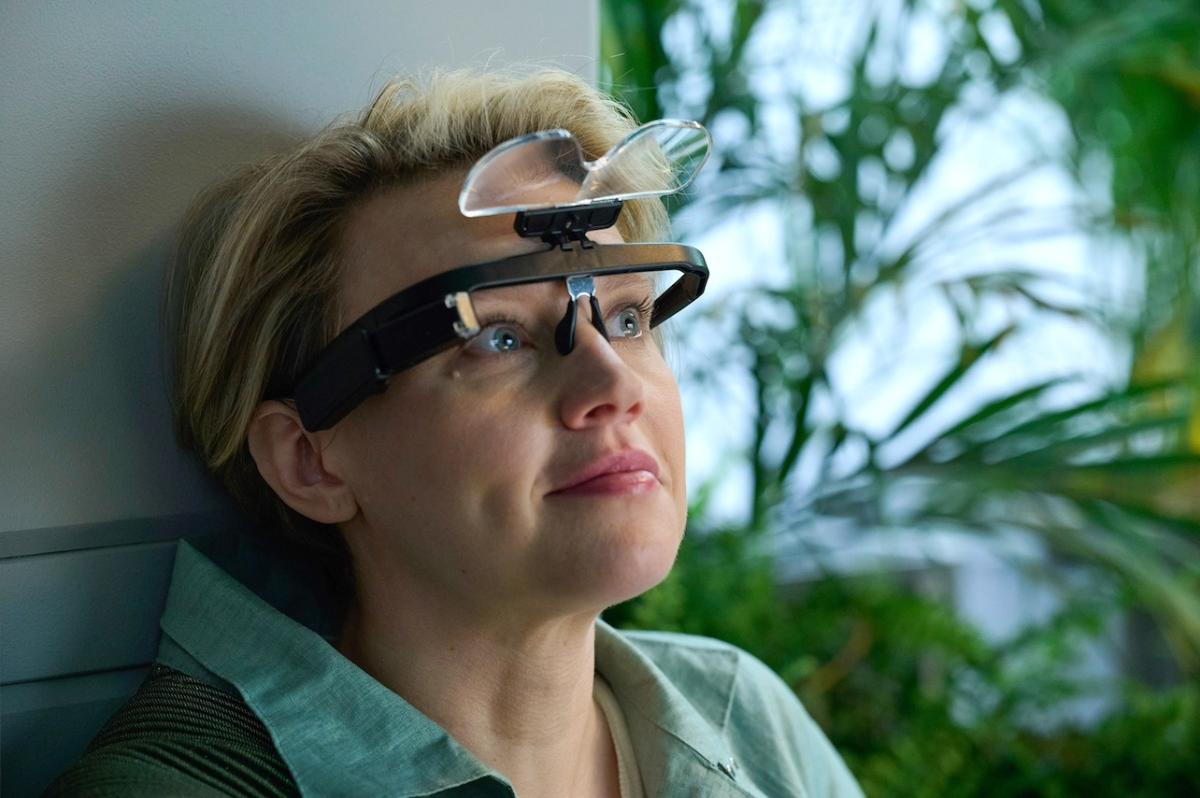
The film isn’t entirely bereft of ideas, however, especially in the future timeline, when ROSCO asks Coakley, “What’s it like to think?” That’s quite a concept to introduce in a movie that has no clue how to explore it – Day’s script paints itself into a corner then seemingly begs the editor to get it outta there by showing us melancholy Neanderthal funerals and Jones in big novelty 2030 glasses so we know what year it is. There’s a meditation on loneliness here that sees the light of day for about 30 seconds before it’s dropped and forgotten; when Neanderthals and Homo sapiens commingle, the movie hovers on the cusp of saying something about trust, kindness and collectivism before it leapfrogs to the other storylines so it can jump a half-dozen other sharks. There were moments when one might interpret In the Blink of an Eye as a grandiose exploration of how intelligence can be defined by how we balance logic and emotion, but when the film itself unwittingly tumbles into its own vast logical crevasses, well, it’s a lost cause.
Our Call: In the Stink of an Eye. SKIP IT.
John Serba is a freelance film critic from Grand Rapids, Michigan. Werner Herzog hugged him once.