Did Meryll Rogge Capture the Spirit of Marni?
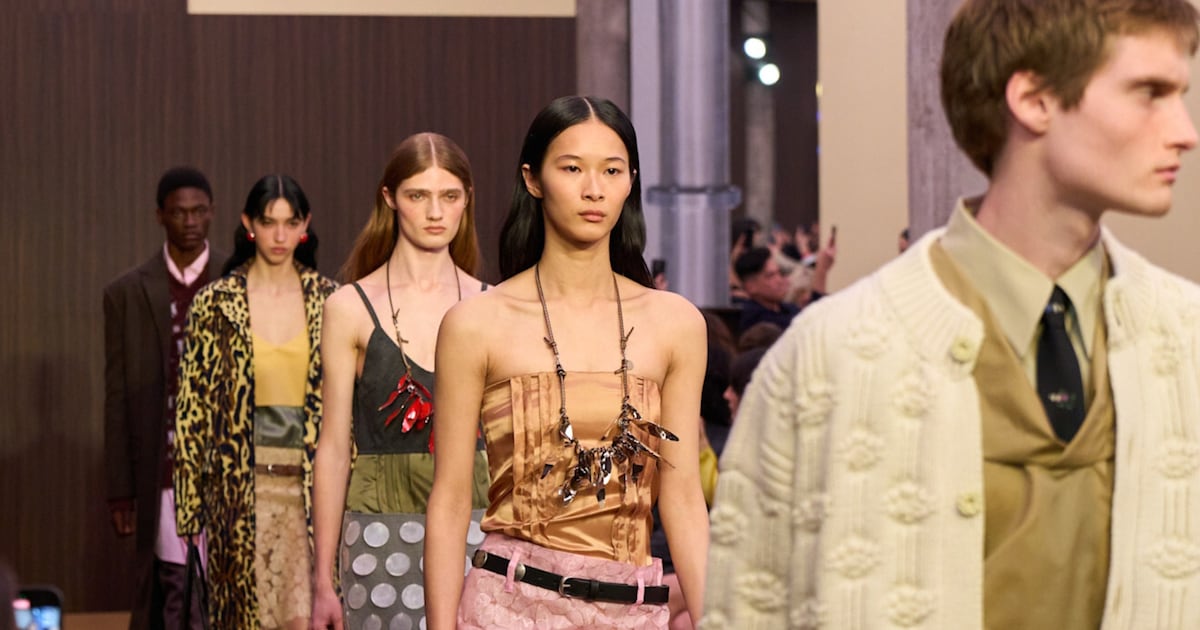
MILAN — Meryll Rogge has yet to meet Consuelo Castiglioni — but her debut on Thursday night as creative director of Marni, the brand that Castiglioni established in 1994, suggested that they’re in touch on some higher plane. Rogge found a way to channel all of the founder’s awkward charm, unique graphic sensibility and experimental bent into a collection that could make Marni matter to a new clientele and ideally reanimate the old one at the same time.“I really prepared a lot in advance before getting here because I had to share the vision,” Rogge said during a preview on Wednesday. “You really needed to understand where this could go. So there was a lot of work done.” The archives were a treasure trove. It showed in her grasp of Castiglioni’s design ethos. She revisited the stripes, the bias check, the patchwork, the heels with socks, the trunk bag, the fussbett sandal (here with a kitten heel), the functional hardware mixed with more idiosyncratic decoration, like the little metal acorns on a “mountain jacket.” Rogge and her family have moved from Antwerp to Milan and she is newly acquainted with the Pre-Alps strung along the horizon. That awareness injected a clunky Mitteleuropa flair by way of embroidered leathers and drawstring knits. There was a suggestion of old Marni awkwardness in the models’ dorky centre parts.Marni Autumn/Winter 2026 (Launchmetrics.com/Spotlight) Marni Autumn/Winter 2026 (Launchmetrics.com/Spotlight) Marni Autumn/Winter 2026 (Launchmetrics.com/Spotlight) Castiglioni loved to combine high and low elements. A collection might include organza and PVC, for example. Rogge opened her show with a coat in silky goat fur (every hide in the show a scrupulous by-product) lined in plain cotton. And she duplicated a leopard coat from one of Castiglioni’s earliest collections in knit. In fact, throughout her collection, knits were the star players, as in a knit waistcoat over a heavily paillette-ed shift, or a fair isle vest (tulips, cute) under a black leather waistcoat, over rompers (a Rogge favourite). Marni started as a way to use offcuts from the Castiglioni family’s main business, which was fur. Rogge tipped her cap to that with artfully shaggy shearling coats, shrugged over striped shirts and slim skirts. The 1960s flair echoed Castiglioni’s occasional appetite for a semi-futuristic pop sleekness. Here, the dropwaisted sleeveless dresses with wide belts at bust and waist, and serious boots, or the crispy, papery skirts that echoed Castiglioni’s candy wrapper organzas, or the revival of a key motif, the polka dot, as holes embroidered in sweaters, or as huge mother of pearl paillettes, clacking together appealingly as they paraded down the catwalk.One reservation I always had with Consuelo’s Marni is that I never felt her man and woman were much in sync. “Yeah, she was the mother and he was the son,” Rogge agreed. “We’re putting them on the same level.” I was still getting a hint of “earnest student” from her guys, but it did seem that, this time round, they might at least get to bond over their chunky knitwear and leather pants. And they were all wearing versions of the glorious gilded leaf necklaces that Rogge fished out of her memories of the collection Castiglioni designed for H&M in 2012. When I first talked to her last April, Rogge was one of the eight finalists for the Woolmark Prize, and she was struggling. “I was not done, I would never be done,” she insisted. “But I was fed up. Six years of dealing with retail. And I was concerned about the way certain retailers act around young, independent brands. I think it’s a little bit irresponsible. At the Woolmark Prize, only Duran [Lantink] and I, and maybe Rachel Scott [of Diotima] still had a wholesale business going on. All the rest were direct to consumer, or special orders.” Then, in June, she won the Andam Grand Prize of €300,000 on her second try. “I’m an expert in prizes. I was an LVMH finalist too. But Woolmark was going to be my last. Then my husband said on the final evening of application for Andam, ‘Oh c’mon, just send the damn PDF. You never know.’”Marni Autumn/Winter 2026 (Launchmetrics.com/Spotlight) Marni Autumn/Winter 2026 (Launchmetrics.com/Spotlight) Marni Autumn/Winter 2026 (Launchmetrics.com/Spotlight) Andam paid off for Rogge in another career-changing way. She’d already met Renzo Rosso, president of the OTB Group, a key partner of the fashion awards, at her first Andam. They stayed in touch and, when OTB, which owns Marni, was looking for a creative director following Francesco Risso’s departure from the brand after nine spectacular years, Rogge was an inspired — and inspiring — choice as his replacement. And her own arc is inspiring, as an independent spirit who never gave up. The brands she loved when she discovered fashion were Prada, Miu Miu, Dries Van Noten, Marc Jacobs, Marc at Vuitton … and Marni. Her subsequent resumé includes a seven-year stint with Jacobs in New York (she wrote randomly to internship@marcjacobs.com and got a callback), and four years as head of womenswear for Van Noten.“At Marc, I learned everything from A to Z, like going to fashion bootcamp for seven years. Fabrics and fittings and castings, really understanding how the process works. And it was bringing something fresh each season. Everything always had to be new. There was so much storytelling in Marc’s work, just like there was at Dries. But it was really nice at Dries to say, ‘Oh, that coat shape is really beautiful, let’s do it again’. It was a bit more like, ‘Okay, it can also be done another way.’ That was interesting.” Her last collab with Dries and his new paymasters at Puig was on his perfume bottles, objets d’art that are practically perfect in every way. And now Rogge’s designing Marni! Marni Autumn/Winter 2026 (Launchmetrics.com/Spotlight) Marni Autumn/Winter 2026 (Launchmetrics.com/Spotlight) Marni Autumn/Winter 2026 (Launchmetrics.com/Spotlight) She has her own stories: the grandfather who bought a house in Cadaqués, the village that Salvador Dali colonised; the aunt who posed (presumably naked) for Dali, much to the fury of her father; the grandmother whose obsession with fashion had her pet tailor in Paris copy Saint Laurent’s collections for her; the other grandmother who spent seven years studying painting and sculpture at the Royal Academy in Antwerp and who also had a tailor, who would run up the outfits she designed for herself. When she died young, her husband could never throw them away, which meant that a young Meryll had access to closets and closets full of custom-made clothes. It makes her career seem like manifest destiny for Rogge, but she had to complete a law degree before her parents would allow her to consider a career in fashion. And, as you’ve already read, the road has been long. But you get a feeling about someone, and I’ve got that feeling about her. Same with Simone Bellotti, Nicolas di Felice and Glenn Martens (who Rogge used to model for when she was a student at the Royal Academy). Marni CEO Stefano Rosso calls it “colouring outside the lines.” Frederic Sanchez, Consuelo’s favourite, made Meryll’s soundtrack. She’s a jazz fan, so he closed the show with Shirley Horn’s “Here’s to Life,” a modern jazz standard that is also one of her favourites. It was the clincher. She is in her happy place.