Audi’s new overkill RS5 is HEAVIER than an RS6 Performance
► Official: new Audi RS5 revealed► 630bhp saloon and estate versions► It’s 500kg heavier than the old RS4!
Audi Sport is redefining the term overkill with its new RS5. This new-generation model arrives with a stonking amount of power via an all-new, Audi Sport-first plug-in hybrid powertrain as well as a suitably aggressive look and a porky kerb weight.
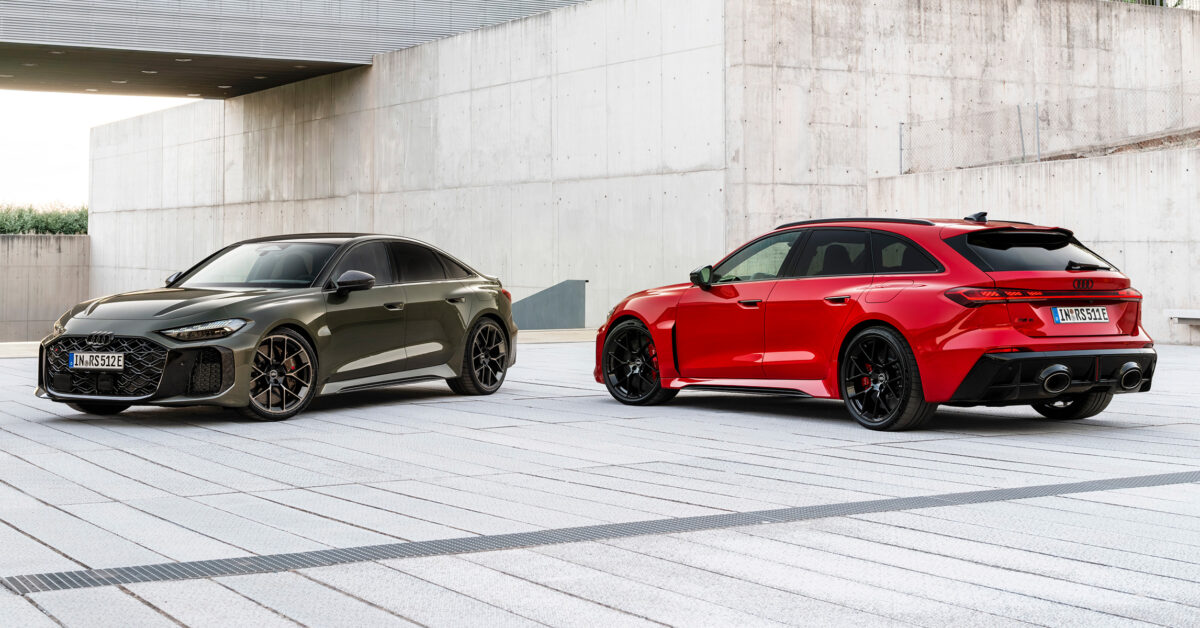
It’s available as a saloon (which is actually a hatchback, confusingly) or Avant estate, and will be available in the summer of 2026.
That is… a look
Yes, this new generation of RS5 is arguably one of the few remaining cars that will have come out of the brand’s old way of design thinking – i.e.: busy. We’ll still see a few more cars like this before the Concept C arrives in production form and models that come after it, likely including the next-generation Q7 and Q9 SUVs launching later in 2026.
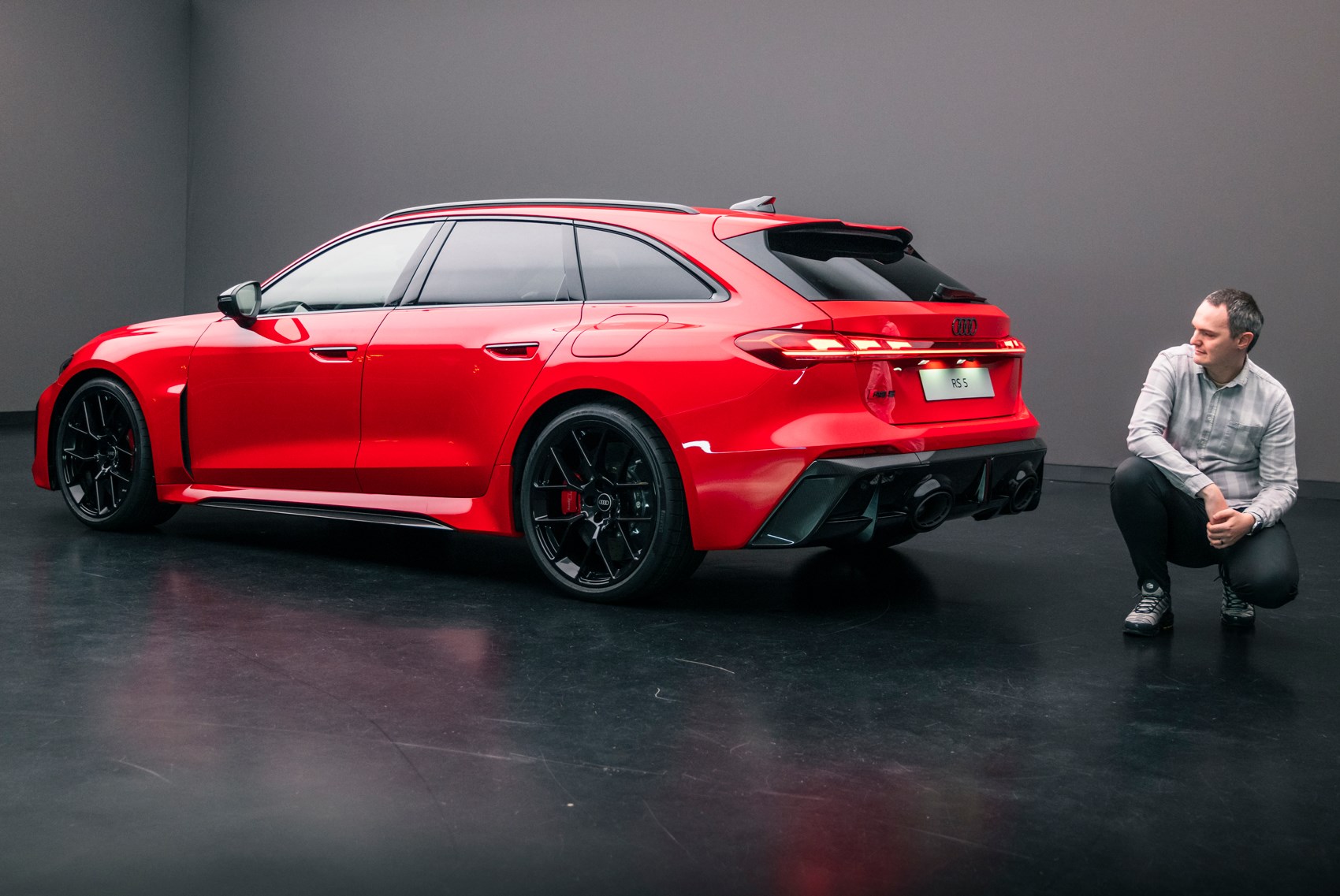
For this RS5 model, Audi Sport designers have really gone to town. Wolf Seebers, Audi Sport designer, tells us that it was ‘an absolute dream’ to work on the RS5. Almost every panel has been modified or made bespoke, with Seebers pointing out that ‘the only pieces we’ve carried over from the base model A5 are the bonnet, roof and trunk.’
The aggressive stance is just one element, with the new and rather large grille taking centre stage up front and flanked by some almost race-spec canards flanking it. The track is wider front and rear by 40mm over a regular A5, with Audi Sport’s classic blistered wheelarches accented with beefy 21-inch wheels. Those wheelarches include outlet vents that channel air out of the wheel wells… and will likely spew road muck up the side of the doors in no time in poor weather.
Not wild enough for you? That’s before you get to the rear with its double-deck spoiler and two oval tailpipes so fat you can put your fist in them and not touch the sides. Checkered flag motifs can be seen in the daytime running lights, too, and if you want to add an extra bit of tackiness, there is the option to trim some of the sills and body panel elements in ‘carbon camouflage’ as seen on the green RS5 saloon.
Anything different inside?
Largely, the interior follows the same structure as that of a regular A5. That means a huge dashboard panel that incorporates the instrument cluster and central infotainment display potential for a passenger display and a lot of gloss black haptic switches. That said, roller wheels make their way onto the steering wheel for some UI simplicity.
The RS5 carries forward the updated user interface that’s being rolled out to cars like the A5, Q5 and Q6 e-Tron with easier to read graphics and a simpler menu system. Pops of colour can be added in this RS model with red and green demonstrated in the two show cars you see pictured, and that ‘carbon camouflage’ can be had inside, too.
This model also benefits from bespoke performance seats as well as bespoke ‘boost’ and drive mode buttons on the steering wheel.
Give me some performance specs, please
Under the hyper-aggressive bodywork is Audi’s Premium Platform Combustion architecture which has been engineered from the start to incorporate plug-in hybrid powertrains.
For the RS5, the recipe starts off with a familiar element: a 2.9-litre twin-turbo V6. That bit is the same as the previous RS4, with engineers saying that around 60 per cent of the engine has been refined or improved via details like revised turbo geometry, new water-to-air intercoolers and a modified Miller combustion cycle.
But this is Audi Sport’s first-ever plug-in hybrid performance car, so there’s naturally a lot of electrification at play. The 25.9kWh battery pack sits below the boot floor (but doesn’t raise it like it does in an AMG C63) and powers the 174bhp e-motor on the rear axle. Power is sent to all four wheels via an eight-speed transmission and a limited-slip differential that can split the power anywhere between 70/30 to 15/85 front to rear. All in, the RS5 is good for 630bhp and 590lb ft, good for a 3.6sec 0-62mph. That’s more powerful than the outgoing RS6 Performance – Audi Sport’s supercar-destroying estate from the next class up.
Audi is very proud of its new Dynamic Torque Control system, which Audi Sport managing director Rolf Michl says is the ‘next generation’ of the brand’s perennial quattro all-wheel drive system. Audi calls it the ‘invisible maestro’ to the RS5’s dynamics, which uses an eight-kilowatt electric motor that provides electromechanical torque vectoring to each of the rear wheels. The prime focus for the RS5 is ultimate traction in any scenario, with Michl telling us that the system ‘uses electric power to shift up to 2000 newton metres of torque [1475lb ft, in theory] to each wheel, allowing for insane corner speeds. For me, this system really is the magical detail.’
It’s all about grip, right up until you don’t want it anymore. As well as a standard RS mode and an RS Individual setting where you can calibrate dynamics settings to how you like, there’s also the RS Torque Rear mode that’s been evolved from the one originally seen on the RS3.
‘Torque Rear’ is Audi code for a drift mode that warns you when you select it that it’s for track use only, and there’s even a graphic on the infotainment that can measure the angle of your slides, and it’ll rank your best ones. It’s wise, then, that the optional carbon ceramic brakes listed as a £6k option in the UK is an option you tick.
Like this? Get more CAR delivered to your browser! Click here to add CAR Magazine as a preferred source on Google.
Why electrify? Aren’t we all collectively against that these days?
Well, sort of. Audi has a mountain to climb in terms of appealing to the performance car buyer with a plug-in hybrid, given BMW and Mercedes-AMG have done the same thing… and haven’t come out well. The AMG C63 has been largely vilified by its fanbase not only for its four-cylinder combustion engine but for its sometimes-synthetic drivetrain systems. BMW, with its ultra-heavyweight M5, may have made an impressive performance car but our experiences have proven that it can feel too big and too complicated to live with as a daily driver.
The thing is: Audi, like any manufacturer, needs to keep increasing its electrified mix of powertrains – particularly in Europe – but Michl acknowledges the uphill battle. ‘Honestly, I’d say the e-Tron GT is the best RS to ever exist when it comes to driveability,’ says Michl. ‘But we know that especially for our long-term RS customers – particularly RS4 and RS6 – you have to take them step by step. I think the PHEV concept is the perfect bridge where we can use its benefits in both a very emotional and practical way.’
You’ve teased me enough – how heavy are we talking?
Er, well – how does 2335kg for the saloon sound? Or 2370kg for the Avant. For reference, that’s around 500kg more than the B9 RS4 – an almost unholy weight increase, particularly when the larger, V8-powered RS6 Performance is around 200kg lighter. Looking at rivals, an M3 is around 100kg under two tonnes depending on your spec, while an AMG C63 is around 2.1 tonnes. There’s simply no getting around that extra bulk.
‘It is a lot heavier, yes,’ Michl admits, but he assures us that ‘you don’t really feel it because it’s so agile.’ He points to electrification being a boon for making a car – regardless of weight – much more communicative on the road and much more adjustable when you’re close to hitting the dynamic ceiling. ‘The most important thing is for it to feel natural in every [drive] mode, especially if you’re touching the limits,’ he says. ‘It gives you a clear response to how it acts and we wanted to have a mode where you could really feel the electric power.’
UK models benefit from a standard, switchable sports exhaust and Michl is keen to point out the RS5 won’t sound muted: ‘If you want it to be a beast, it can be, but it has to fit in the world, too. And, honestly, our customers wouldn’t tolerate it if offered them something artificial.’
Come on, then – how much?
Base pricing for the saloon is £89,400 or £91,300 for the Avant estate. There are three trims: a base one, Carbon Black adds £6k and gives you some extra trimmings (mostly in black, obviously. Then there’s Performance Vorsprung which adds another £8k.
Audi promises a limited number of options to keep things simple, with an RS Technology Pack being offered in the UK for base and Carbon Black models, and those £6k carbon ceramic brakes.