The Secret Agent is a thrill ride through Brazil’s dictatorship
Many of the critics writing in the French magazine Cahiers du Cinema in the 1950s eventually made movies themselves: Truffaut, Godard, Rohmer, Chabrol, Rivette, for starters. That has rarely happened elsewhere – in the US, Paul Schrader, Peter Bogdanovich, anyone else? – and perhaps never in this country, where film-makers and film critics rarely seem to have much in common at all.
The Brazilian director Kleber Mendonça Filho, though, began his career as a film journalist, then made some shorts before graduating to his first feature, Neighbouring Sounds, in 2012. All his films have won multiple prizes; The Secret Agent, his fourth, has already been garlanded, winning Best Director and Best Actor at Cannes last year, and is in contention for Best Picture, Best Actor and Best Casting as well as Best International Feature at next month’s Oscars.
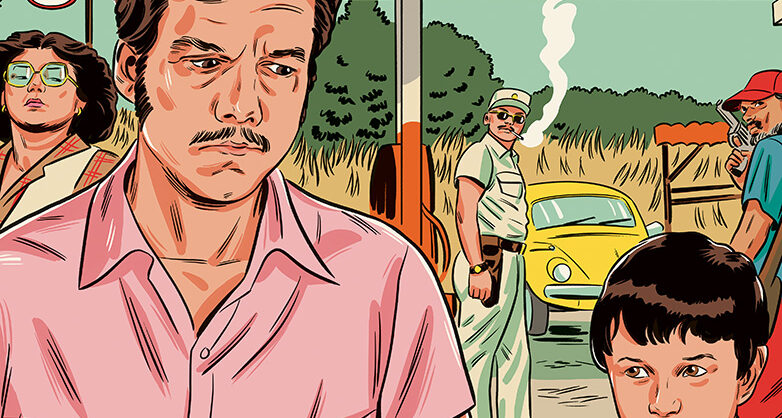
The accolades are deserved. The Secret Agent (nothing to do with Joseph Conrad’s novel or Hitchcock’s film) is so absorbing that, despite its 161-minute run-time, you’re taken by surprise when it ends. The setting is 1977 in Mendonça Filho’s native north-eastern coastal city of Recife during carnival. It’s “a period of great mischief”, we’re warned at the start. In a brilliant pre-credits sequence, a yellow VW Beetle rolls up at a remote petrol station, manned by a remarkably fat, sweaty man. On the forecourt, there’s a rancid corpse, inadequately covered with cardboard and newspaper. It’s been there since Sunday, the owner comments indifferently; the police are too busy to come. But then the police do turn up. Ignoring the body, the cops examine the Beetle, trying to shake down the driver for a bribe but he refuses, offering only cigarettes.
So much is already established, not just general corruption and chaos, but the way in which the driver Marcelo (Wagner Moura) doesn’t comply. As the film progresses, we piece together his backstory: recently widowed, he is fleeing São Paulo to rejoin his nine-year-old son Fernando in Recife. As an academic scientist, Marcelo has run afoul of a corrupt businessman and politician, who has sent two vicious contract killers after him. He finds refuge in a kind of resistance commune, run by a tiny and autocratic old lady, Dona Sebastiana (Tânia Maria, a treat in every moment she appears). This dissident network finds Marcelo a job in the local identity cards office, where he searches for documentary evidence about his own missing mother, until the assassins catch up with him.
Subscribe to the New Statesman today for only £1 a week.
There’s a thriller plot here, culminating in a shootout and a tense Hitchcockian chase through the city streets. But it is also an immersive evocation of a time and a place, the city where Mendonça Filho grew up in the years of the military dictatorship, building on his 2023 documentary about the cinemas of Recife, Pictures of Ghosts. Marcelo’s father-in-law, Alexandre (Carlos Francisco), is a projectionist in one of the picture palaces that’s a centre of sedition, one crucial meeting taking place while the off-screen audience screams at The Omen. Fernando is obsessed with Jaws, which he is too young to see. But there are real sharks in Recife too, one slit open and disgorging a human leg, which then takes on a life of its own in some bizarre stop-motion sequences, an urban myth created at the time in the papers to hint at police brutalities.
Other digressions include a cameo from the late Udo Kier, as a Holocaust survivor mistakenly admired by the asinine local police chief as a Nazi fugitive, and a two-headed cat. But the film-making is so vivid nothing drags. Mendonça Filho combined antique Panavision anamorphic lenses with new digital cameras to get some remarkable images. Moura (Pablo Escobar in Narcos, Joel in Civil War) proves a true star too, which is to say you feel total empathy with him all the way.
Intermittently, we see two young women transcribing surveillance tapes of Marcelo’s conversations, seeming at first to be security agents until we realise they are contemporary historians, looking back to this troubled time. In a coda, one of these women (Laura Lufési), inspired by Marcelo’s appealing voice, goes to meet Fernando, now a middle-aged doctor (also Wagner Moura) and presents him with the past he knows little about on a data stick.
It’s not just a thriller. This is a film intimately concerned with identity and lineage, with what has been forgotten and what needs to be remembered. Go see it. No need to be a film critic either.
“The Secret Agent” is in cinemas from 20 February
[Further reading: Robert Duvall was a class act]
Content from our partners
Related
This article appears in the 18 Feb 2026 issue of the New Statesman, Class warrior