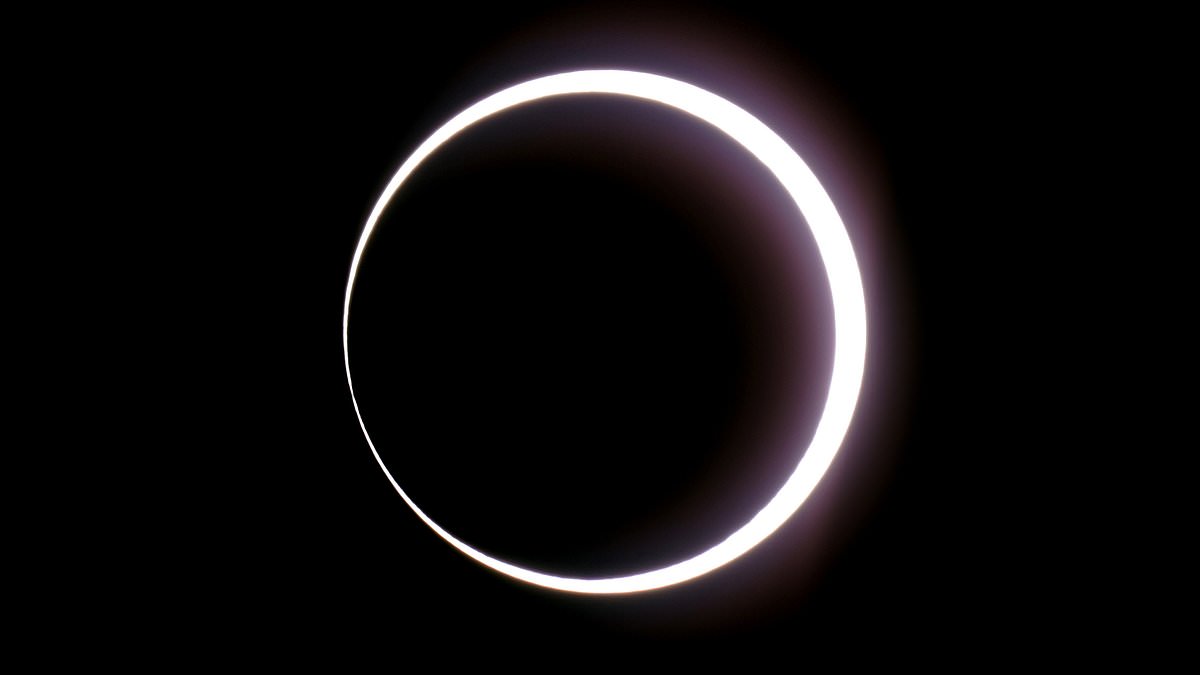
Rare 'Ring of Fire' Solar Eclipse is about to appear in the sky…but it will only be visible to 100 PEOPLE
A rare 'Ring of Fire' eclipse is about to appear in the sky, but the chances of seeing it are astronomically slim.From 09:56 GMT until 14:28 GMT today, the moon will pass in front of the sun, casting a perfect shadow over Earth.The only catch is that the spectacular total eclipse will only be visible from the most remote regions of Antarctica.The only humans on this path are the 100 outstandingly lucky scientists spending the Antarctic summer at the Concordia and Mirny research stations.What makes these researchers especially fortunate is that today's solar display is an annular, or Ring of Fire, eclipse.At 12:12 GMT today, the shadow of the moon will align with the sun to leave a perfect glowing ring of light in the darkened sky.Dr Shyam Balaji, of King's College London, told the Daily Mail: 'An annular solar eclipse occurs when the Moon passes directly in front of the Sun but is slightly farther from Earth in its elliptical orbit.'At maximum eclipse, the Moon blocks the central part of the Sun, leaving a bright ring of sunlight visible around its silhouette.' A spectacular 'Ring of Fire' eclipse is about to appear in the sky, but only about 100 people will be able to see it. Pictured: A Ring of Fire eclipse seen from Bryce Canyon National Park in 2023 The total eclipse will only be visible in the most remote region of Antarctica, home to just two research stationsAlthough totality will only be seen by a handful of people in Antarctica, a partial eclipse will be visible in a much wider area.At least some level of eclipse will be visible from South Africa, Argentina, Chile, Madagascar, Mauritius, and a few other parts of Southern Africa.In total, TimeAndDate.com estimates that around 176,000,000 people could have an opportunity to see the partial eclipse.However, many of these people may only see a tiny part of the sun obscured by the moon.Outside of Antarctica and the uninhabited islands of the French Southern Territories, Mauritius will get the best view as the sun appears up to 32 per cent obscured.This is followed by Port Elizabeth in South Africa, where the sun will appear 14 per cent obscured.If you are lucky enough to live in the path of today's eclipse, it is important to remember that the sun can still damage your eyes during occlusion.Dr Balaji says: 'It is not safe to look at the eclipse with the naked eye. At no stage of an annular eclipse is it safe to look at the Sun without proper solar filters.' The Concordia research station will be one of the only places on Earth where people will be able to see the full Ring of Fire eclipse. It is home to around 50 people in the summer months A 'Ring of Fire' eclipse occurs when the sun and moon align while the moon is at its furthest point from Earth, meaning that it does not cover the entire sun. Pictured: A Ring of Fire eclipse seen by the Japanese Antarctic observation team in 2003That means you will need to use special eclipse glasses that block out the majority of the harmful light from the sun.Even the researchers in Antarctica won't be able to take off their eclipse glasses during totality because the bright rim of the Ring of Fire eclipse can still damage their eyes.Although the sun is 400 times further away than the moon, it is also 400 times larger.This means, by pure coincidence, both celestial bodies appear to be the same size in the sky, which allows for total solar eclipses.However, this alignment can very rarely occur while the moon is further away from Earth.'Because it appears a little smaller in the sky, it does not completely cover the Sun’s disk,' says Dr Balaji.'In a total eclipse, by contrast, the Moon is close enough to obscure the Sun entirely.'But if you can't make it out to Antarctica to see this year's solar eclipse, there is no need to worry. Outside of Antarctica, a partial eclipse will be visible in South Africa, Argentina, Chile, Madagascar, Mauritius, and a few other parts of Southern Africa (pictured)In a fortnight, stargazers in the Southern Hemisphere will be treated to a full lunar eclipse on March 2.While this might seem like a lucky coincidence, solar and lunar eclipses often come in pairs due to the nature of the moon's orbit.Although the moon passes in front of the sun every 28 days, causing a new moon, it doesn't always produce a solar eclipse.This is because the sun and moon don't orbit on the exact same plane, so they only line up perfectly on very rare occasions.However, when they do line up to create a solar eclipse, they are usually in the right place to trigger a lunar eclipse once the moon has moved around to the other side.The lunar eclipse in March will be visible from North and South America, parts of Asia, Australia, and New Zealand.Meanwhile, the next solar eclipse will come on August 12 later this year and will be visible in Greenland, western Iceland, and northern Spain.What is an annular eclipse and how does the stunning display happen? Diagram of an annular eclipseThe spectacular eclipse is when a 'burning ring' appears in the Earth's sky.It happens when the Earth, Sun and Moon align as the Moon is at the furthest point away from Earth in its orbit.This means it is unable to fully obscure the Sun, causing a 'burning ring' to appear in the sky. This is shown in part B of the diagram on the left.The fascinating light display happens every six months or so, but has not been visible from the UK since 2003.The next time Britons will be able to see it will be on 10 June 2021, when it will be visible across the whole country.Source: NASA