Feeling discomfort driving at night? It’s not you — it’s the bright headlights, experts say
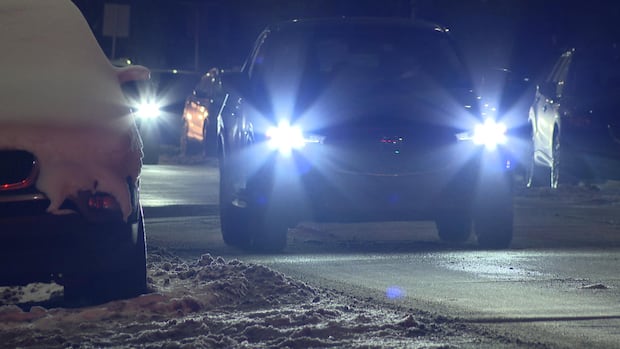
LISTEN | Throwing shade on super bright headlights:The Current24:42Throwing shade on those super bright headlightsSaskatoon optometrist Rachael Berger has seen an increase in the number of patients concerned about their vision when driving at night.“I'm seeing an alarming number of perfectly young, healthy individuals coming in and saying, ‘I'm having a hard time seeing at night, what's going on,’” she told The Current guest host Peter Armstrong. She tells patients it’s not them — it’s the LED headlights increasingly used on vehicles. When it’s dark, Berger explains, the rods in our eyes turn on to help us see better. “When you're driving at night and your rods are activated, and all of a sudden this blast of light comes, it can be very jarring, because our night system isn't prepared or necessarily expecting that,” she said.Advocates are calling on the federal government and car manufacturers to adjust their regulations and industry standards around bright headlights because there needs to be a better balance between solutions to help drivers see while not compromising other’s safety.Optometrist Rachael Berger says she's seen an increasing number of patients, of all ages, who've experienced discomfort when driving at night due to bright headlights (Submitted by Rachael Berger)LED headlights can be up to four times brighter than other light sources. Exposure to bright, concentrated light can cause a phenomenon called discomfort glare; an annoying or painful sensation due to bright light that causes visual fatigue, says Berger. Sudden, bright flashes of light are sometimes called “glare monsters.”WATCH | Blinded by the light? New LED headlights are extremely bright:More new cars are being equipped with LED headlights that are extremely bright, producing something experts describe as discomfort glare.People can also experience discomfort glare if they’ve had hours of exposure to bright headlights from oncoming vehicles or through their rearview mirrors, according to vehicle lighting consultant Daniel Stern. Stern, the chief editor of Vancouver-based Driving Vision News, worries that cognitive overload could prevent people from driving safely. “If you're having to devote attention to dealing with glare by gritting your teeth or looking away, you're not looking where you need to be,” he said. Align regulations for new and old vehicles: expertIt used to be routine for drivers to get their headlight aim adjusted when they got their vehicles inspected every year or two, Stern says.“That is largely a thing of the past, which is really unfortunate, because as headlamps have evolved with wider, brighter beams, they've grown more sensitive to miss aim,” he said. Stern wants more stringent headlight regulations for new vehicles and ones already on the road. For example, having proper bulbs. “A lot of people think, ‘Well, I had a great result putting LED bulbs in my dining room or garage. I'll put them in my headlights too.’ The problem is that's like putting on somebody else's eyeglasses, the optics are mismatched,” Stern said. Stern says not enough emphasis is put on glare control in North America.
(Dillon Hodgin/CBC)Transport Canada last updated its headlight regulations in 2018. Those changes addressed new lighting technologies to increase visibility, requirements around headlight height and automated levelling devices to adjust the light’s direction. While federal regulations set safety standards for vehicles as originally delivered by the manufacturer, they don’t cover alterations made by dealers or vehicle owners. It’s advised not to replace original bulbs with LED kits unless using parts from the original equipment manufacturer. Regulation and enforcement related to vehicle maintenance and re-sold vehicles fall under provincial jurisdiction.David Adams, president of Global Automakers of Canada, which represents several auto brands in Canada's market, says it makes no sense that people can enhance their vehicles however they want once they’ve driven off the lot.“If you have an aftermarket provider or somebody doing DIY stuff to their vehicles and taking that vehicle out of the regulatory compliance that the manufacturer has to adhere to, they should then bear the responsibility,” he said.Canada handcuffed to U.S. regulations: expertStern says the crux of Canada’s headlight brightness problem is we’ve handcuffed ourselves to U.S. regulations.“The philosophy in North America, driven primarily by the United States, has been that more light is always better. There's really no emphasis on glare control,” he said.Transport Canada spokesperson Flavio Nienow says the agency is conducting a nationwide survey to get insights on the relationship between headlights, glare, and their effects on visibility and driving performance. The goal is to learn how glare from modern headlights affects driver safety, comfort, and visibility. The results are scheduled to be presented in May.He adds the federal government is also working as part of the United Nations Economic Commission for Europe’s task force dedicated to reducing glare. Adams says given the smaller volume of vehicles sold in Canada — around two million annually — it would be complicated to have unique Canadian regulations. "Certainly it would be more difficult, and potentially, I would suggest, more expensive, if we were to go down that road," he said.He notes accounting for the diversity of vehicles, such as SUVs that tend to sit higher than sedans, adds another challenge to updating Canada’s standards.“At the end of the day, anything is possible in terms of trying to resolve some of these issues but it does come down to, unfortunately, to money and adding cost to the vehicle,” Adams said. “Currently in North America, I would say vehicles are almost unaffordable.”David Adams is the president of Global Automakers of Canada, a national trade organization. (Submitted by David Adams)B.C. councils call on Ottawa to update regulationsRecently, Vancouver and Victoria’s city councils passed motions calling on the federal government to address the headlights problem.Coun. Sean Orr submitted Vancouver’s motion after looking into how the matter is tackled elsewhere.“When I first saw them, I thought, how are these legal? Are people modifying their own cars, what's happening,” he told As It Happens host Nil Köksal.Others have suggested adding features that are used in Europe and Asia like auto-dimming or different light options for driving in various settings.“There's even [a feature that] when you turn a corner, the lights move with the corner, instead of going straight on and blinding oncoming traffic,” Orr said.Vancouver Coun. Sean Orr submitted a motion calling on the federal government to updates to national vehicle safety standards to address excessive headlight brightness.
(Ben Nelms/CBC)Vancouver Mayor Ken Sim says he’ll write a letter to Transport Canada urging action to address excessive headlight brightness. The letter is set to be discussed at the Federation of Canadian Municipalities conference this June.Stern says the motions put forward by Vancouver and Victoria city councils are an indication that political will is building.“I kind of think of it like air pollution. It's a social ill but until the political will developed to clean up the air, nothing was done,” he said.