Ireland should apologise for ‘unjustifiable conduct’ during Troubles, says new UUP leader
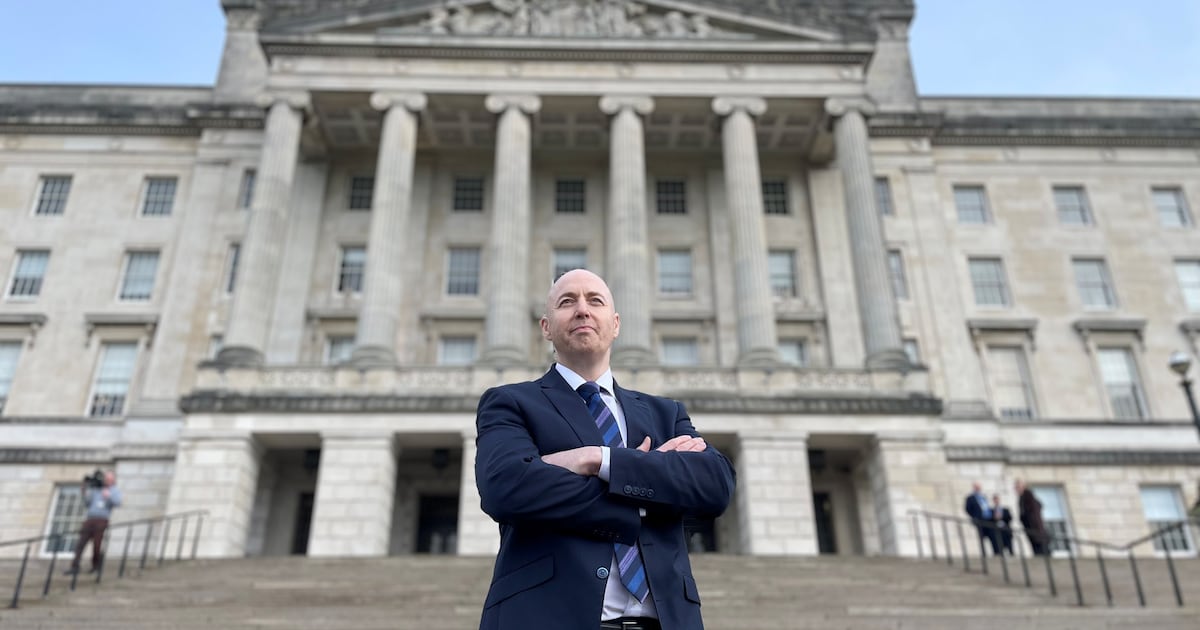
Almost 16 years ago, Jon Burrows, now leader of the Ulster Unionist Party (UUP), stood with the crowds in Derry’s Guildhall Square as the Saville report on Bloody Sunday was published. Then the city’s police chief, he watched as the British prime minister, David Cameron, apologised. The killings of civilians by British soldiers in Derry on January 30, 1972, had been “unjustified and unjustifiable”, Cameron said. “I literally saw people sob in the street,” Burrows tells The Irish Times of that day in June 2010. “I felt the air lift; it was validation. I got goosebumps … it was a very powerful moment.”He believes it is time for the Irish Government to make a similar gesture and create a similar moment. “I think they should make a major statement about the past,” he says. “I would love Ireland to say that some of their conduct during the Troubles was unjustified and unjustifiable. READ MOREMan who alleged ex-partner cut his face and arms gets protection order against herMunich was no love-in, but Rubio spared Europe a Valentine’s Day massacre Mary Black: ‘It’s beginning to sink in, this goodbye is a bigger deal than I thought’“I think it would be seismic for our relationships … seismic for good relations.” UUP leader Jon Burrows spent 22 years as a police officer, including as area commander for Derry. Photograph: Mark Marlow/PA Burrows’s own story is entwined with that past. The 49-year-old from Bangor, Co Down, describes his as a “uniform family … there was pride in being in service and uniform”.Relatives fought in the British army in the first and second world Wars, and his father was a member of the Royal Ulster Constabulary. Burrows joined the Police Service of Northern Ireland (PSNI), saying: “I 100 per cent wanted to follow in my dad’s footsteps”. He spent 22 years as a police officer, including as area commander for Derry and Strabane and as head of the force’s disciplinary branch. In Derry, he was under “heavy threat” from dissident republicans. A viable letter bomb addressed to him was intercepted in the post, he lived in a constant security “bubble”, had to move house and was the subject of social media smear campaigns and false allegations. It took its toll on his mental health and he retired from the PSNI in 2021. He believes that, “given the scale and threat of the Troubles, the UK police and army did remarkably well” although at times things went “catastrophically wrong”, not least on Bloody Sunday. But he also emphasises the need for Ireland “to address … their conduct” during the Troubles, particularly over the extradition of suspects to the UK. “I think there’s something specific about the Irish state’s approach to extradition that stands out as an equivalent of Bloody Sunday, but over a long period of time, and it was a decision at the highest level,” he says. “They refused to [extradite] murderers,” he said. Asked if Britain should make an apology similar to that which he advocates for from Ireland, Burrows cites the example of the Kenova team’s inquiries, particularly into the IRA double agent known as Stakeknife. “Every time there’s been something shown to be wrong, I think the British Government have said, ‘We got that wrong’.”Jon Burrows lays a wreath on Remembrance Sunday last November at the Memorial Gardens, Ballymena.
Photograph: Andrew McCarroll/Pacemaker He says “there is a double standard on legacy today” and the Irish Government needs to “engage in good faith, with equal footing” and put in place “parallel arrangements” similar to those in place in the UK jurisdictions “to investigate, to co-operate, to disclose” in regard to Troubles-era killings, “especially given all the murders on the Border. “So many attacks were planned in the South; people came from the South, devices were made in the South, and they escaped to the South, and they’ve left Northern Ireland and the UK with the burden of investigating and responsibility for the sort of ownership of legacy, and they need to take their part.” Burrows is happy to have that conversation with the Irish Government. “I’m waiting for an invite,” he says, while stressing the importance of “mutual respect” and “practical, good relationships because we share an island together”.He describes Taoiseach Micheál Martin as “one of the better ones” in that he “at least understands unionism, doesn’t speak down to unionism”.But, he says, “you still get different taoiseachs who’d be nakedly nationalist”. “I think they should reassure us that in all of their policies there is no Trojan horse towards unity, that we’re engaging, when we’re discussing co-operation in good faith that it’s not politically or ideologically driven, it’s genuinely practically driven.” He views the treatment of candidate Heather Humphreys during the presidential election campaign as “a blast of cold reality for some unionists … clearly there’s an issue [with sectarianism] in the Republic of Ireland”.This is coupled with the election of Catherine Connolly, whose geopolitical views he says many unionists “would be horrified by”. He believes these “probably solidified unionist resistance to this new and agreed Ireland. It doesn’t look very new and agreed”.Jon Burrows, right, arrives at the Stormont Hotel in Belfast before being elected leader at a party meeting last month. Photograph: Mark Marlow/PA Burrows himself is “confident but not complacent” about Northern Ireland’s constitutional status. “We need to be on our game, arguing the case” and “evangelising … for the union”.He believes unionism has thus far failed to sell the positive benefits of being part of the United Kingdom. He advocates making “the rational case for the union … for those people who are disinterested or just see themselves as Northern Irish or who are nationalist but persuadable”.He lists multiple benefits from the economy to international security interests. “Western Europe is very vulnerable: international terrorism, [undersea] cables, organised crime, other hostile states.” In Britain, Europe and globally, he says, “you want us to be part of the UK because we create a huge security headache for you if we leave”.Yet, ultimately, Burrows is less concerned with the constitutional question. “It’s going to take a lot to convince people to make this leap into the dark,” he says. He is more concentrated on practical, day-to-day politics. He hopes to attract voters from across the traditional orange and green divide by sorting out grit boxes, school uniforms and potholes rather than discussing identity, nationality or geopolitics. “I do think there’s a real appetite out there for a bit more plain speaking and common sense and relatable politics that almost pricks this wee bubble that our politicians live in.”His has been a remarkable political rise. A year ago, Burrows was not even a member of the UUP. He was co-opted into the Assembly in September and became party leader a matter of weeks ago. His goal is to make the UUP the dominant force in political unionism again, but it is a challenge many have faced and failed at. Burrows is the fifth person to lead the party since 2012, but in that time the party has stagnated, going from 13 per cent of first preferences in the 2011 Assembly elections to 11 per cent in 2022.“People can judge me on my performance, and ultimately they will judge me on the electoral performance of [the next Assembly election in] May 2027, and that’s my challenge.”Burrows speaks of “momentum” building, of the gap narrowing in the polls between the UUP and Democratic Unionist Party. “If we come back with 14 MLAs, 15 MLAs, dozens more councillors… suddenly we’re building, so I’m looking at building a mass movement,” he says.“I think people in Northern Ireland want something different, and we’re offering that difference.” He compares it to his time as Derry’s police chief when he tried to change relationships between police and the community and “humanise” the force by, for example, bringing PSNI officers into the city’s schools. “I am trying to challenge people’s perceptions, build confidence and trust, but also deliver practically. In many ways it’s the same, I’m just wearing a different uniform now.”