Mark O'Connell: Ireland’s weather has been like our tax regime - a nice little arrangement. Until now
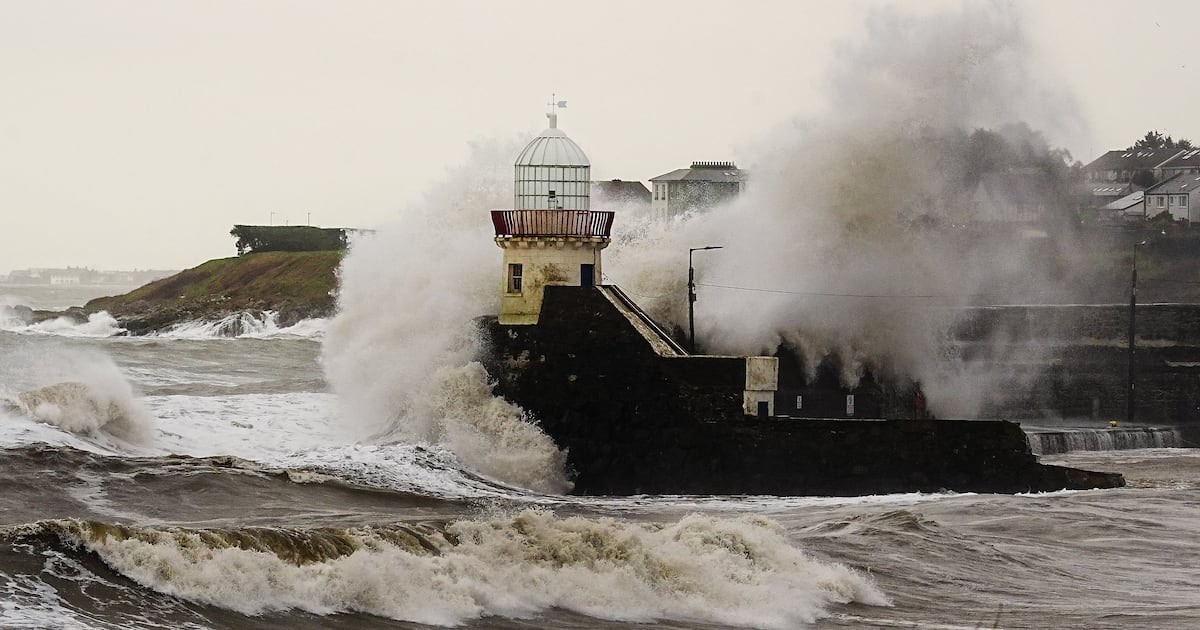
When the weather is as cold and wet and miserable as it has been in recent weeks, a thing I find myself often reminded of – along with the fact that life itself is suffering, and that whichever minor bureaucrat god is in charge of our weather bears us nothing but the purest ill-will – is that we live on a small island in the northern latitudes of the Atlantic Ocean. Our climate is the climate of the ocean itself. The experience of recent weeks has been one of being almost literally at sea: buffeted this way and that by gusts of scouring nautical wind, your face set in grim resilience as you trudge through wave after wave of rain. At such times, I find myself channelling Bonaparte O’Coonassa, the narrator of Flann O’Brien’s satirical misery memoir The Poor Mouth, muttering under my breath about how there will “never be any good settlement for the Gaels”, that our fate until the end is “misery, trouble and exhaustion”, with the spite of the earth down every night upon us out of the skies.The level of rainfall we have experienced in the last few weeks is, if not quite a freak event, certainly out of the ordinary. It’s a result, according to meteorologists, of our prevailing weather system, which is normally dominated by the North Atlantic jet stream being challenged by cold air pushed down by something called the “polar vortex”. And so, the recent horrendous weather has been a reminder of the fragility and contingency of the weather system dynamics by which this country is afforded its comparatively benign climate. Because, with all due respect to the lived experience of Bonaparte O’Coonassa, things could always be worse.The Gulf Stream (or as it could well soon be renamed, the Trump Stream) and our beneficial arrangement with it are highly vulnerable to powerful global forces beyond our controlIt is sobering to look at a map of the world, and to see the places with which we are on a latitudinal par, and to consider how much warmer it is here than in those places. As I write, I am sitting in the city centre of Dublin, where it is 9 degrees Celsius. If I were to travel westward along the same latitude, I would eventually find myself in the Canadian city of Saskatoon, where right now it is, depending on the time of day, between 10 and 20 degrees colder. Other places to be found on roughly the same latitude include Newfoundland, Minsk, and the Russian city of Samara, on the eastern bank of the Volga, which is at present experiencing a decidedly brisk afternoon temperature of -13 degrees. READ MOREA month in Australia, my son’s new home‘Some of the rooms are 23 degrees with no heating on’: the joys of living in an energy efficient houseHow Kerrygold took over Britain’s most fashionable kitchens: ‘It’s what butter should be’Should parents be held responsible for children’s activities online?If I understand this matter correctly, it is the Gulf Stream and prevailing westerly winds that primarily distinguishes us from our frigid latitudinal fellows. The Gulf Stream forms a kind of underwater conveyor belt that consistently moves warm water northward through the Atlantic from the tropics, and colder water back down south. And as many of us have learned in recent years, it is not some immutable fact of nature, like gravity or the motion of the planets around the sun, but rather a sort of fragile diplomatic detente between opposed great-power thermal forces.[ An hour and a half of sunshine in a week? No wonder Irish weather chat has intensifiedOpens in new window ]Perhaps we could think of it as an ocean-current version of our 12.5 per cent corporate tax rate: a nice little arrangement we’ve managed to carve out for ourselves, allowing us to forget about the extreme precariousness of our situation, and whose loss would mean we were completely screwed.As with that corporate tax rate, the Gulf Stream (or as it could well soon be renamed, the Trump Stream) and our beneficial arrangement with it are highly vulnerable to powerful global forces beyond our control. According to recent climate models, the Atlantic Meridional Circulating System (Amoc) – the broader ocean current system of which the Gulf Stream is an integral part – could one day “switch off”, possibly much sooner than had previously been modelled. Since the turn of this century, measurements have shown a long-term decline in the strength of the system, due partly to melting ice adding fresh water to the North Atlantic, causing the reduction of water density. As so often with things to do with climate chaos, terrible events which were previously thought to be quite far in the future are now projected as alarmingly close. Stefan Rahmstorf, one of the climate scientists at the Potsdam Institute for Climate Impact Research, who carried out a study based on recent climate modelling, has even claimed that “the tipping point where the shutdown becomes inevitable is probably in the next 10 to 20 years or so”. Reducing the risk of this catastrophic event taking place – bringing in its train much colder winters in northern and western Europe – requires exactly the sort of dramatic reduction in carbon emissions that global leaders seem to have basically given up on working towards.The idea of ‘global warming’ was always something of a blunt instrument. And one of the results of its prevalence as a term was a kind of soft denialism about its effects and their distributionOne of the things I think has been happening in recent years, in the world in general and in this country in particular, is a recalibration of our understanding of what the future holds in terms of man-made climate catastrophe. The idea of “global warming” was always something of a blunt instrument. And one of the results of its prevalence as a term was a kind of soft denialism about its effects and their distribution. In Ireland, there was a distinct collective tendency to think of it as something that would surely cause great chaos and destruction in the global south – in places such as Bangladesh and Sri Lanka – and would bring about huge political upheavals to which we in the global north would not be immune, but which, on the other hand, might take the edge off Ireland’s rubbish weather. A time of great devastation and tribulation was at hand, it was true, but it might be nice to be able to sit out in the back garden in the spring months, eating domestic olives and drinking a nice full-bodied red from the vineyard down the road. I think that this delusion, as consoling as it may have been in its half-assed way, has been finally laid to rest. It remains the case, distressingly, that there will never be any good settlement for the Gaels.