From umbrella to uncertainty: Europe and Canada's nuclear deterrence anxiety
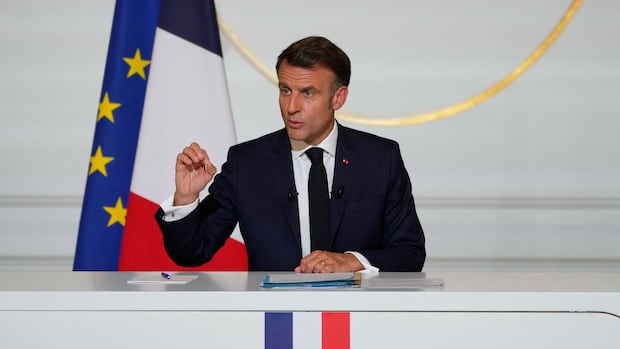
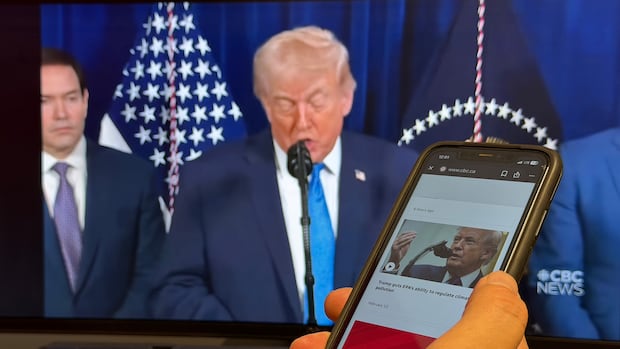
Normally, it's considered a good thing when the world beats a path to your door.Maybe not so much when we're talking about nuclear deterrence.At the very least, it is an ominous sign of the times.Although little has been said publicly, several Western allies are now apparently elbowing each other to shelter under France's nuclear arsenal.While the sentiment is more prominent in Europe, it's clear Canada cannot be excluded from the slow-burning crisis of confidence among allies about whether the United States can still be relied upon to live up to its long-standing formal guarantees — through NATO — of nuclear protection.There is no authoritative official count showing the specific countries that have formally requested a direct nuclear deterrence guarantee from France's nuclear arsenal. Unlike the United States, the French government does not currently extend formal nuclear guarantees.What we do know is Poland and now Germany have quietly acknowledged they're talking with France on nuclear deterrence co-operation.In a statement on Jan. 29, German Chancellor Friedrich Merz acknowledged Berlin was in talks with Paris to explore deeper co-operation on deterrence, including the role of French nuclear forces in protecting European allies."These talks are in their very early stages," Merz said in Berlin in response to a question on the matter. "We know that we have to make some strategic and military-political decisions here, but again, the time is not yet ripe for that. We are holding strategic talks on this issue with the countries involved."Merz was quick to paint the dialogue and possible inclusion in France's nuclear deterrence as complementary to the U.S. nuclear umbrella.LISTEN | Should Canada have nuclear weapons?Front Burner29:58Should Canada have nuclear weapons? French President Emmanuel Macron has signalled he's open to discussing an expanded role for France's nuclear forces with European partners, but wouldn't commit to a formal extended "nuclear umbrella" like that provided by the United States under NATO. At the Munich Security Conference on Friday, Macron reiterated the urgency for Europe to become a "geopolitical power" and begin consultations with key partners — including Germany and the United Kingdom — on reshaping collective defence, including nuclear deterrence considerations.Macron said he's committed to launching a strategic dialogue with allies this year. There's a limit to how far the dialogue can go because Macron has made it clear France will maintain "doctrinal control" over how and when nuclear weapons could be used.The way former French defence officials describe it, the notion of having an international committee in the room during a crisis deciding whether to fire a nuclear weapon is not going to happen; there must be a straight line of command — or "one man, one button" approach.Several European analysts emphasize that Macron's goal is strategic signalling rather than the actual deployment of French nuclear weapons abroad. Nuclear arms remain under French sovereign control, and any extended guarantee would be political rather than formalized in a treaty akin to NATO sharing.Where Canada fits in this international undercurrent of anxiety isn't entirely clear.While it may have been reading too much into the optics, it seemed significant that Prime Minister Mark Carney made France and the United Kingdom — Europe's only two Western nuclear military powers — his first overseas stops at the height of U.S. President Donald Trump's 51st state rhetoric and threats to economically crush Canada into joining the American union. British Prime Minister Sir Keir Starmer speaks with President of the European Council Antonio Costa at a meeting during the Munich Security Council. The U.K. and France are NATO's European nuclear-armed states. (Stefan Rousseau/Pool/Reuters)The former chief of the defence staff, retired general Wayne Eyre, told a panel discussion in Ottawa recently that Canada should keep its options open when it comes to nuclear weapons.He didn't elaborate, but defence expert Michael Byers says there's a difference between acquiring nuclear weapons — which Canada decades ago chose not to do despite having the capacity — and seeking nuclear deterrence guarantees. "Anyone who thinks that acquiring nuclear weapons is a quick fix forgets that, you know, in Canada, it takes more than two decades to build a warship, right? It takes two decades to procure a fighter jet," said Byers. "So [acquiring nuclear weapons] would be a long-term project. And the reason I point that out is that Europe already has a nuclear deterrent."Adding to the muted sense of dread in Europe, a new report released as part of the Munich Security Conference said Europe must urgently prepare for the possibility that the United States may no longer be a reliable nuclear guarantor.The report warns of a widening "deterrence gap" on the continent — a development with direct implications for NATO allies beyond Europe, including Canada.In Mind the Deterrence Gap: Assessing Europe's Nuclear Options, the European Nuclear Study Group argues that Russia's nuclear-backed aggression in Ukraine and renewed uncertainty about Washington's long-term commitments have upended long-standing assumptions about European security. "Europe has entered a new nuclear era," the authors wrote, warning that policymakers have been "slow to grasp its implications."The U.S. for its part has not formally signalled that it's prepared to walk away from its commitments.But Trump himself has said of NATO allies: "If they don't pay, I'm not going to defend them."U.S. Defence Secretary Pete Hegseth stated in early 2025 that "stark strategic realities prevent the United States of America from being primarily focused on the security of Europe."For the study group, the danger lies not necessarily in a formal U.S. withdrawal from NATO, but in ambiguity. A deterrence gap could emerge gradually "through ambiguity, delays and mixed signals — especially in moments of crisis, when credibility matters most."Such a gap, the report said, would invite probing behavior from Moscow, particularly if Russia perceived "a growing mismatch between Europe's interests and its capacity or willingness to defend them."For Canada, which has historically relied on U.S. nuclear guarantees while contributing conventionally to NATO, the report drives home the notion that the credibility of deterrence in Europe is inseparable from North American security. A weakened NATO nuclear posture might not be confined to the Baltic or the Black Sea. It would reshape alliance cohesion, Arctic stability and the broader strategic balance between Russia and the West.Byers said he believes much of the debate is missing the point that should any adversary try to mess with NATO, it runs up against the whole alliance with all of its conventional capabilities which are being improved."We're in a collective security pact," Byers said."You bring to the table what you're best suited to bring. But it's a partnership. We're not sheltering. We are at the table together with France, with the United Kingdom, with Germany, with Italy, with Poland. That's what makes us strong. And so this idea that we need to hide under the skirts of the French and the British is simply false."