No place for politics in F-35 cockpits as Canadian fighter jet pilots get ready to train at U.S. base
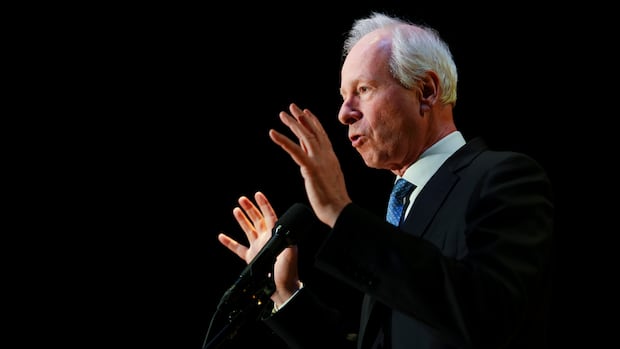
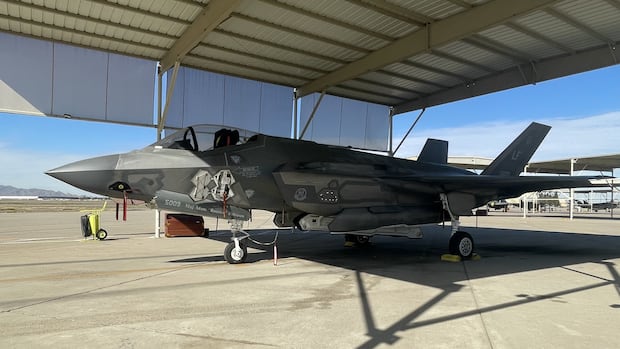
The constant roar of the F-35 fighter jet can be heard and felt at Luke Air Force Base in Arizona as pilots practise flying the stealth planes across the vast desert sky. But what’s louder is the ongoing debate within the Canadian government about just how many F-35s it will purchase. Last March, Prime Minister Mark Carney's government announced that it would be reviewing the procurement of Canada’s new fleet of fighter jets amid continued political and trade tensions between Canada and the United States. The F-35 purchase has become symbolic of the political discourse. But when it comes to pilots training in the air, it’s politics aside and off the radar. U.S. Brig. Gen. David Berkland, who commands Luke Air Force Base in Glendale, Ariz., says he can’t let that noise distract him as he focuses on training pilots from around the world.“Things that are in the news that are above my pay grade, we just can't get distracted by,” said Berkland. He’s referring to friction between some European countries and the U.S. given President Donald Trump’s renewed desire to acquire Greenland, which has dominated headlines in recent weeks. WATCH | Pilots training on F-35s try to keep politics out of cockpit:Military pilots will head south this summer to learn to fly the F-35 — even as Canada weighs a multi-billion-dollar decision about how many American-made fighter jets it will buy. For The National, CBC's David Common goes to Luke Air Force Base in Arizona where trainers are trying to keep heightened political tensions out of the cockpit. "So flying with the Danes, we're all focused very singly on training the world's greatest fighter pilots. That's our mission here at Luke," said Berkland."And as far as I can tell, 100 per cent seamless as far as our relationship with all of our partners."Canada has contractually committed to buying 16 F-35s made by U.S. aerospace and defence company Lockheed Martin, with the option to purchase up to 88 of the fifth-generation stealth fighter jets.While the fate of the remaining jets that will make up the Royal Canadian Air Force’s (RCAF) fleet is still unknown, the fact remains that Canada will be in possession of 16 F-35s — and pilots need to be trained to fly them. Trust built in a training environmentLater this year, members of the RCAF will get that training at Luke in a mixed squadron amongst American counterparts. Berkland, who has worked with the RCAF throughout his career, says they’re ready and excited to welcome Canadians. U.S. Brig. Gen. David Berkland, who commands Luke Air Force Base in Glendale, Ariz., stands in front of an F-35. (Laura Clementson/CBC)“Having that trust built right up front in the training environment is really powerful.”Berkland says having Canadians on the base and working with them will offer an opportunity to create vital relationships.“You know, when it's night one of major combat operations, we don't have time to establish trust and relationships. So when you build that trust in a training environment, right at the beginning of your flying career, we can move that much more quickly on night one of a fight tonight type scenario,” said Berkland. In preparation for the arrival of the RCAF, three F-35s have been identified as the jets they’ll train on while Canada’s actual 16 planes are still being assembled at the factory in Fort Worth, Texas. ‘Leave politics to the politicians’The base is a known training hub for the F-35 among allied partners and is currently host to Italy, Belgium, Norway, Denmark and the Netherlands, along with other nations focused on various programs. Lt. Col. Joseph Luijsterburg, commanding officer of the Dutch training contingent at Luke Air Base for the Royal Netherlands Air and Space Force, is part of that international contingent. He’s been living in the States for over a decade now. Last month, Luijsterburg spoke with CBC News about being on a U.S. military base in the midst of Trump's threats to annex Greenland, which is a self-governed Danish territory.Lt. Col. Joseph Luijsterburg is the commanding officer of the Dutch training contingent at Luke Air Force Base. (Jonathan Castell/CBC)"Obviously, we follow the news. And then being here with a Danish contingent, Dutch, and American together, it's quite interesting at times, let's say that," he said. "But we try not to get bogged down in it."He says that they don’t notice the global tensions on a day-to-day basis as they’re focused on the job — training pilots. “It's like, leave politics to the politicians and just be effective, and that's kind of what we're focusing on,” Luijsterburg continued. Denmark’s second thoughts about the F-35But for many, politics cannot be kept out of the cockpit. Though Danish Member of Parliament and chairman of Denmark’s Defence Committee Rasmus Jarlov isn't involved in military operations with the F-35, he was one of the Danish politicians who decided to purchase the American jets.Following Trump's threats, he says he’s not sure if they would buy the F-35 again.He says that in 2016, when Denmark chose the F-35, they had no concerns about the Americans."But of course, that has changed completely and especially during the last year,” Jarlov told CBC News in an interview on Jan. 20, when tensions were particularly high between Denmark and the White House.Jarlov says that since the F-35 is American made and relies on U.S. parts, Denmark would be in a precarious situation if relations between the two countries were to deteriorate further. He noted that if the U.S. were to shut down supply lines for parts, it could destroy Denmark's air force. "And that's a concern in a situation when you're dealing with a president who's very, very obsessed with who has the cards and is not afraid to use any card that he has to put pressure on you if you have something that he wants."Jarlov says that it now seems like a risk to be overly dependent on the U.S., given that the White House has become “unreliable” at the moment. “I think some of us have second thoughts,” he said. “We would feel more confident that we could use our fighters if we had bought a European plane.”WATCH | Weighing the differences between Gripen and F-35 fighter jets:With the future of Canada’s fighter jet fleet being re-examined, CBC’s Murray Brewster breaks down the differences between the American F-35 and Sweden’s Gripen. Canada reconsidering what jets to buyThe Canadian government found itself in a similar situation last year following Trump’s comments about making Canada the 51st state, which contributed to Ottawa hitting the pause button on the purchase of the remaining jets. It, too, is now considering buying jets from Europe, with a close eye on Sweden's Gripen. According to an EKOS poll from December, 72 per cent of Canadians favour incorporating the Gripen into Canada’s fleet either by purchasing all Gripens moving forward, or supporting a mixed fleet of both F-35s and Gripens. “That’s a Canadian decision,” said Pete Hoekstra, the U.S. ambassador to Canada. “That's a national, national security decision for Canada. If interoperability, if interchangeability, isn’t important to the Canadians anymore, they may go in a different direction.”In an exclusive interview with Hoekstra at Luke Air Force Base, CBC News asked about the idea that Canada might be hesitant to spend billions on a fighter jet from a country that many Canadians have recently come to view as a threat to the country's sovereignty.U.S. Ambassador to Canada Pete Hoekstra has long been a proponent of Canada's F-35 procurement. ( Jonathan Castell/CBC)"That's crazy, OK," Hoekstra said. "We're not a threat."Hoekstra has long been a proponent of Canada's F-35 procurement and says it’s a system that has worked for a long time because of its interchangeability and interoperability.“It's worked in the past. It's working very, very well today," he said, adding that it creates a platform to take aim at "the more complex threats that the continent's facing."