29 Years Ago, GM Sacrificed One Of Its Own For The Sake Of Chevy
You might think that it'd be completely wild to pluck modern-day Mazdas, Hyundais, Hondas, and Toyotas from their assembly lines, then casting them as one, new brand. But defunct General Motors brand Geo has already done something similar. The Geo nameplate and its lineup of small re-badged Japanese cars was born in 1989 to steer people toward Chevrolet showrooms and away from other highly-appealing Japanese cars. The brand was sacrificed for Chevy's sake in 1997, just shy of its double-digit birthday, joining the list of car brands killed by GM.
To say that American car quality in the 1980s was suffering is a bit like calling a compound fracture a broken leg. Faced with the reality that Honda, Nissan, and Toyota were topping the J.D. Power problem-free car charts, GM decided to form its own little small car supergroup. Dubbed Geo, it would tap what turned out to be shrewd GM alliances forged with Isuzu in 1971, Suzuki in 1981, and Toyota in 1984 for source material.
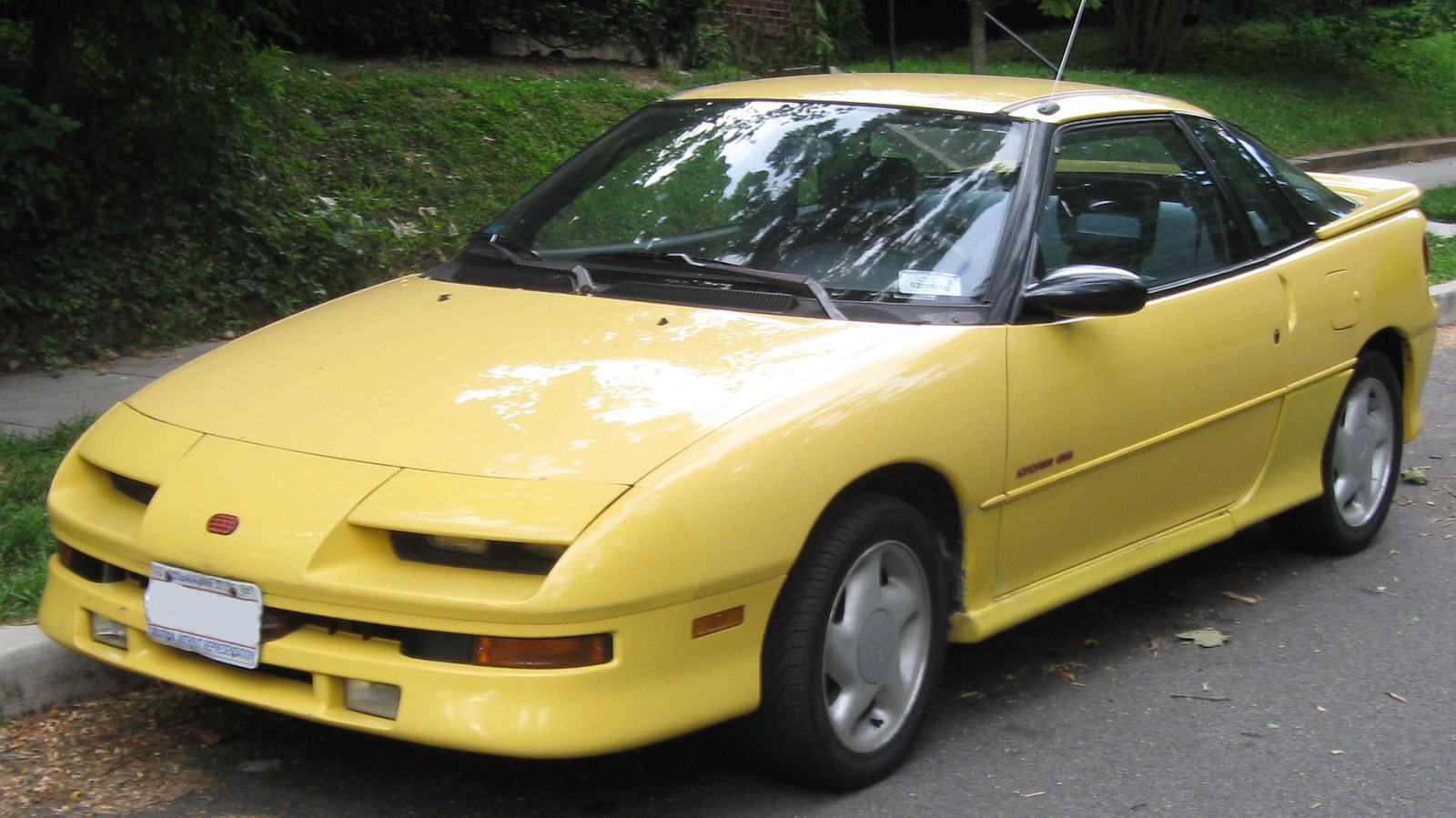
The Isuzu I-Mark — which Chevy had already been selling as the Spectrum – became the Geo Spectrum. The thrifty Suzuki Swift emerged as the Geo Metro, which readers now playfully want to see in a chase scene. The Geo Prizm was a Toyota Corolla, and the diminutive Suzuki Sidekick begat the Geo Tracker. Rounding it all out was an alternative version of the Isuzu Impulse known as the Geo Storm. Once Chevy's brand image improved, though, GM gave Geo the heave-ho.
Getting to know Geo
Geo launch ads ooze early-'90s energy while later campaign voiceovers took dead aim at Honda, Nissan, and even Toyota. Renditions of Rodgers and Hammerstein's show tune "Getting to Know You," from the 1956 musical "The King and I" were repurposed into earworm promotional soundtracks. These commercials were aimed at a generation that grew up when Japan emerged as a global automotive powerhouse while America wallowed in a recession.
When Geo arrived to lend life support to Chevy dealerships, GM was still reeling from disco-era difficulties. The 1973 Oil Embargo slammed the American economy in the head. Long gas lines made economy cars desirable, and American car companies struggled to build them. In a retrospective summary of reviews for the Chevrolet Vega and its Ford Pinto small car counterpart in the 1970s, Car and Driver said, "The pair was derided as two of the worst cars of all time." The Embargo also set off inflation that, coupled with mismanagement, had the Big Three bleeding red ink into the 1980s.
To turn perceptions around, Ford did itself proud with the 1986 Taurus while Chrysler conceived the minivan from its little K-Car platform. Meanwhile, GM's Saturn division was just getting off the ground. Badge engineering — rebranding other cars under different brands – was a quick way for GM to minimize its blood loss. When your cupboard is stocked with awful badge engineering exercises like the homemade Cadillac Cimarron, it's best to consider ordering out. That's exactly what GM did, and Geo delivered.
No matter what (at least until Chevy's comeback)
Reviews of Geos could be mixed, but the brand kept on rolling, finding somewhere around 800,000 takers from 1989 to 1997. As people got to know these vehicles, another ad campaign, touting the versatility and economy that made the Geo Prizm such a practical car, featured the catchphrase: "No Matter What, It's a Geo."
While these ads mentioned how you could get a Geo at your Chevrolet dealership, Chevrolet itself had been focusing on its own models. Its S-10 Blazer 4x4, introduced for 1983, got a makeover for 1995 just as SUV sales skyrocketed — as did the Camaro and Corvette around this time. And yet, divine weirdness intervened. In the 1994 J.D. Power Initial Quality Survey, the Geo Prizm outscored its brother from another mother, the Toyota Corolla, by 20 points — despite being built alongside one another in a joint GM-Toyota factory. This was attributed to things like Corollas being built in several plants and Geo customers simply having lower quality expectations.
Regardless, by 1996, GM felt that Geo had successfully served its purpose. The Wall Street Journal reported that, together, Chevrolet and Geo made over 50% of GM's sales. The Chevrolet brand was, unsurprisingly, more recognizable, and GM wanted to streamline things. So, the Metro, Prizm, and Tracker were once again re-badged as Chevrolets for 1998, and they'd continue to sell as such until 2001, 2002, and 2004, respectively. Geo was born to die, but it lives on forever as a critical piece of GM history.