Musk distracts from struggling car biz with fantastical promise to make 1 million humanoid robots a year
Elon Musk's car company is getting ready to be Skynet. Tesla, facing an 11 percent decline in automotive revenue in Q4 2025, has committed to $20 billion in capex spending this year on manufacturing and compute infrastructure. The goal: build lots of humanoid robots.
The cash conflagration includes a plan to shift its Fremont, California, manufacturing facility from making Tesla S and X model vehicles, discontinued as of Q2 2026, into a production line capable of turning out one million Optimus robots annually.
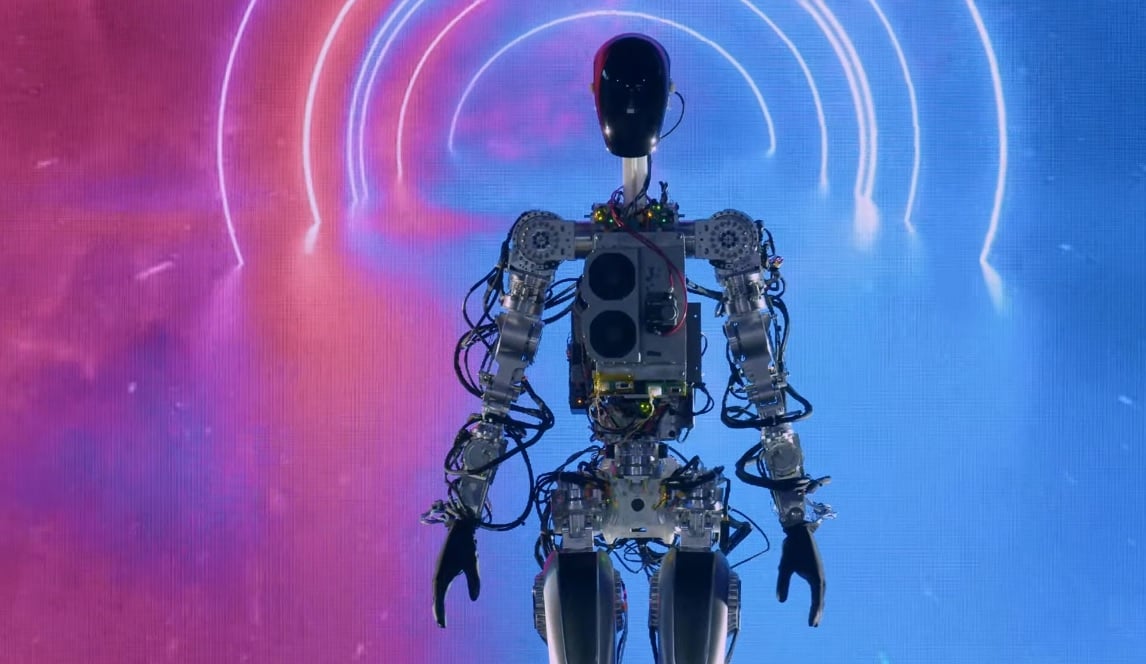
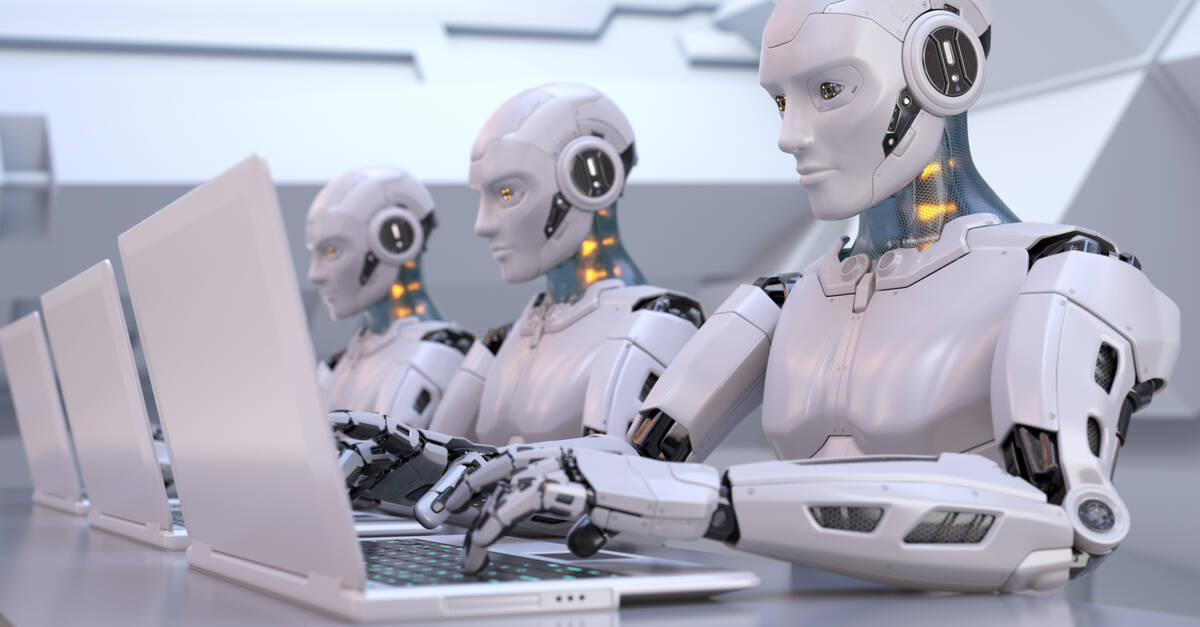
Optimus, as described by Tesla, is "A general purpose, bi-pedal, humanoid robot capable of performing tasks that are unsafe, repetitive or boring." Tesla says it is aiming at a manufacturing cost of $20,000 per unit.
"I'm confident that we'll get to a million units a year in Fremont of Optimus 3," said Musk on Tesla's Q4 2025 earnings call. "This Optimus really will be a general-purpose robot that can learn by observing human behavior."
Musk has a history of fanciful forward-looking statements. For example, in a 2011 interview with The Wall Street Journal, he said that Space X would put an astronaut into space within three years. That didn't happen until 2020. His claims about sending astronauts to Mars remain similarly unfulfilled.
During the Recode Conference in 2016, Musk said, "Well, we're going to send [a SpaceX rocket] to Mars in 2018."
"Wait, wait, wait," said moderator Walt Mossberg. "2018? That's for sure?"
"Yeah, a couple of years," Musk replied.
There have been many other such missed predictions, particularly around the prevalence of driverless Tesla robotaxis. At one point, Musk said there'd be a million on the road in 2020. Six years later, there are reportedly couple hundred or so operating, and all of them are currently using safety drivers, according to Electrek.
If Tesla were to produce a million humanoid robots, they wouldn't be all that useful. Asked during the conference call how Tesla employs Optimus, Musk said the robots currently are not doing meaningful work.
"Well, we are still very much at the early stages of Optimus," he said. "It's still in the R&D phase. We have had Optimus do some basic tasks in the factory. But as we iterate on new versions of Optimus, we deprecate the old versions. It's not in usage in our factories in a material way. It's more so that the robot can learn. We wouldn't expect to have any kind of significant Optimus production volume until probably the end of this year."
Even if Tesla hits its production milestone of one million units by the end of 2027, the company needs to demonstrate their Optimus can actually perform useful labor alongside other humans for less than it would cost to hire a human. We note that Boston Dynamics and Hyundai have planned for more modest manufacturing capacity amounting to 30,000 humanoid robots per year, mainly for warehouse tasks.
People who work in the robotics industry have doubts that humanoid robots are ready for deployment outside of controlled industrial spaces. That's what we heard at the Humanoids Summit in Mountain View, California. There are many technical, social, and practical barriers that need to be overcome.
In its October 2025 report, "Humanoid robots: Crossing the chasm from concept to commercial reality," global consultancy McKinsey observes that public demonstrations of humanoid robots don't translate into economically viable autonomous machines.
"[T]he gap between what is technically demonstrated in pilots and what is commercially viable at scale remains wide," the report says. "The prototypes that are capturing headlines are impressive but still far from delivering consistent, reliable, and economically justifiable performance in real-world settings."
Barriers include the safety implications of free-roaming robots, limited battery life when not tethered to power, lack of manual dexterity and mobility, and cost.
Lei Yang, CEO of IntBot, a humanoid robot startup, told The Register in an email that given the rapid advances being made in hardware and AI, he expects Tesla and the robotics industry will be able to deliver humanoid robots in the not-too-distant future.
"While we see impressive demonstrations of robots dancing or performing backflips, these are often visible signs of hardware progress rather than autonomy," said Yang. "If you look past the spectacle, the deeper reality is that many demos still rely on scripted behaviors or direct supervision. The true challenge remains turning that raw capability into safe, repeatable, and autonomous operation around people."
Yang said that commercial viability is already here, pointing to the humanoid robots his company has deployed to hotels for hospitality functions.
"These units are already generating value by amplifying the guest experience – welcoming visitors, answering questions, and providing real-time assistance," he said.
Yang said safety remains the biggest issue. "The engineering challenge lies in creating 'inherently safe' systems that balance power with compliance," he said. "A robot must be strong enough to be useful, yet soft and responsive enough to never injure a human, even in the event of an AI misinterpretation or system accident."
Dale Walsh, VP of strategy and innovation at Roboworx, a robotics field support company, told The Register that his company is starting to see humanoid robots in the field, but they're only capable of performing specific tasks.
"'Humanoid' is a form factor and not so much a type of robot," Walsh explained. "When we're talking about Tesla Optimus or other robots like Atlas from Boston Dynamics, they're humanoids but they're general purpose robots where the goal is to be able to make them do pretty much what a human can do. So we're not seeing that yet in the market space."
Walsh said that general purpose humanoid robots present a lot of challenges. A five-foot tall robot, he said, might weigh 150 or 200 pounds. "In its natural state, it's unstable," he said. "So as it loses power, it's gonna fall. So safety is a big concern for that."
Then, he said, there's the whole issue of social acceptance. "People already fear robots taking their jobs when it's an AMR [autonomous mobile robot], you know, that moves around on the floor," he said. "Well when the robot looks like you and acts like you and moves like you, you know, that's going to be even more of a challenge from an adoption standpoint."
Asked to estimate the current size of the market for humanoid robots, Walsh said, "I would say hundreds," with the caveat that a lot depends on how you define the term. He noted that Softbank produced about 27,000 Pepper robots before discontinuing them in 2021.
"That's by most definitions a humanoid robot, but it's not a general purpose robot," he said.
Veteran MIT roboticist Rodney Brooks, founder and CTO of Robust.ai, in a January 1, 2026, blog post, voiced skepticism about seeing useful humanoid robots any time soon.
"For [Figure and Tesla] and probably several others the general plan is that humanoid robots will be 'plug compatible' with humans and be able to step in and do the manual things that humans do at lower prices and just as well," Brooks wrote. "In my opinion, believing that this will happen any time within decades is pure fantasy thinking." ®