An aging substation caused Montreal’s latest blackout. Its replacement is still years away
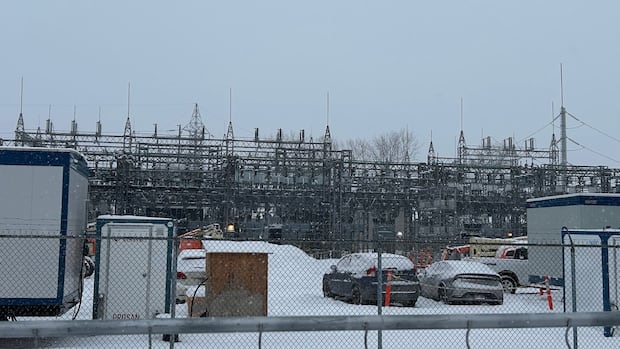
Listen to this articleEstimated 4 minutesThe audio version of this article is generated by AI-based technology. Mispronunciations can occur. We are working with our partners to continually review and improve the results.The equipment failure that left thousands of Montrealers without power during this weekend’s bitter cold originated at a substation that Hydro-Québec has been aiming to replace since at least 2018.Project documents show the utility has long identified the Hampstead substation as a weak link in the local grid.Pascal Poinlane, a Hydro-Québec spokesperson, said the outage was caused by the failure of a breaker at the substation — an issue that is “not as easy to fix as a problem caused by a snowstorm.”“When it happens in a substation with equipment like that, it takes more time,” he told CBC. He said generators were installed to restore power as quickly as possible.François Bouffard, an associate professor of engineering at McGill University who closely follows the public utility, said that replacing a failed breaker is a complex task even under ideal conditions. “This is the kind of repair that can take several weeks to complete — in the summertime,” he said.Without knowing the details of the malfunction, Bouffard said aging pieces of equipment are “bound to fail eventually” after being in use for more than half a century.At the outage’s peak, more than 20,000 customers were without electricity on Saturday in Montreal and Côte Saint-Luc. Service was expected to be restored to all residents and businesses by the end of the day Monday. Early Tuesday, some residents in Côte Saint-Luc and in Montreal's Notre-Dame-de-Grâce neighbourhood were still without power.The City of Montreal said Monday that more than 50 people had used a warming centre in Côte-des-Neiges, some of them staying overnight.WATCH | What's behind this latest blackout?:Hydro-Québec said it had to fix a breaker at the Hampstead substation, which feeds power to areas such as Côte-Saint-Luc, Que., and Montreal’s neighbouring Notre-Dame-de-Grâce neighbourhood. Thousands of customers went without electricity during the winter storm sweeping the region.In service since 1955While Hydro-Québec has a plan to completely rebuild the aging station, the project has faced delays and is not scheduled for completion until 2029. Further upgrades to the power lines servicing Côte Saint-Luc won’t be finished until 2031.The plan calls for converting the facility from 120 kilovolts to 315 kilovolts to meet growing demand. The substation will also be renamed the Côte Saint-Luc substation to reflect its actual location, which is Côte Saint-Luc — not Hampstead.A 2019 public notice stated that the rebuild was necessary to replace “aging equipment” and ensure the reliability of the power grid.The substation has been in service since 1955. At the time, Hydro-Québec documents describe the site as being almost in the “middle of a field.” While the area was bordered to the southeast by a Canadian Pacific railway line, the surroundings were largely agricultural.In the decades that followed, the area’s rural character gave way to dense, suburban development.That shift has complicated the upgrade process — and driven up demand. New, larger transmission lines will run through residential neighbourhoods and required extensive consultations.The replacement substation is part of an overall effort to provide more power, more reliably, in the years ahead, Bouffard said.“It’s a big challenge for Hydro-Québec to build up its capacity in a restricted amount of space,” he said.Project delayed by pandemicHydro-Québec began public consultations for the project in 2018, but the timeline was delayed by the COVID-19 pandemic, according to the utility.Nessim Malka, a Côte Saint-Luc resident with a baby who just turned one, said the outage has been difficult for his family. He believes Hydro-Québec should have been better prepared and communicated more clearly with residents.“We knew this was coming. We knew we were going to have the coldest days this winter, and it seems like Hydro-Québec was not prepared,” he said.Poinlane acknowledged that Hydro-Québec must improve its communications. He conceded that the utility’s outage-tracking site, Info-pannes, provided incorrect restoration timelines for some customers.“We apologize for that,” he said. “We know that some people were waiting for their power to be restored and it did not happen as indicated.”David Tordjman, the mayor of Côte Saint-Luc, said he will work with Hydro-Québec to make sure they have measures in place to ensure power is re-established more quickly — before the infrastructure is replaced. He pointed out that the lines into his community will only be completed five years from now, in 2031. “We’re going to work on mitigation measures to make sure we don’t go through something like this again,” he said.