Raspberry Pi flashes new branded USB drives that promise speedy performance
Over the past few years, Raspberry Pi has released a slew of peripherals and accessories that offer great build quality and premium features, whether you’re using them with everyone’s favorite single-board computer or not. Today’s entry: a USB flash drive that promises high speeds, good looks, and strong durability.
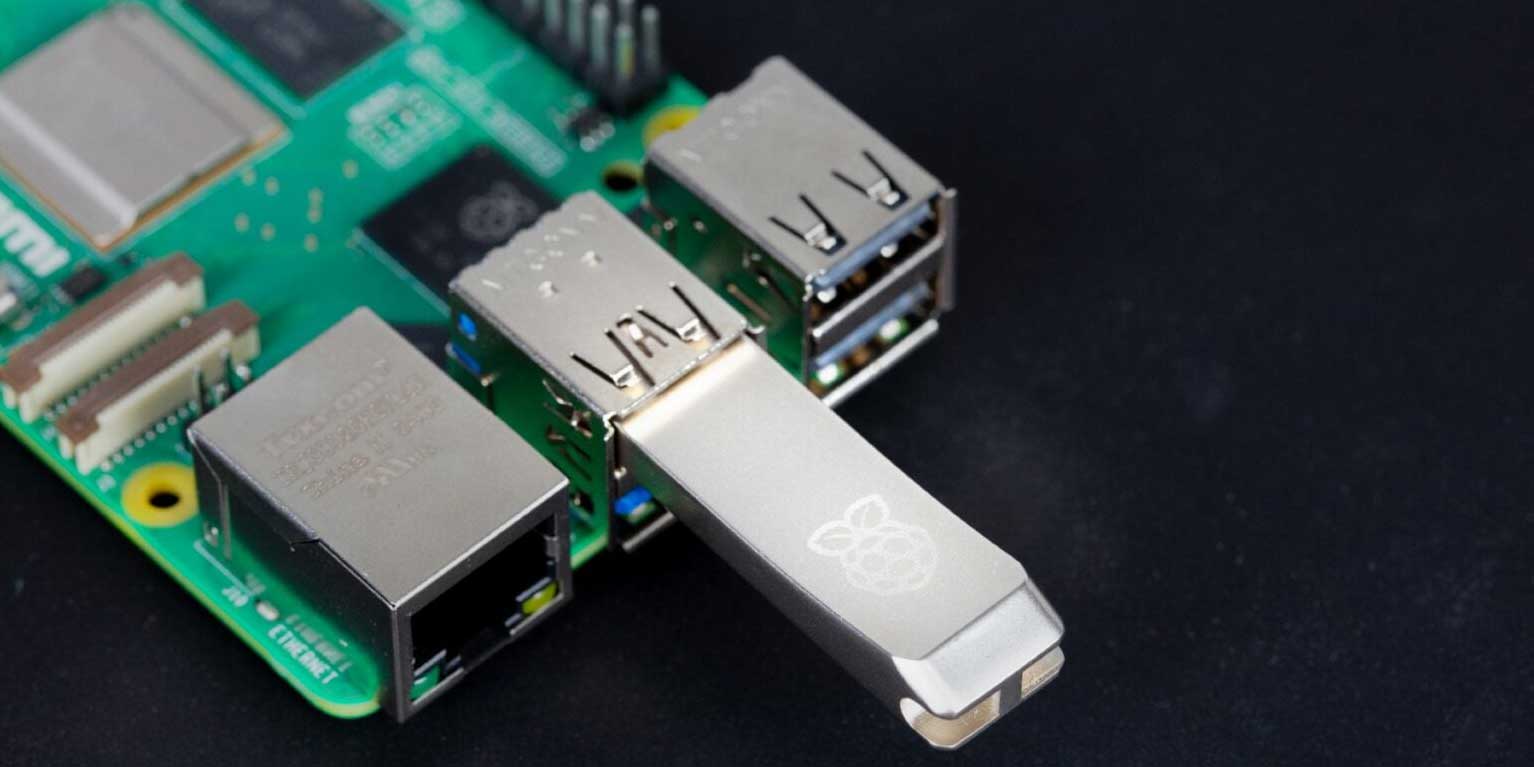
The drive comes in 128 GB ($30 list price) or 256 GB capacity ($55) and plugs into any USB Type-A port, though it works best when attached to one that operates at USB 3 (aka USB 3.1 Gen 1 and USB 3.2 Gen 1) speeds of up to 5 Gbps. The snazzy-looking stick boasts an all-aluminum chassis with a Raspberry Pi logo on it and a hole you can use to attach it to a keyring.
Raspberry Pi USB Flash Drive - Click to enlarge
The drive can be used for anything a regular USB drive is used for, but a logical use would be to boot your Pi – more about that later. That said, it has some premium features that should lead to better performance than your average USB stick. It uses a pseudo-SLC cache, which turns some of the native QLC (quad-level cell) NAND that comprises its regular storage memory into single-bit mode to improve performance, particularly on bursty workloads.
According to Raspberry Pi, the cache allows the drive to “be almost as fast as USB 3.0 can go” in sequential writes, but when a workload saturates the cache and it has to write straight to the QLC, the drive operates at speeds of 75 MB/s (128 GB capacity) and 150 MB/s (256 GB capacity). The company does not tout a sequential read speed but estimates random read and write speeds in terms of IOPS (Input / Output Operations per second) at a 4K block size.
At the 128 GB capacity, the drive is rated for 16,000 random 4K read IOPS and 21,000 random 4K write IOPS. At 256 GB capacity, those numbers jump up to 18,000 and 22,000 respectively.
These drives can be used with any compatible device, but if you are planning to deploy them as boot drives for a Raspberry Pi 4 or 5, you should get better performance than from a microSD card, the most common boot device for Pis. Raspberry Pi’s own branded A2 microSD card ($15 for 32 GB) promises 5,000 random 4K read IOPS and 2,000 random 4K write IOPS on the Raspberry Pi 5 with lower rates of 3,200 / 1,200 IOPS on the Pi 4 (the Pi 5 has a faster card reader).
Raspberry Pi USB Flash Drive - Click to enlarge
If you want the fastest Raspberry Pi storage money can buy and you have a Pi 5, then the solution is to get a Raspberry Pi SSD kit, which is available for as little as $55 US and contains both a 256 GB SSD and the M.2 Pi HAT+ you need to connect it. The 256 GB official Pi SSD boasts 4K random reads of 40K IOPS and 4K random writes of 70K IOPS, both much higher than the USB drive can provide. The Raspberry Pi 4 and earlier cannot use the SSD kit.
Raspberry Pi also touts the new flash drive as resilient, particularly when it comes to power failure. The company says that the drive survived even when being power cycled tens of thousands of times while reading and writing. Like an SSD, the drive also supports SMART health reporting, which detects imminent hardware failure, and TRIM for maintaining performance over time.
If you’re just out shopping for a USB 3 flash drive on the cheap, you can definitely save money over Raspberry Pi’s new offering, though it's hard to compare performance without having tested the new drives. As of this writing, Amazon in the US sells the Samsung Bar Plus flash drive, which also has an all-metal casing, for $22 and $32 for its 128 and 256 GB flavors. User reviews claim that the 256 GB capacity gets about 115 MB/s in sequential writes (no IOPS measurements are available, so this isn't a perfect apples-to-apples comparison). Unlike the Raspberry Pi flash drive, Samsung claims this drive is waterproof.
It may not be the most affordable choice on the market, but this vulture still wants a Raspberry Pi-branded flash drive because it looks really sleek and Pi has a long history of making high-quality gear. I own Raspberry Pi’s 15-inch portable monitor and, though it doesn’t stand out on the spec sheet, it has superior build quality, strong image output, and a very convenient kickstand. The company’s keyboard and mouse look a little like toys, but feel like they are built to last.
Even if you are not a Pi fan, the Raspberry Pi flash drive looks like it could serve you well while looking really nice on your desk or on your keychain. ®