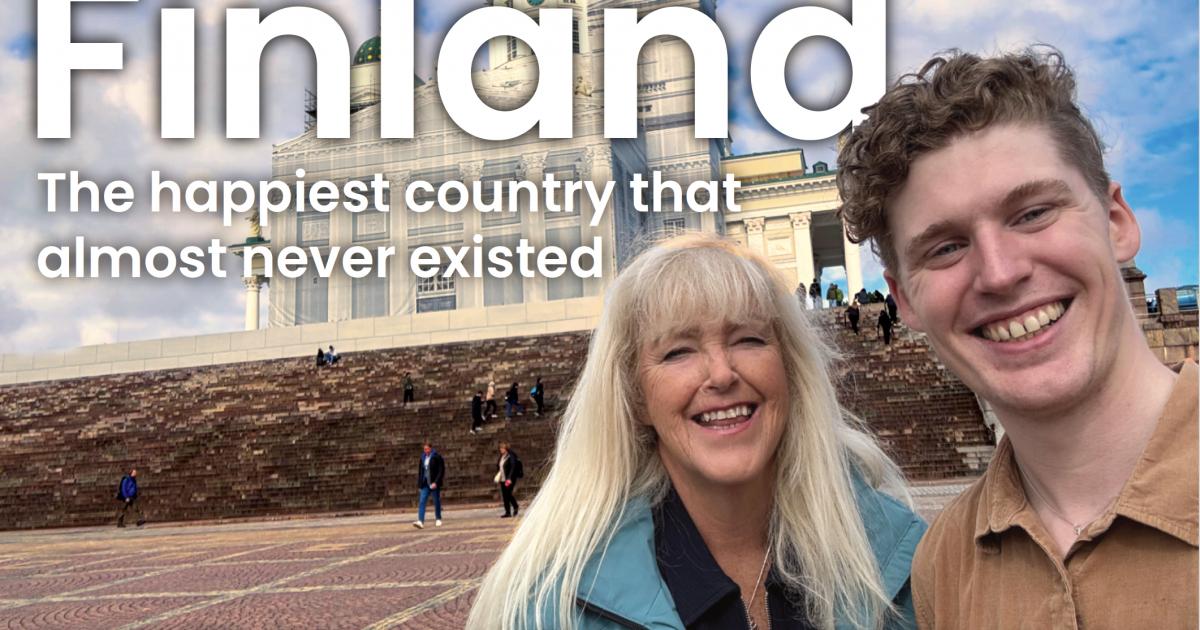
Film exploring what Scotland can learn from Finland premieres ahead of 12-venue run
The film will dive into what life is like in Finland, looking at how Finns remain among the happiest people on the planet despite the country’s turbulent history of famine, war, and occupation, as well as the modern day threat of Russian aggression.
It forms part of a series from Riddoch on Scotland’s “successful, small Nordic neighbours”, with previous entries covering the history of the Faroe Islands, Iceland, Denmark, Estonia, and Norway.
Riddoch said that Finnish culture is all about patiently building up trust, saying that even the wildlife have something to teach Scots (Image: Lesley Riddoch)
She believes that because Finland has roughly the same population as Scotland and “a history that makes our troubled past look like a walk in the park”, there are “huge parallels” between the two nations.
After recent Russian incursions into Scottish waters, Riddoch also argues that Scotland is yet to answer the question of national security and preparedness, and could learn from Finland's civilian readiness.
READ MORE: US coastguard escort seized Russian-flagged oil tanker escorted into Moray Firth
She explained: "It is very different in language, geography, history from the other Nordic countries. The rest [of the Nordic nations] more or less understand one another – Finnish is as different as Gaelic is from English. Finland also has the longest land border with Russia which has shaped its history for hundreds of years till the present day.
"For example, filmmaker Gavin Hanigan hails originally from Inverness and now works at Aalto University in Helsinki and plays in a punk rock band with some very gentle musicians. They nonetheless comprise an army battalion of deadly war skills they've had to learn as conscripts and members of Finland's reserve army.
"I had no idea until I went to film with Gavin in September of last year that there is almost a parallel economy in Finland dedicated to surviving any attack – that means underground swimming pools which must be evacuated within 72 hours to create a bomb shelter.
"It means stockpiles of food, medicine and vitamin D which are constantly checked and replaced. It means almost everyone we interviewed has a military skill of some kind. And it means picturesque little hills in parks most likely contain bomb-proof bunkers.
"Yet there is next to no sense of nervousness, stress or panic. By contrast, the Finns are very relaxed."
Riddoch alongside Hanigan and one of his Finnish friends who is also a trained anti-tank operative in the army reserve, demonstrating the preparedness of the civilian population (Image: Lesley Riddoch)
Riddoch previously told The National: “The current situation with Russia highlights Finland's enduring problem of having to coexist with an occasionally belligerent, acquisitive former colonial power as the nearest neighbour.
“Anyone who has read the history of Finnish resistance during the Second World War will realise that a country with half its population volunteering to join an army that became the only one to ever repel the Red Army, will be no pushover.
“Today Finns live with bunkers in the cellars of their houses and grab-bags ready at the instruction of their government in case of attack. And yet their lives are relaxed, orderly, and chilled.”
READ MORE: Time now to end our reliance on American technology
In a previous crowdfunding campaign for the film, she said: “Finland quietly excels in education – something Scotland was once renowned for. The Finns like the Scots sometimes lack confidence, but their way of life is more equal, digital, cooperative, and relaxed than almost anywhere else on earth.
“Scotland rightly prides itself on having the lowest levels of child poverty in the UK at 22% – the figure in Finland is 3.7%. So, in the dog-eat-dog, adversarial days of Donald Trump, I'd guess the world might want to know more about the happy, equal, educated and slightly awkward Finns.”
The film explores the social foundations of this happiness and equality, focusing on how trust in government and society is built through patience, courage and tough decisions.
As part of her work Riddoch met with Captain Pasi Järvelin, the commanding officer of Finland's LNG-powered icebreaker ship, Polaris (Image: Supplied)
Riddoch, a National columnist, became known for her broadcasting roles on BBC Two, Channel 4, Radio 4, and BBC Radio Scotland, for which she won two Sony speech broadcaster awards. She was also the assistant editor of the Scotsman and has written regularly for The National since it was founded in 2014.
She is also the co-founder and director of the Scottish think tank Nordic Horizons which focuses on bringing Nordic experts to Scotland to advise MSPs, civil servants, businesses and the public.
Her previous film covered the happiness of Danes and the success of Denmark’s social policies and has amassed over two million views since it was uploaded to YouTube last year. The Finnish film will be released to be viewed for free on YouTube in March.
The film will premiere in Carnoustie at the Carn Ustaidh Hub on Tuesday 13, with tickets available for £5. The film will then begin a three-month tour across Scotland with showings in Tayport, Perth, Nairn, Inverness, Glasgow, Musselburgh, Edinburgh, Dundee, Tarland, Greenock, and Stonehaven.
Details about each venue and ticket prices are available on www.lesleyriddoch.com/events