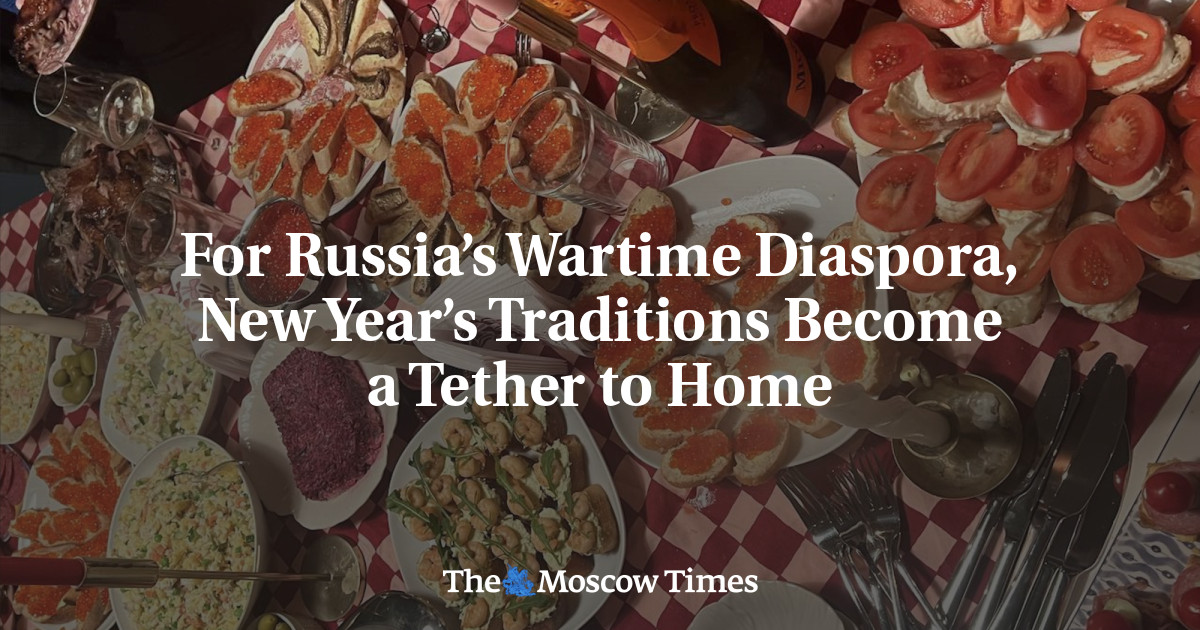
For Russia’s Wartime Diaspora, New Year’s Traditions Become a Tether to Home
Ahead of New Year’s Eve, the biggest holiday in Russia, Sergei, 30, a Russian IT specialist based in Romania, said he would try to watch “The Irony of Fate,” the 1975 romantic comedy that is a New Year’s staple in Russia, in its entirety for the first time.
“It's kind of a weird tradition that came from the U.S.S.R., but there is something cozy about it,” Sergei said.
Sergei is one of the estimated 650,000 Russians who left the country after the full-scale invasion of Ukraine in 2022. Many have not returned to Russia since then, citing fears of prosecution for opposing the war, ruptured family ties or a moral break with a country continuing to wage war on Ukraine.
For these people, the classic Russian New Year’s traditions offer a way to feel connected to home from afar and to share a bit of their culture with their new communities.
The Moscow Times spoke to seven Russian emigres who moved abroad after the invasion of Ukraine about how they celebrated the new year in countries around the world.
What emerged was a picture of a diaspora community that rings in the new year with a mix of nostalgia for their pre-war lives and a desire to adapt to their new homes, all while taking comfort in familiar traditions — with plenty of Olivier salad to go around.
Some of their names and identifying details have been withheld for safety reasons. Interviews have been condensed and edited for clarity.
Manya Koneva, 28, Dubai
“This year, I celebrated Christmas on Dec. 25 for the first time. I’ve made new friends from Europe here in Dubai, and they invited me to Christmas dinner. I can't say that it’s that different from our New Year’s celebrations apart from the date, except that there was no chime on the screen and no address from Putin.
My friends, who are mostly French, had never tried Olivier salad, so it was a matter of honor for me to make a large pot of it. There are some issues with finding doctor's sausage in Dubai because it contains pork. I had to visit a few shops with non-halal food departments to find it. My friends loved the salad. We had the leftovers for breakfast the morning after. It reminded me of home, where my family and I always have Olivier salad for breakfast on the morning of Jan. 1. I think it tastes even better then.
New Year's Eve in Dubai always seems a little surreal: sunny summer weather, sand instead of snow. But anyway, it will always be a reason for me to meet up with friends from Russia, drink champagne and feel at home for a second. And on Jan. 1, I'm going to watch [the Soviet New Year’s film] ‘Ivan Vasilyevich Changes His Profession’ again, just with French subtitles this time.”
Courtesy photo
Sergei, 30, IT specialist, Bucharest, Romania
“Olivier salad is a must for every New Year’s. The combination of Olivier, mandarins and salmon roe is probably the essence of New Year’s for me.Although I'm based in Bucharest now, this year I'm celebrating New Year’s in Serbia with my partner. This year, I still hope to arrange a 'proper' New Year’s Eve, cooking salads and watching ‘The Irony of Fate’ — I've never watched the whole thing. It's kind of a weird tradition that came from the U.S.S.R., but there is something cozy about it. Will I succeed? I’m not sure…
I have to admit that partly after leaving Russia, I started valuing New Year’s more. It feels like a certain level of connection with your culture and your traditions abroad. On the other hand, there is a part of me that can still say ‘Well, we won't die if we skip it and just go to sleep,’ like I thought quite often even back in Russia.”
Anfisa, 29, animator, Paris
"This is my first Christmas and New Year’s in France. For New Year's Eve, we plan to get together with a large group of friends and make Olivier salad. My mother used to make sandwiches for the New Year holidays: baguette, pesto and melted Camembert. I want to make the same ones. These are very French products, but they also remind me of family feasts. There is a Russian shop near my house, and I want to buy some red caviar there to treat my friends.
Most likely, I will watch ‘Home Alone.’ It reminds me more of my childhood and home than Soviet films. I never liked ‘The Irony of Fate.’ At midnight, we'll turn on the chimes, but without Putin. We'll watch Yekaterina Schulmann’s New Year's address.”
Lena, 34, Tbilisi, Georgia
For me, a live Christmas tree is an important tradition. That's how it was always done in my parents' house when I was a child. I thought I would abandon this tradition when I moved from my small town to Moscow, because it's not that easy to drive to a bunch of Christmas tree markets in search of the perfect tree in a big city without a car. But I couldn't break the tradition. The search itself, plus the happiness of finally finding what I was looking for and being able to drag myself and the tree across the city on the bus, frozen stiff, became part of the tradition.
They don't sell my favorite type of tree in Tbilisi. Here, the trees do not have the scent of pine needles that we are used to in Russia. I had to sniff literally every tree at every market to find that very scent, and I paid a hefty sum for it. But as soon as I bring this fragrant living tree into my flat, I immediately feel like I am home. I decorate it with garlands and immerse myself in childhood memories, in a carefree time of wonders; I see my parents' house and feel safe.”
Many Russian emigres tune into Yekaterina Schulmann's address instead of Putin's at midnight on Jan. 1.
Courtesy photo
Dasha, 30, Canada
“This will be my third New Year's Eve in Canada, where I live with my Lebanese husband. For him, and for Canadians in general, New Year's Eve is not the main holiday. Christmas is much more important.
I try to piece together my New Year’s traditions: I make Olivier salad, buy kilos of mandarins and look for red caviar in Russian shops. This helps me to somehow recreate the feeling of a familiar holiday.
This year, my friends and I went to see the Soviet cartoon ‘The Snow Queen.’ Surprisingly, it was shown in a small independent cinema, in Russian with English subtitles. For an immigrant, this is always especially valuable: the opportunity to share a part of your culture with others.
Sometimes, on the contrary, you begin to understand how absurd some things look from the outside. I tried to retell the plot of ‘The Irony of Fate’ to my husband: a group of men get drunk in a banya, put the wrong person on a plane, he bursts into the apartment of a strange woman, who is not particularly opposed, and then she falls in love with him. And this is a movie that the whole country watches every year at New Year’s.”
Yekaterina, 29, Valencia, Spain
“I don't feel the New Year’s atmosphere in southern Spain. For me, the presence of a palm tree next to a Christmas tree creates a strong sense of dissonance. This is my second time celebrating New Year’s here. Salads, sparkling wine and watching musicals from the 2000s are a must. They do add to the mood, at least.
This year, we are celebrating with a small Russian-speaking group and have invited friends from other countries. Salads are the main tradition — herring in a fur coat, Olivier. Only on New Year's Eve can I let myself eat so much mayonnaise. I haven't really embraced Spanish traditions yet, especially since they don't have many New Year's traditions.
I can't say that I really miss the New Year celebrations I used to have. But I do miss the times when I was little and celebrated with my parents. Everyone was healthy, full of energy, I had lots of presents and no worries. My favorite year, 2005, was about to begin, and tomorrow, on Jan. 1, we would go to the Christmas tree and I would ride a pony. And then I would watch cartoons like ‘Shrek,’ ‘Ice Age’ and all the New Year's musicals until Jan. 7. Everything was different back then. Maybe it was because I didn't have to think about anything, or maybe things really were better. Who knows?”
Courtesy photo
Kirill, Berlin“My girlfriend and I left Russia about a month after the war started, right after I served 15 days in a detention center near St. Petersburg for participating in an anti-war protest.
My feelings about celebrating New Year's abroad are mixed. On the one hand, there is always a sense of adventure, because every year is different. On the other hand, it is difficult for me to accept that I am no longer celebrating the arrival of midnight at the same time as my family and friends.
The easiest way is to preserve your Russian identity and celebrate in the traditional Russian style. To do this, we usually buy all the same products that we would buy in Russia, but it takes a little longer and is a little more complicated to organize. In any case, even if we don't watch Russian television, we watch old Soviet films, because that is also a tradition. We will definitely watch some kind of address, maybe even Zelensky's address instead of Putin's.
In general, if all these conditions are met, it is possible to recreate the atmosphere of Russian New Year’s and not feel so isolated. Yet there are small nuances that cannot be overcome, like time zones, political differences, slightly different tastes in food and separation from friends, that remind you that you are actually away from home.
At the same time, I’m willing to put up with the inconveniences of celebrating New Year's abroad if it means I don’t have to return to Russia. In Russia, it is now common on television to talk about how our boys, our soldiers, are on the front lines, and we should feel unity with them. I do not want to feel this unity at all. I don’t see them as fellow citizens, and I am completely uninterested in how they celebrate New Year's. On the contrary, I want to feel as much distance from them as possible.”
A Message from The Moscow Times:
Dear readers,
We are facing unprecedented challenges. Russia's Prosecutor General's Office has designated The Moscow Times as an "undesirable" organization, criminalizing our work and putting our staff at risk of prosecution. This follows our earlier unjust labeling as a "foreign agent."
These actions are direct attempts to silence independent journalism in Russia. The authorities claim our work "discredits the decisions of the Russian leadership." We see things differently: we strive to provide accurate, unbiased reporting on Russia.
We, the journalists of The Moscow Times, refuse to be silenced. But to continue our work, we need your help.
Your support, no matter how small, makes a world of difference. If you can, please support us monthly starting from just $2. It's quick to set up, and every contribution makes a significant impact.
By supporting The Moscow Times, you're defending open, independent journalism in the face of repression. Thank you for standing with us.
Not ready to support today? Remind me later.
×
Remind me next month
Thank you! Your reminder is set.
We will send you one reminder email a month from now. For details on the personal data we collect and how it is used, please see our Privacy Policy.