Russian Military Reveals More Details of Alleged Drone Attack on Putin’s Residence
Russia’s Defense Ministry on Wednesday provided its first detailed account of an alleged Ukrainian drone attack on President Vladimir Putin’s Valdai residence, saying that more than half of the drones involved were destroyed hundreds of kilometers from the estate.
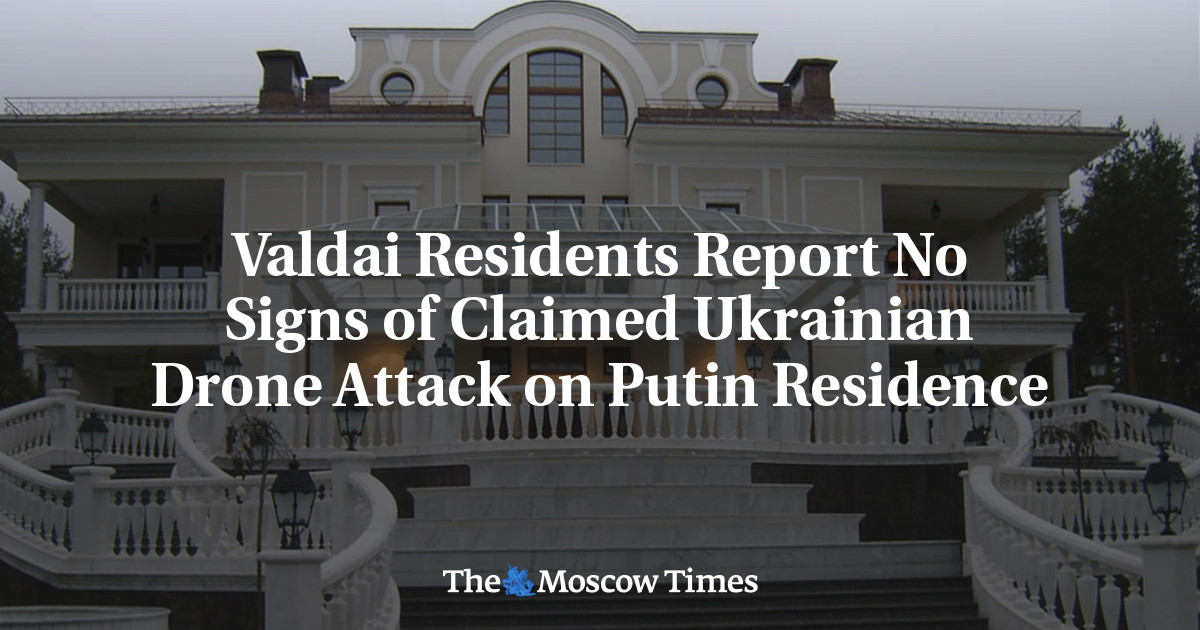
Authorities in Moscow claim that Ukraine launched a large-scale drone operation targeting Putin’s home in the northwestern Novgorod region between Sunday night and Monday morning. Ukraine has dismissed the accusations as an attempt to disrupt U.S.-brokered talks to end the war.
Russia’s allegations appeared unusual in both their timing and presentation. Initial details of the attack were released not by the Defense Ministry or regional authorities, who typically report on Ukrainian drone strikes, but by Foreign Minister Sergei Lavrov, who delivered what resembled a military briefing while Putin was speaking by phone with U.S. President Donald Trump on Monday.
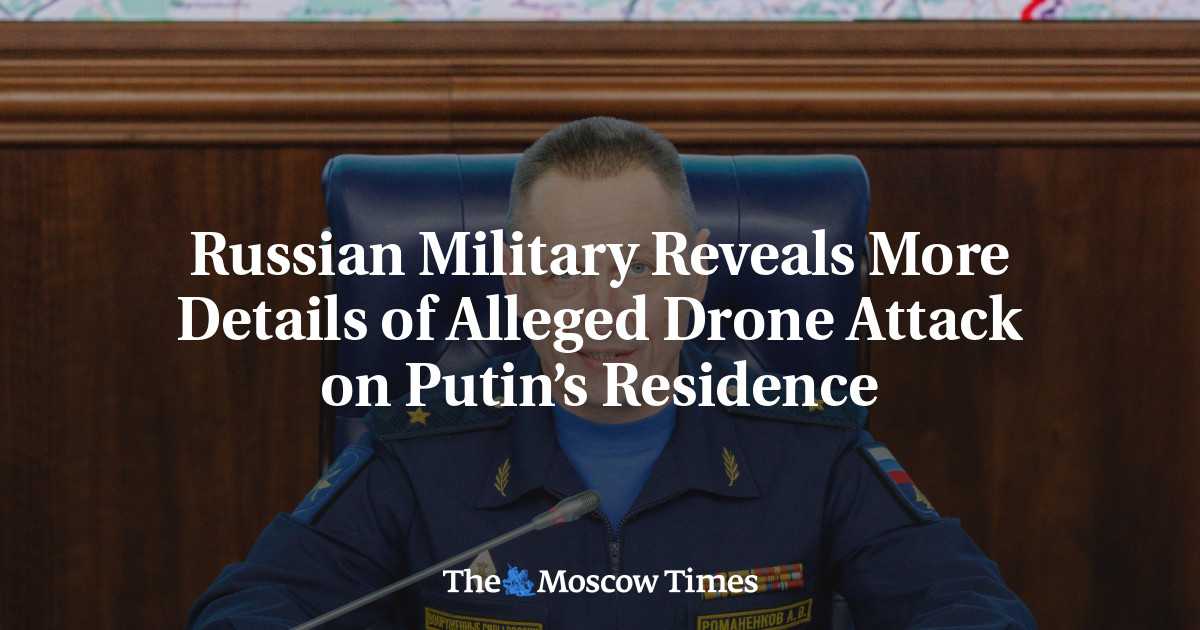
On Wednesday, Major General Alexander Romanenkov, who heads the Russian Aerospace Forces’ air defense missile troops, said Ukraine carried out the drone assault “along several routes toward the Russian president’s residence, passing over the Bryansk, Smolensk, Tver and Novgorod regions.”
According to Romanenkov, 50 of 91 drones used in the attack were intercepted over the Bryansk and Smolensk regions, both of which are located hundreds of kilometers from Putin’s residence and regularly face drone strikes from Ukraine.
A map shown during Romanenkov’s briefing at a Defense Ministry gathering indicated that the center of the intercepts in Bryansk and Smolensk was roughly 520 kilometers (323 miles) south of Valdai.
Romanenkov, who did not explain how the military determined that those 50 Ukrainian drones were en route to Valdai, said another 41 unmanned aircraft were shot down in the Novgorod region. The Defense Ministry previously reported downing only 18 Ukrainian drones in the region between Sunday and Monday.
“The configuration of the attack, the number of aerial assault assets involved… clearly indicate that the terrorist attack by the Kyiv regime was deliberate, carefully planned and conducted in a layered manner,” Romanenkov said.
Alongside the general’s statement, the Defense Ministry released a video that it said showed a downed Ukrainian drone in a snowy forest at night, claiming it was one among the dozens used in the attack on Valdai. The footage did not include details allowing independent verification of when or where it was recorded.
The military also released a video testimony from a man it identified as Igor Bolshakov, described as a Valdai resident, who claimed he heard explosions at the time of the alleged attack on Putin’s residence.
The Moscow Times was able to find a profile belonging to Bolshakov on the social media website VKontakte, where his location was listed as Valdai. However, it was not immediately possible to verify his account, which contradicts reports by independent Russian media citing more than a dozen local residents who said they heard nothing between Sunday night and Monday morning.
The Defense Ministry briefing, which raised more questions than it answered, is unlikely to dispel accusations from Ukrainian officials that Russia’s claim of an attack on Putin’s residence was fabricated and possibly an attempt to drive a wedge between the Trump administration and Kyiv at a critical moment for peace talks.
Trump, who met with Ukrainian President Volodymyr Zelensky in Florida this weekend to discuss a 20-point peace plan, told reporters Monday that he was “very angry” about the incident.
Zelensky, meanwhile, said Ukraine’s negotiating team discussed the allegations with U.S. officials. “Our partners can verify whether this was fabricated, given their technical capabilities,” he said.
U.S. Ambassador to NATO Matthew Whitaker said Tuesday that Western intelligence agencies were in the process of examining the Russian claims, indicating that officials were not yet ready to take them at face value, as Trump appears to have done.
“It is unclear whether it actually happened,” Whitaker said in an interview with Fox News. “Ukraine is receiving drones and missiles every night in its capital city, and all it can do is defend itself.”
If confirmed, the incident would not be the first time Ukrainian drones have reached areas where Putin lives. In May 2023, two drones struck the roof of the Kremlin, which Russian authorities described as an attempted assassination on the president.
At the same time, Zelensky previously said that Russia has made multiple unsuccessful attempts to assassinate him since the launch of the full-scale invasion of Ukraine in February 2022.