Here's Why A Simple Fresnel Lens Makes Traffic Lights Safer
The most important thing to know about Fresnel lenses, before casually attempting to drop them into conversation, has to do with phonetics: "Fresnel" is pronounced "Fruh-NEL." If the silent "S" makes you suspect Fresnel lenses have French origins, you're correct. It's also true that the science behind why Fresnel lenses make traffic lights safer today — their ability to focus light — made them maritime miracles when they debuted in early-19th-century lighthouses.
They're everywhere, yet we basically know nothing about traffic lights, or why a basic glowing green orb without a Fresnel lens might not cut it. Having light, and being able to see it well, are not quite the same thing. This was of concern in 1811 France, where the lamps and thick glass used in then-modern lighthouses offered limited light projection, and shipwrecks were still vexing people centuries after the lighthouse came to be. The French Commission on Lighthouses put together a committee to improve illumination, which physicist Augustin-Jean Fresnel joined.
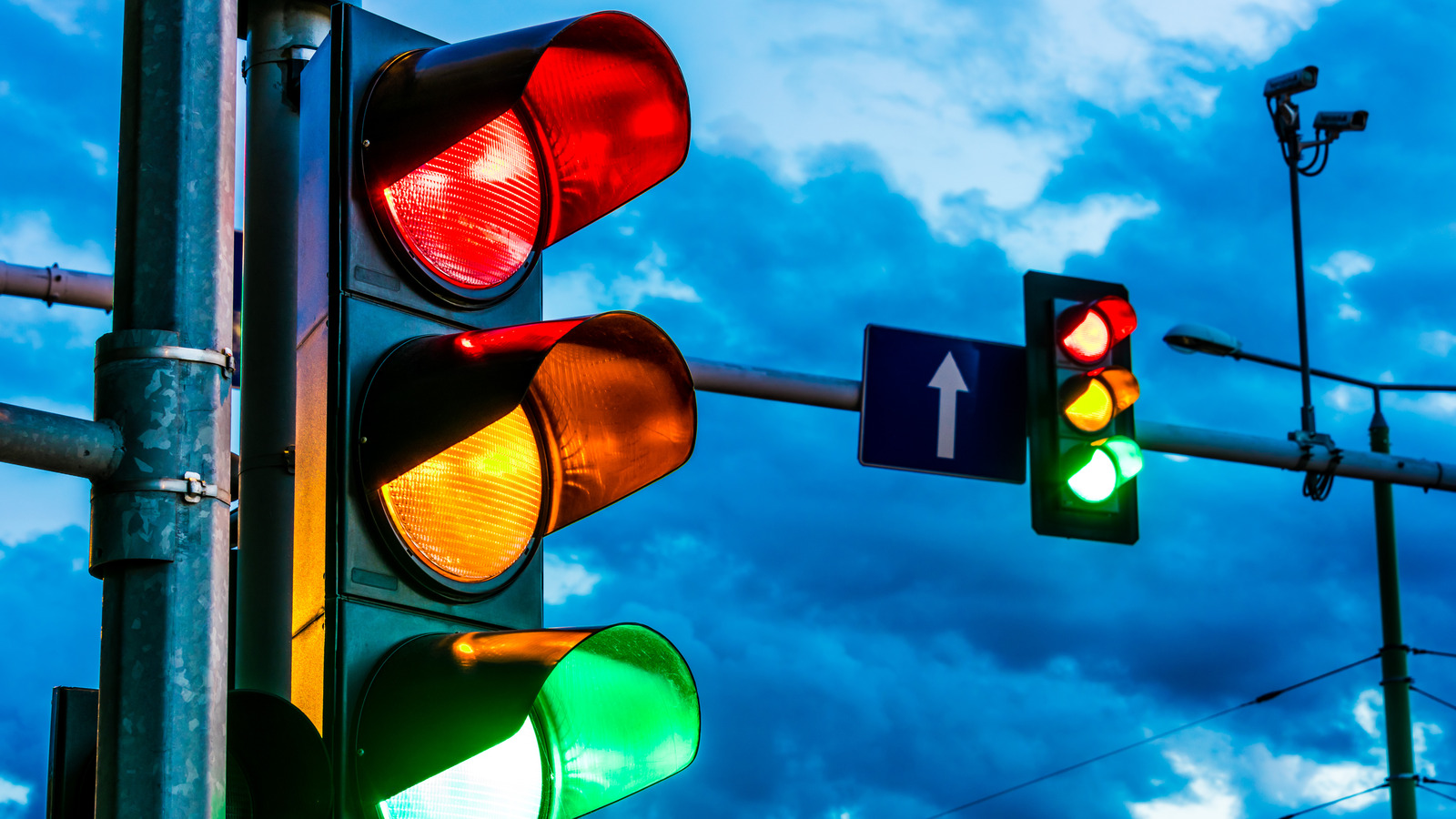
Out of this skunkworks in 1822 sprang his Fresnel lens. Featuring stacked, prismatic, concentric glass rings, and a bull's-eye lens at center, the Fresnel lens array turned scattered lamplight into a narrow beam that could be visible for miles. This technology continues to prove itself in millions of traffic signals around the world, directing powerful light toward certain lanes day and night so drivers know where — and when— to safely proceed.
Like miniature lighthouses, traffic lights contain a reflector, bulb — or array of LEDs — and lens, and have to operate in a variety of conditions, 24 hours a day. In Fresnel's original lighthouse design, rotating a series of panels around the lamp sent beams in several directions at once, while different shapes and cuts of glass created different patterns, or shielded the beam altogether.
Traffic lights don't have to rotate, but sending the right beam in the right direction is critical. When you're driving in bright sunlight or dense fog, you need to see traffic lights from afar, and know clearly which color is illuminated. At night, or while waiting for a designated turn signal, you can't afford to mistake the green glow — or blue, if you're dealing with traffic lights in Japan — from other lanes as your cue to accelerate. And when you're a pedestrian or cyclist, traffic signals also have to function from your particular perspective.
Fresnel lenses work in all these circumstances, allowing uniform light to be cast at different angles, visible from different distances. Signal visors also help shield or direct light where it's intended. In addition to glass, Fresnel lenses are now made from a variety of materials, such as acrylic plastic. And fortunately, modern electric signal lights don't tend to explode, as the world's first traffic lights did on the streets of London due to their gas-powered lamps.
Intersections. Toll plazas. Parking garages. Railroad crossings. Fresnel lenses, credited with saving countless ships, are now found in traffic lights all over the planet, still doing their part to help make the world a safer place to navigate.