Dead dreams of the emperors
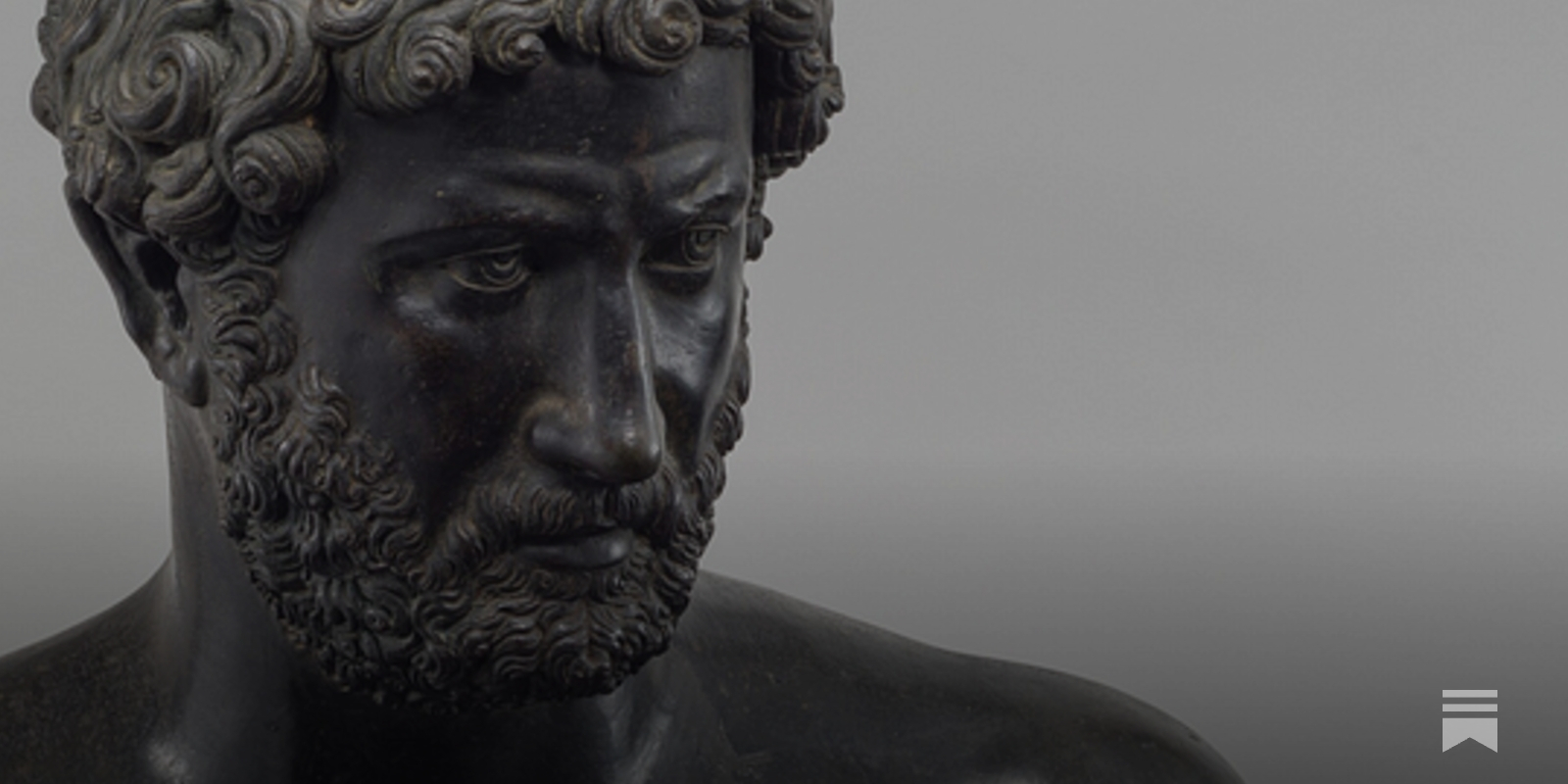
“The Emperor Hadrian,” Ludovico Lombardo, c. 1550 (National Gallery of Art)One of the oldest desires in philosophy was Plato’s fantasy of a philosopher-king.Oh well. A few weeks ago, you may remember novelist Joyce Carol Oates asking why one of our modern masters of the universe, Elon Musk, who wants to spread “the light of human consciousness” to Mars, seems empty as the void between planets:Joyce Carol Oates (x.com)Some of the chasms in Elon Musk’s life got spelunked in Walter Isaacson’s decently reported but disappointingly conflict-avoidant biography. Musk has read books in the past (“Hitchhiker’s Guide to the Galaxy” is a favorite, if I recall) and projects a fondness for the Classical world, but where’s the rest? He seems a few fractions short of a whole man, like if they only built Ozymandias’ desert statue up to the boots. Musk’s most dramatic miseries aren’t commercial or gravitational but personal: the rift with his awful father Errol, his impulse to be funny without making people laugh, the ominous manic episodes that loved ones call “demon mode,” the addictions to politics and posting at the expense of his industriousness, the endless kids with whichever woman but only boys, the haunting estrangement from his trans daughter. Here is someone who wants to change the universe but I’m convinced can’t change himself. Maybe that’s what the ketamine is for.The stranger character is Donald Trump, our developer-king. I wonder what he dreams about at night. The rest is public domain. One of the luckiest people ever, in every sense of that word, who, unlike Musk, seems to enjoy life, with its Pavarottis and Andrew Lloyd Webbers — so how come this president never gets less angry? He spends the days remaking the world in his likeness, gifted like one of the X-Men with an amazing power to transmute desire into concrete reality: He wishes the Kennedy Center were named after him and simply makes it so. Trump’s psyche is the only permanent structure in his vicinity. He talks shit like he’s going to live forever. A year ago an assassin almost blew his brains out, and this 79-year-old seems no more circumspect about death than if he were still in his twenties. President Trump’s post about the slayings of Rob and Michele Reiner. (Truth Social)Their alliances with the religious right can obscure how much Musk and Trump are practically Roman in their imperial godlessness, building and ruling as if to keep the everlasting grave at bay. The dramatic contradictions within the lives of great materialists have their literary attractions, much how the existentialism of the pagan ancient world intoxicated writers such as Flaubert:The melancholy of the olden time seems to me more profound than that of our day, which implies, more or less, the idea of immortality beyond the grave. But to the ancients the grave was infinity; their dreams were conceived and enacted against a black and unchangeable background. No cries, no convulsions, nothing but the fixity of a thoughtful visage! The gods no longer existed, and the Christ had not yet come; and the ancients, from Cicero to Marcus Aurelius, lived at a unique epoch when man alone was all-powerful.Flaubert’s 1861 letter inspired a young Marguerite Yourcenar (1903-1987) to write an existential historical novel from the perspective of a Roman emperor. “Memoirs of Hadrian,” told in the form of correspondence to the future emperor Marcus Aurelius, is one of the most ambitious books I’ve read, practically the work of a fanatic. Its bibliography is incredible. “The facts of my father’s life are less known to me than those of the life of Hadrian,” Yourcenar wrote later. “The rules of the game: learn everything, read everything, inquire into everything, while at the same time adapting to one’s ends the Spiritual Exercises of Ignatius of Loyola, or the method of Hindu ascetics, who for years, and to the point of exhaustion, try to visualize ever more exactly the images which they create beneath their closed eyelids.” Marguerite Yourcenar’s “Memoirs of Hadrian.”Interrupted by World War II, Yourcenar scoured the historical record across multiple languages for the facts necessary to reanimate Hadrian from the dead. “It did not take me long to realize that I had embarked upon the life of a very great man,” she wrote. “From that time on, still more respect for truth, closer attention, and, on my part, ever more silence.” The novelist exhorted herself: “Keep one’s own shadow out of the picture; leave the mirror clean of the mist of one’s own breath.” Yourcenar’s historical Hadrian is a conscientious warrior who hates war, who wants to see and inhabit the full breadth of the world he inherits, who loves poetry and climbs volcanoes to be first Roman to see the day’s sunrise, who falls tragically in love with the young Antinous. The norms of Roman culture might as well be alien to us today (there’s the matter of Antinous’ age when they meet, for one thing), but the echoes of history meant “Memoirs of Hadrian,” published in 1951, would be told as what we might now call a queer love story.“Marble portrait head of Antinoos,” Roman, c. ca. 130–138 CE (The Metropolitan Museum of Art)What’s so epically tragic about the book was that Hadrian yearned to rule well and mostly got to. “I fell to making, then re-making, this portrait of a man who was almost wise,” recalled Yourcenar. Gazing back to Hadrian’s time across the ashes of Hitler’s Europe, she concluded of her subject that “if this man had not maintained peace in the world, and revived the economy of the empire, his personal fortunes and misfortunes would have moved me less.” In Hadrian’s voice:I wanted the cities to be splendid, spacious and airy, their streets sprayed with clean water, their inhabitants all human beings whose bodies were neither degraded by marks of misery and servitude nor bloated by vulgar riches; I desired that the school boys should recite correctly some useful lessons; that the women presiding in their households should move with maternal dignity, expressing both vigor and calm; that the gymnasiums should be used by youths not unversed in arts and in sports; that the orchards should bear the finest fruits and the fields the richest harvests. I desired that the might and majesty of the Roman Peace should extend to all, insensibly present like the music of the revolving skies; that the most humble traveller might wander from one country, or one continent, to another without vexatious formalities, and without danger, assured everywhere of a minimum of legal protection and culture; that our soldiers should continue their eternal pyrrhic dance on the frontiers; that everything should go smoothly, whether workshops or temples; that the sea should be furrowed by brave ships, and the roads resounding to frequent carriages; that, in a world well ordered, the philosophers should have their place, and the dancers also. This ideal, modest on the whole, would be often enough approached if men would devote to it one part of the energy which they expend on stupid or cruel activities; great good fortune has allowed me a partial realization of my aims during the last quarter of a century.Then Hadrian got old. His torrid love with Antinous ended, as every torrid love must. The young lover was deified, his likeness crafted into sculpture, impressed onto imperial coinage, and passed down through the ages.“Antinous, died A.D. 130, Favorite of the Emperor Hadrian,” Giovanni da Cavino, mid 16th century (National Gallery of Art)Not all of the peacemaker’s rule was peaceful. Especially relevant to current events was Hadrian the butcher’s bloody annihilation of the Bar Kokhba revolt, and the expulsion of the Jews from Judea, what we would call in today’s terms ethnic cleansing or genocide. Like his predecessor Trajan, in the end Hadrian awaited death surrounded by supplicants but ultimately alone, reflecting that even in his greatest achievements “perhaps I had offered only one more object as prey to Time the Devourer.” The glory of Rome would fade after Hadrian. Every empire, like every emperor, dies in the end.If our time is as godless as Flaubert’s antiquity, I wouldn’t say it feels melancholy. It mostly feels busy, as life does when you’re in the middle of it. Stories have to end before you can call them epic. In the present tense, it’s just journalism. But Yourcenar cautions: “On the whole, however, it is only out of pride or gross ignorance, or cowardice, that we refuse to see in the present the lineaments of times to come. … Both Plutarch and Marcus Aurelius knew full well that gods, and civilizations, pass and die. We are not the first to look upon an inexorable future.” Memento mori.