U.S. says it has seized yet another oil tanker near Venezuela's coast
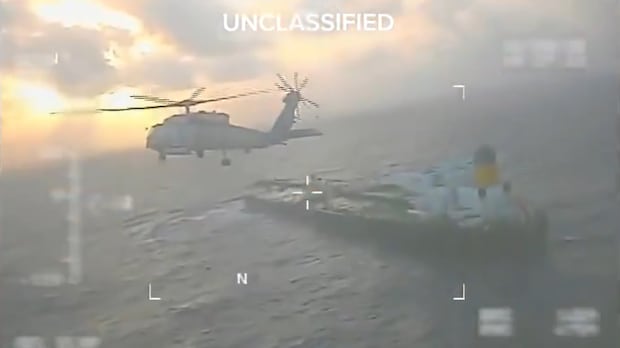
Listen to this articleEstimated 5 minutesThe audio version of this article is generated by AI-based technology. Mispronunciations can occur. We are working with our partners to continually review and improve the results.The United States has seized an oil tanker off the coast of Venezuela in international waters, U.S. Homeland Security Secretary Kristi Noem confirmed Saturday, a move that comes just days after U.S. President Donald Trump announced a "blockade" of all sanctioned oil tankers entering and leaving Venezuela.This would mark the second time in recent weeks that the U.S. has seized a tanker near Venezuela and comes amid a large U.S. military buildup in the region.Noem confirmed that the U.S. Coast Guard seized a tanker that was last docked in Venezuela."The United States will continue to pursue the illicit movement of sanctioned oil that is used to fund narco terrorism in the region," she said in a statement posted to social media. "We will find you, and we will stop you."The coast guard and Pentagon referred questions to the White House, which did not immediately respond to a request for comment. Venezuela's oil ministry and state oil company PDVSA did not immediately reply to requests for comment.British maritime risk management company Vanguard said the vessel was believed to be the Panama-flagged Centuries, which was intercepted east of Barbados in the Caribbean Sea.Jeremy Paner, a partner at Washington, D.C., law firm Hughes Hubbard & Reed LLP and a former investigator with the U.S. Office of Foreign Assets Control, said the vessel has not been sanctioned by the U.S."The seizure of a vessel that is not sanctioned by the U.S. marks a further increase in Trump's pressure on Venezuela," Paner said."It also runs counter to Trump's statement that the U.S. would impose a blockade of all sanctioned oil tankers."Trump on Tuesday said he was ordering "A TOTAL AND COMPLETE BLOCKADE OF ALL SANCTIONED OIL TANKERS going into, and out of, Venezuela."In the days since U.S. forces seized a sanctioned oil tanker off the coast of Venezuela last week, there has been an effective embargo in place — with loaded vessels carrying millions of barrels of oil staying in Venezuelan waters rather than risk seizure.Since the first seizure, Venezuelan crude exports have fallen sharply.WATCH | Venezuela denounces U.S. oil tanker seizure as 'piracy':Venezuela's government says the U.S. seizure of an oil tanker off the coast of Venezuela 'constitutes a blatant theft and an act of international piracy.' U.S. Attorney General Pam Bondi says the FBI, the Department of Homeland Security and the U.S. Coast Guard carried out a seizure warrant for the tanker, alleging it was transporting sanctioned oil from Venezuela and Iran.While many vessels picking up oil in Venezuela are under sanctions, others transporting the country's oil and crude from Iran and Russia have not been sanctioned — and some companies, particularly U.S. energy corporation Chevron, transport Venezuelan oil in their own authorized ships.China is the biggest buyer of Venezuelan crude, which accounts for roughly four per cent of its imports, with shipments in December on track to average more than 600,000 barrels per day, analysts have said.For now, the oil market is well supplied, and there are millions of barrels of oil on tankers off the coast of China waiting to offload. If the embargo stays in place for some time, the loss of nearly a million barrels a day of crude supply is likely to push oil prices higher.WATCH | Why a U.S. ground invasion of Venezuela would be a disaster:Tensions between the United States and Venezuela are escalating as the U.S. continues to strike alleged Venezuelan drug-trafficking boats and signals the possibility of a ground invasion. Andrew Chang breaks down the geographical, logistical and political challenges involved in ratcheting up the conflict to this level.
Images provided by The Canadian Press, Reuters and Getty ImagesSince the U.S. imposed energy sanctions on Venezuela in 2019, traders and refiners buying Venezuelan oil have resorted to a "shadow fleet" of tankers that disguise their location and to vessels sanctioned for transporting Iranian or Russian oil.The dark or shadow fleet is considered exposed to possible punitive measures from the U.S., shipping analysts have said. Centuries, which loaded in Venezuela under the false name "Crag" and is part of the dark fleet, was carrying some 1.8 million barrels of Venezuelan Merey crude oil bound for China, according to internal documents from state oil company PDVSA, the oil's seller.The vessel departed Venezuelan waters on Wednesday after being briefly escorted by the Venezuelan navy, according to company sources and satellite images obtained by TankerTrackers.com.The crude was bought by Satau Tijana Oil Trading, one of many intermediaries involved in PDVSA's sales to Chinese independent refiners, the documents showed.WATCH | Maduro warns Trump against 'endless war' with Venezuela:Venezuela's President Nicolás Maduro is calling for the U.S. to make peace after U.S. President Donald Trump dramatically upped the ante with its military presence in the Caribbean. As of this week, of more than 70 oil tankers in Venezuelan waters that are part of the shadow fleet, about 38 are under sanctions by the U.S. Treasury, according to data from TankerTrackers.com. Of those, at least 15 are loaded with crude and fuel, it said.Trump's pressure campaign on Venezuelan President Nicolás Maduro has included a ramped-up military presence in the region and more than two dozen military strikes on vessels in the Pacific Ocean and Caribbean Sea near Venezuela that have killed at least 100 people.Trump has also said that U.S. land strikes on the South American country will soon start.Maduro has alleged that the U.S. military buildup is aimed at overthrowing him and gaining control of the OPEC nation's oil resources, which are the world's largest crude reserves.