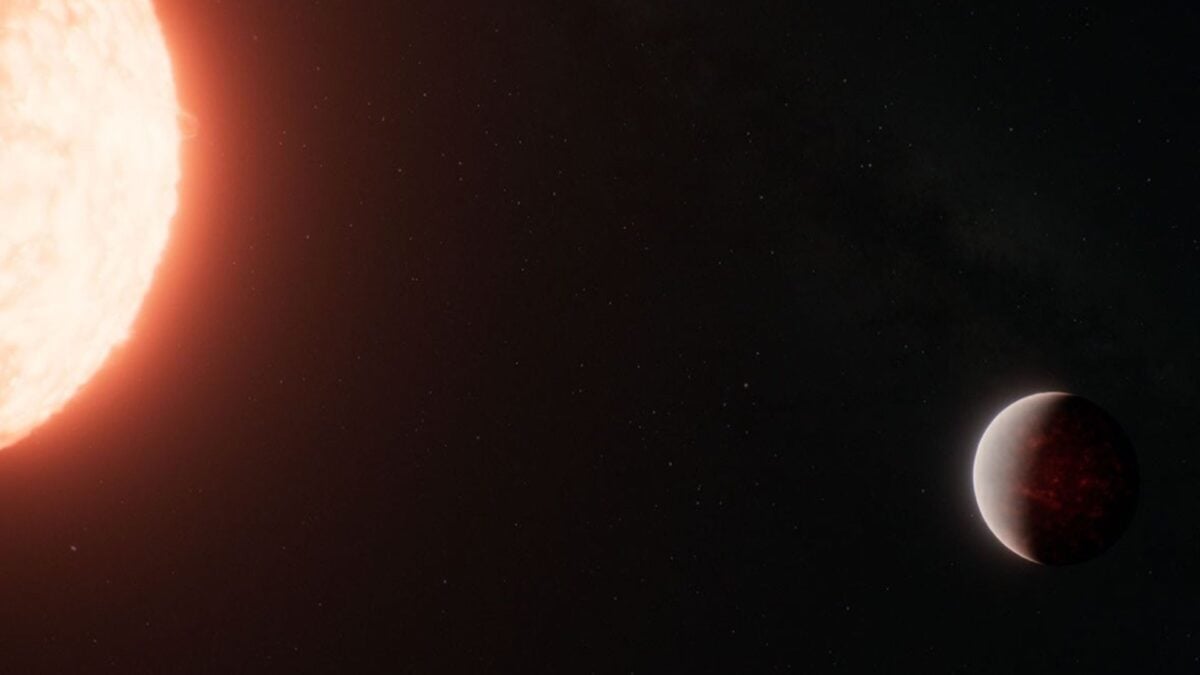
This ‘Wet Lava Ball’ in Space Somehow Clings to an Atmosphere
Scientists have discovered the strongest evidence yet of a rocky planet with an atmosphere outside the solar system, challenging previous notions that small planets that orbit closely to their stars are unable to sustain a thick blanket of gases. TOI-561 b orbits a 10-billion-year-old star located about 280 light-years from Earth and has a vast magma ocean. Using NASA’s Webb Space Telescope, a team of researchers probed the ultra-hot super-Earth exoplanet and found evidence suggesting it’s surrounded by a thick atmosphere. The new findings explain the planet’s unusually low density and help scientists better understand rocky worlds beyond the reaches of our own solar system.
The peculiar world was first discovered in 2020 and is the innermost of at least three planets orbiting an ancient G-type star. Although its star is slightly smaller and cooler than our Sun, TOI-561 b orbits so closely to the host star (less than one million miles) that it is likely tidally locked. As it completes an orbit in 11 hours, one side of the planet is permanently facing its star.
“What really sets this planet apart is its anomalously low density,” Johanna Teske, staff scientist at Carnegie Science Earth and Planets Laboratory and lead author of a paper published in The Astrophysical Journal Letters, said in a statement. “It’s not a super-puff, but it is less dense than you would expect if it had an Earth-like composition.”
Its close proximity to its host star would result in scorching temperatures, too hot to sustain an atmosphere. The radiation from the star would cause the gases of the atmosphere to escape to space. The planet’s low density, however, suggests that it’s not purely a rocky world.
The team of scientists behind the new study set out to understand whether TOI-561 b is just bare rock or lava, or if there’s something else at play. The scientists used Webb’s NIRSpec (Near-Infrared Spectrograph) to measure the planet’s dayside temperature (the side of the planet that’s facing its star) based on its near-infrared brightness. If TOI-561 b has no atmosphere to carry heat from its dayside to its nightside, then temperatures on the planet’s star-facing side should be approaching 4,900 degrees Fahrenheit (2,700 degrees Celsius). Webb’s observations told a different story, however, revealing that the planet’s dayside appears to be closer to 3,200 degrees Fahrenheit (1,800 degrees Celsius). That’s still pretty hot, but not nearly enough to account for a lack of atmosphere.
The team explored other explanations, but none of them fared quite as well. Without an atmosphere, the planet’s nightside would probably be solid, preventing heat transfer from the dayside. The planet’s magma ocean could also play a part if it were to have a thin layer of rock vapor on its surface, but its cooling effect would be minimal. “We really need a thick volatile-rich atmosphere to explain all the observations,” Anjali Piette, a researcher at the University of Birmingham, United Kingdom, and co-author of the study, said in a statement. Although the presence of an atmosphere on TOI-561 b may be the only viable explanation, it still poses a mystery of how such a small planet exposed to copious amounts of radiation from its host star could hold onto a thick blanket of gases. The researchers believe the answer may lie within the planet’s magma ocean.
“We think there is an equilibrium between the magma ocean and the atmosphere,” Tim Lichtenberg, a researcher at the University of Groningen in the Netherlands and co-author of the study, said in a statement. “At the same time that gases are coming out of the planet to feed the atmosphere, the magma ocean is sucking them back into the interior.” “This planet must be much, much more volatile-rich than Earth to explain the observations,” he added. “It’s really like a wet lava ball.”