At least 12 Palestinians dead or missing in Gaza as devastation from floods spreads
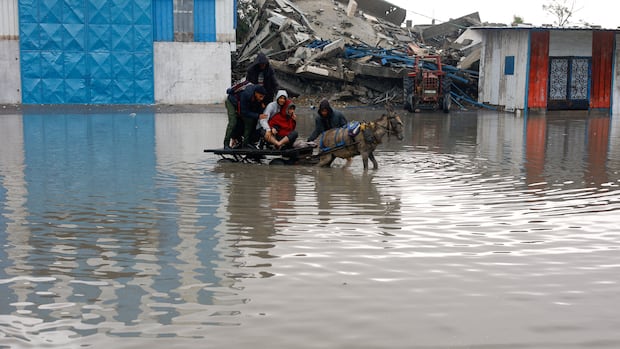
Listen to this articleEstimated 4 minutesThe audio version of this article is generated by AI-based technology. Mispronunciations can occur. We are working with our partners to continually review and improve the results.Hundreds of thousands of displaced Gazans face flooding from heavy rains, and materials for shelters and sandbags are not being allowed to enter the enclave, the UN International Organization for Migration said on Friday.Torrential rain swept across the Gaza Strip on Thursday, flooding tents sheltering families displaced by two years of war, and leading to the death of a baby girl due to exposure, local health officials said.A total of 12 people are dead or missing as a result of storm Byron, with at least 13 buildings having collapsed and 27,000 tents flooded, the media office of the Hamas-run Gaza government said.Nearly 795,000 displaced people are at heightened risk of potentially dangerous flooding in low-lying, rubble-filled areas where families are living in unsafe shelters, the IOM said. Insufficient drainage and waste management also heightened the risk of disease outbreak, the UN agency added.Materials to help reinforce shelters, such as timber and plywood, as well as sandbags and water pumps to help with flooding have been delayed from entering Gaza due to access restrictions, the IOM said.WATCH | 8-month-old dies after exposure amid torrential rain in territory, according to medics:Local health officials say a baby girl died from exposure as torrential rain swept through the Gaza Strip, flooding tens sheltering displaced families. Damage to equipment and fuel shortages have officials saying they can’t cope with the storm.Israel says it is meeting its obligations and accuses agencies of inefficiency and failing to prevent theft by Hamas, which the group denies. COGAT, the Israeli military arm that oversees humanitarian matters, was not immediately available for comment.In a displaced camp in Nuseirat, central Gaza, ankle-deep water had pooled around the tents, soaking mattresses, shoes and clothes. Working with a bucket, 50-year-old Youssef Tawtah was trying to bail the water out but it had nowhere to go and he appeared to make little progress."All night long the children and I were on our feet," he said. "How can the children handle it?"As his family gathered around a small open fire on a sandy bank near the tent, he hauled a sopping mattress through the floodwaters. Even cooking a meal will be difficult. "Our food is ruined," he said.Bahjat Dardouna, 50, says the tent where his son's family was sheltering in collapsed on them overnight. "If it weren’t for the neighbours who saved them, they would’ve been dead now," Dardouna told CBC News on Friday in Gaza City. "Everything is destroyed, nothing is left. We lost everything. The only thing we have left are the clothes we are wearing now," he said.Palestinians search for victims in a destroyed house that collapsed amid heavy rains Friday in northern Gaza's Beit Lahiya. (Mahmoud Issa/Reuters)Supplies already dispatched to Gaza, including waterproof tents, thermal blankets and tarpaulins, were not able to withstand the flooding, the IOM added."After this storm made landfall yesterday, families are trying to protect their children with whatever they have," IOM director general Amy Pope said.A ceasefire agreement was signed on Oct. 10 and while the truce has largely held, Israeli airstrikes on Gaza have continued since, with at least 383 people killed. Israel says three of its soldiers have been killed during that time.The war has destroyed much of Gaza’s infrastructure, resulting in dire living conditions. UN and Palestinian officials said at least 300,000 new tents are urgently needed for the roughly 1.5 million people still displaced.The World Health Organization (WHO) said more than 4,000 people were living in what it described as high-risk areas on the coast, with 1,000 people directly affected by high waves from the sea.It warned of health risks from pollution. "Thousands of families are sheltering in these low-lying and debris-filled coastal areas with no drainage or protective barriers, with heaps of garbage everywhere along the roads," said WHO representative Rik Peeperkorn.