The nightmare water disaster in a Kent town that could be coming to you
The fact that a British town in 2025 could go without guaranteed clean water for approaching two weeks raises urgent questions about the state of our infrastructure
Royal Tunbridge Wells – the Kent town which has become synonymous with middle-class affluence – has not had certifiably clean, running water for 11 days now.
And for five days from the evening of 29 November, there was no water at all.
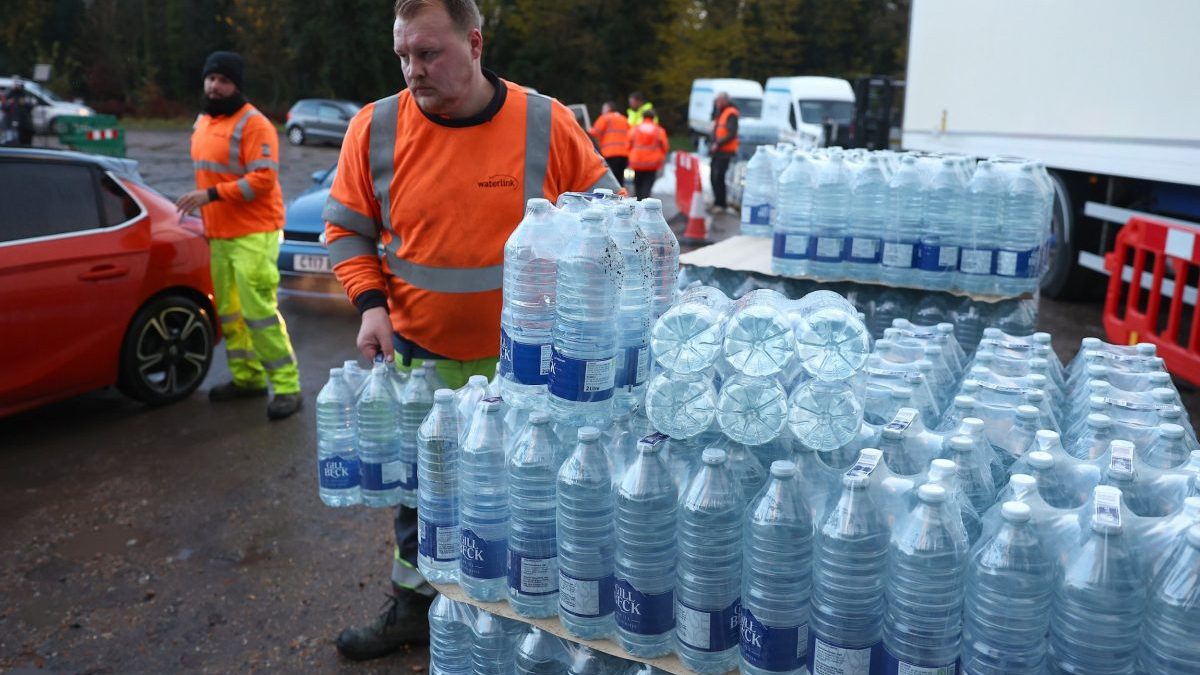
Increasingly frazzled residents relied on bottled mineral water for everything from washing the dishes to hydrating pets. Queuing for bottles at distribution centres became a part of daily life.
On one particularly inclement day, locals collected rainwater in buckets just so they could flush their loos.
As a Tunbridge Wells resident, my family has been one of the approximately 24,000 households affected.
In ShortQuick Stories. Same trusted journalism.
The running water has been back for us since Wednesday 3 December, but it is subject to a boil water notice, meaning it can only be drunk or used for a variety of other purposes, such as cooking, if it is boiled first.
There has been no word from the supplier, South East Water, about when normality will resume. Until further notice, bottles remain the order of the day for drinking, cooking, brushing teeth, washing surfaces and cleaning hands.
If we want to give our two young boys a bath we’re reliant on the kindness of friends who live a 10-mintue car drive away in homes outside the affected zone.
While the episode has been a frustrating inconvenience for us, the consequences have been far more severe for many others.
Elderly and vulnerable residents have been reliant on neighbours to collect water. Care homes and GP practices have struggled to adapt. Nurseries, schools, pubs and restaurants have been forced to shut, with hospitality businesses losing tens of thousands of pounds at what should be their busiest time of the year.
The Tunbridge Wells water outage has plunged a population of more than 100,000 people into days of chaos. The fact that a British town in 2025 could go without guaranteed clean water for approaching two weeks raises urgent questions about the state of the water industry and the resilience of our critical infrastructure.
The Drinking Water Inspectorate has announced it is investigating the incident.
The Commons Environment, Food and Rural Affairs Committee has meanwhile summoned both the chief executive of South East Water, Dave Hinton, and the DWI for a grilling in January.
Alistair Carmichael, a Liberal Democrat MP and chair of the EFRA Committee, said he feared that Tunbridge Wells may not be a one-off.
“Could this happen again? On the basis that past behaviour is a good predictor of future conduct, almost certainly yes,” he told The i Paper.
So what caused the crisis?
Piecing together exactly what caused the outage is difficult, mainly because South East Water has refused to share almost any information about what triggered it. The firm’s communication with customers has been roundly condemned, particularly the absence of Hinton, who has not given a single interview since the outage started.
Initially, the water company blamed a “bad chemical batch” at its Pembury Water Treatment Works. Deadlines for the water returning were repeatedly set and missed. After a few days – and with water restored to some but not all households – the firm said that “water quality issues” had reoccurred in the treatment works. Water was subsequently restored across the network but with the boil notice in effect.
A lot of the scrutiny has focused on the condition of the Pembury treatment works. This is due to the fact that South East Water flagged to the DWI last year that there was a “significant risk of supplying water” from the works, which “could constitute a potential danger to human health or could be unwholesome”.
However, South East Water’s water supply director, Douglas Whitfield, has denied that the state of the plant is to blame. He told the BBC last week that the outage has “not been to do with the asset health or the failure of assets” but related to “raw water challenges and the ability of the treatment process to cope with that”.
The i Paper understands that the problem which occurred related to “turbidity” – essentially the amount of suspended particles in the “raw” water of a reservoir.
To lower turbidity to a safe level, water companies add coagulant chemicals (the “chemical batch” which South East Water referred too) to the water to make the particulate matter stick together. It forms a “sludge blanket” while the clarified water is drawn off for further treatment.
A source familiar with what happened at Pembury said: “All of a sudden the chemicals they put in to coagulate, they stopped working.” The source said that it was not clear whether this was due to an “inert” batch of chemicals or changes in the reservoir’s underlying water chemistry. If it was the water chemistry, then it is not yet clear what altered it.
The i Paper asked South East Water what happened at Pembury, but the company declined to provide a detailed explanation. It would only say that the boil notice remained because of the “water quality issues that caused the initial shutdown of our water treatment works in Pembury”.
Ageing reservoirs mean ‘it definitely could happen elsewhere’
A water industry source told The i Paper that if the problem was related to the water chemistry, then this was not necessarily fullly within South East Water’s control. “[Water companies] have no control over the quality of the water as it enters the reservoir,” they said. “So much of it is dependent on what’s happening in the catchment in terms of the farming, in terms of the loading into the reservoir of things like nutrients, fertiliser and also just sediment generally from runoff.”
The source said that water companies were only now beginning to take a “long-term picture” approach to catchment management [working with landowners and farmers to prevent pollution] and improving water quality.
They warned that water chemistry issues could cause problems in other parts of the country. In fact, the risk is growing due to ageing reservoirs and the impact of climate change, they said.
On the Tunbridge Wells outage, they said: “It definitely could happen elsewhere.”
“If you think about reservoirs, they’ve been used for decades. We don’t generally do any dredging of them anymore because actually from an environmental perspective that’s not necessarily a good thing to do.”
The source explained that the silt and sediment at the bottom of many reservoirs contained heavy metals, ‘forever chemicals’ and “goodness knows what”.
“You’ve got these reservoirs which have been used for decades, and they’ve just been having lots of sediment loading into them. You’ve got this bottom layer of the reservoir which is probably really sludgy, just contains a lot of nasty stuff.
“Then if you have a drought summer, your reservoir water level is going to drop lower and lower and lower, and you’re getting closer to that sludgy stuff at the bottom. So you are at risk of having to work with and treat lower quality water.
In this aerial view an ancient packhorse bridge is revealed by low water levels at Baitings Reservoir in Ripponden, United Kingdom. Rainfall from Storm Amy in October helped Yorkshire’s reservoirs recover from drought conditions, although water levels still remained below average for the time of year. (Photo by Christopher Furlong/Getty Images)
“That is probably going to happen a lot more frequently, where we are pushing these resources probably to their limit in terms of the reservoir capacity.”
The UK has not built a major reservoir for more than 30 years – but the Government has plans to fast track the construction of new ones. Although, it is thought these will not be ready until well into the 2030s.
“The nature of where the world is going with climate change, with population increase, this critical infrastructure is going to come under a lot more pressure.”
Water quality infrastructure not industry’s ‘top priority’
However, the source said that investment in water quality infrastructure was no longer the industry’s top priority. “Public attention in recent years has swung from drinking water quality to sewer discharges,” they said. “That’s where all the water companies are spending money, because they don’t want the bad PR. They’re spending all of their money on waste.”
In the case of Tunbridge Wells, South East Water is a water supplier but not a wastewater company, so it has not been prioritising the latter over the former. However, Mike Martin, the MP for Tunbridge Wells, shares the overall concern about underinvestment.
“The entire water network is under-invested,” he told The i Paper. “You could either build redundancy into your networks or you can make them cheap and efficient. Obviously if you run water companies as private ventures, their shareholders naturally demand efficient use of capital. They don’t want resilient water networks… that is the fundamental flaw in the model.
“If you’ve got no resilience built into your network, [when an incident happens] it falls over catastrophically and then the costs are not borne by the shareholders of South East Water, the costs are borne by the businesses, the schools, the GPs.”
While many parts of the country can be supplied by an alternative treatment works or reservoir in the event of a problem, Tunbridge Wells is completely reliant on the Pembury works.
The water industry source said: “That is a thing that the water company should have tried to anticipate in terms of their network resilience.” They added that with climate change, the ability to move water across region would become increasingly important.
Other vulnerable locations
It’s a problem which South East Water is already grappling with in Haywards Heath, Sussex, where the local Ardingly reservoir is running low after a dry spring and summer. To stop Ardingly running out, the company is exploring the idea of a 13km overland pipeline to transfer water from Weir Wood Reservoir, owned by Southern Water.
Beyond the issues of infrastructure and investment, MPs think that what happened in Tunbridge Wells is a reflection of deeper issues in the water industry.
Carmichael said that such outages could happen because “the culture within the water industry is one that doesn’t feel the need to provide accountability to the customers that they serve.”
Martin said: “The leadership of South East Water are complacent, hugely prone to an optimism bias, feel sorry for themselves.”
He said that when the outage started, the company did not even have pre-planned locations for distributing water bottles. “They didn’t have a list of schools, nurseries, GPs. They didn’t know about the Tunbridge Wells kidney treatment centre. It’s unbelievable… their crisis management was literally non-existent.”
Meanwhile in communications, the company had repeatedly issued conflicting information, including “inconsistent advice on how to prepare baby formula” during the boil notice, he said.
Martin added: “They’ve got to change the leadership because they’re just not capable of fulfilling the functions they need to fulfil.”
Your next read
South East Water’s Incident Manager, Matthew Dean, said: “We know the past week has been incredibly frustrating for residents and businesses in the Tunbridge Wells area, and we are very sorry for the impact this situation has had – and continues to have.
“Our boiled water notice remains in place in the Tunbridge Wells area due to the water quality issues that caused the initial shutdown of our water treatment works in Pembury.
“We are testing the water regularly, it remains chemically safe and contains no bacterial contaminants. The water can be used for flushing toilets or showering, but crucially cannot be used for drinking or cooking without boiling and letting it cool first.”