
Remember me
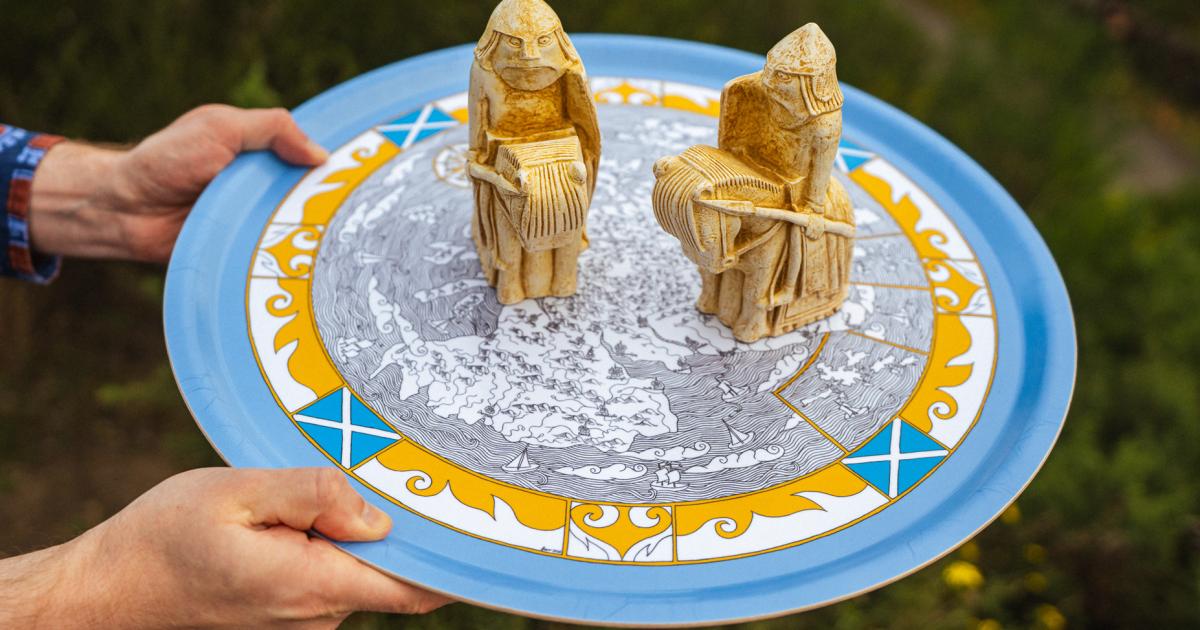

Illustrator and map-maker Andrew Redmond Barr has produced a circular map which can be viewed from every direction, meaning there is no single “correct” way up.
The unusual design grew from his interest in finding new ways to depict Scotland and questioning some of the assumptions created by conventional maps.
READ MORE: 71-year-old arrested amid hunt for £500k gold trophy stolen from Scots museum
Speaking to The National, Barr explained: “In a traditional map of Scotland you see the country from a southern perspective, looking south to north, but I have designed this 360-degree round map so that whichever way you spin it, the drawing is always the right way up.
“When I’m mapping Scotland, I’m often thinking of ways to depict the country which either show it in a fresh light, or somehow challenge traditional preconceptions.
“I was fascinated to learn, for example, that the northernmost part of mainland Scotland is called Sutherland, meaning ‘southern land’, because it was in the south from the perspective of the Norse culture.
“In this new map I’m trying to follow that thread, showing Scotland from alternative angles to give us new lenses to see it with.”

Barr believes the conventional way the country is mapped can subtly influence how people understand Scotland’s place in the world and where they imagine its centre to be.
He shared: "It’s all about perspective and the things we can see from different angles.
"The Prime Minister seems to think the north of the UK is half-way up England, but I think now in Scotland there is generally a much more affirming sense that we are not a northern region of another place, but a place our own, with our own north, south, east and west.
"This self-awareness is not an insular or inward-looking perspective, it’s an affirmation of our own existence and value and place in the world. That’s what I’m trying to reflect by mapping Scotland in the round in this design.”
The concept also draws on some of the unexpected quirks of Scotland’s geography and history.
Barr shared that he was interested to learn that the deep faultline of the Great Glen also cuts through Newfoundland in Canada, thousands of miles away.
Schiehallion – sometimes described as the centre of Scotland – was "loosely" in the mind of Barr as he drew out the map, "swirling out in all directions".
"I also really like how Schiehallion forms the geographical centre-point of mainland Scotland, adding to its mythology and symbolism as an ancient hill of the Caledonians," he added.

Looking at Scotland without automatically placing north at the top also changes the relationship between its islands, coasts and neighbouring countries, he argues.
Barr said: “If you look at some of Scotland’s islands from certain angles you can see how they relate historically to other parts of Europe and the north Atlantic. Our islands and coasts have always been points of exchange and communication, and I think they could have an even greater role to play in Scotland’s future.
“It’s worth remembering that Scotland has been an independent country for the majority of its history, meaning that it forged its own relationships with other European nations across the sea in various directions. Scotland’s coastal and island places were often very central to how things worked, rather than being seen as distant or on the edges.”
The design has been printed on round birchwood trays which can be used on dining or coffee tables or displayed as artwork.
He explained: “Recently I have been interested in the idea of turning my art into useful objects for the home. As a result I have printed the map onto round birchwood trays which can be used on dining tables, coffee tables, or simply put on display as art.
“I like the idea of this map being an everyday object with multiple purposes, while still being an artistic expression of seeing Scotland from another perspective.”

The idea of combining art and function has long appealed to Barr, who points to one of Scotland’s most celebrated designers as an inspiration.
He said: “I’ve always liked the idea of making something functional and useful with my designs. I admire people like Charles Rennie Mackintosh who designed everything from entire buildings to relatively small pieces of furniture for everyday use, showing how artistic visions can be scaled. I’ve always been interested in interiors and homes, and there’s something appealing to me about making something beautiful for the everyday.”
Asked what anyone who insists Scotland is supposed to be viewed with north at the top, Barr said: "That’s all part of the fun! I like to imagine a group of people sitting round a dining table with this tray in the middle – everyone will see Scotland from a different perspective, and none of those perspectives will be ‘the wrong way up’.
"All of this relates to something which runs throughout my work, which is that I’d like Scotland to find more imaginative ways of seeing itself.”
Comments (0)