
Remember me







Suspended in a pool, holding onto an oxygen mask as her teeth chattered, Julia Wolf began to seriously consider the possibility of hypothermia.
The 31-year-old musician was on set at the historic New York oysterman’s mansion known as the Captain Barnes for the music video of one of her latest singles, “Deep End,” a moody lament about Wolf’s seemingly endless capacity for yearning.
Her plan was to float around an underwater living room set up in her inner, surreal, suffocating fantasy world. However, the unheated pool in Staten Island instead felt bone-chilling in the early May temperatures, which hovered at a low 60 degrees Fahrenheit.
The chorus, “In the deep end till I’m blue, you know I’ll drown if I have to,” was starting to feel a little too real, she said half-jokingly from her dry seat in the Los Angeles Times’ office.
“I genuinely felt like I was gonna pass out,” Wolf said. “You do it for the art, I guess.”
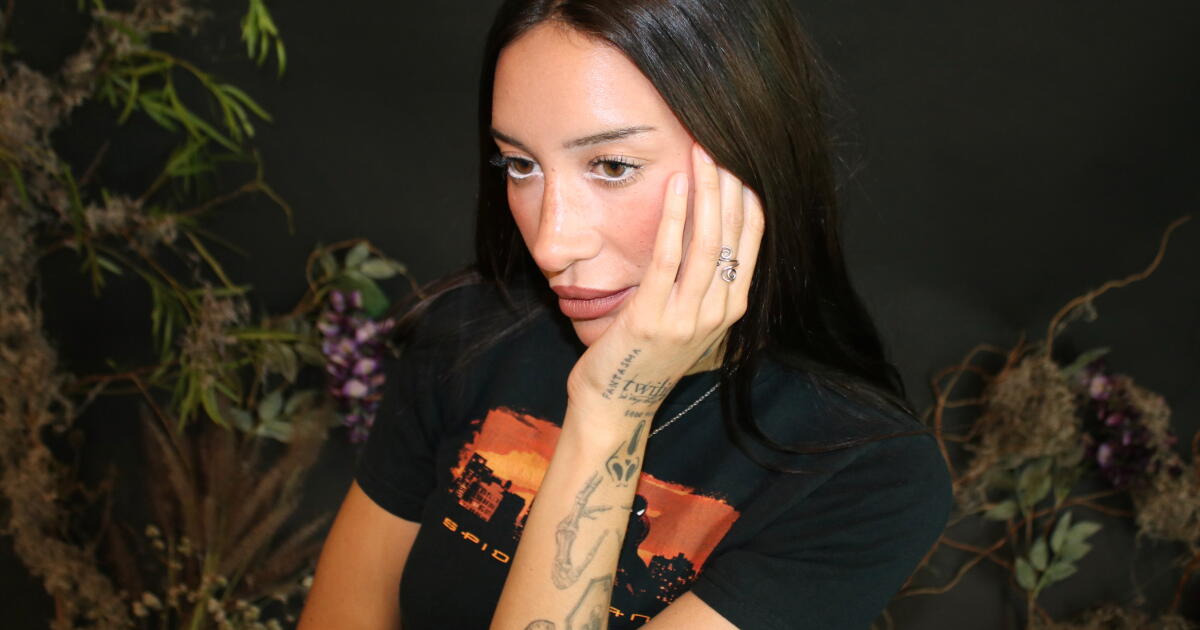
Wolf has her arms folded over her “Spider-Man 3” T-shirt, her skin crisscrossed with a mosaic of tattoos including ones of Ghostface, the ghost dog Zero from “The Nightmare Before Christmas” and a skeleton in a casket.
Below those is her favorite, which spans across her knuckles in the signature curled “Twilight” font: “Twilight is my drug.”
Wolf owes some of her newfound success to “Twilight,” whose characters starred in video edits set to her music that launched her 2025 single “In My Room” to viral fame. Fittingly, her sold-out “Deep End World Tour” kicked off Sept. 10 in Forks, Wash., in the “Twilight Forever” festival, before she arrives in L.A. to perform at the Fonda on Oct. 25.
The grunge-infused hit song, which details her attempts to grab a lover’s attention to the point of slitting her throat, catapulted Wolf from a SoundCloud indie artist to 17 weeks on Billboard’s Hot Rock & Alternative Songs, recently reaching No.1 on the Alternative Radio chart, and marking her first time on the Billboard Hot 100, staying there for 10 weeks.
Now at more than 200 million streams on Spotify, “In My Room” was the song Wolf knew would click — so she made people listen.
“When I made ‘In My Room,’ I knew it was the song that I was not gonna give up on,” Wolf said. “I just knew that it felt real to me. I posted it on TikTok every single day, sometimes twice a day, because I could picture girls singing it with me and relating to that feeling.”
Born from Wolf’s real frustrations in a long-term relationship, the melodramatic hit bubbles with acoustic guitar and low, vocal flip-laced mourning to amplified crescendos, replete with punchy garage-rock drumming and Wolf’s howling chorus.
“I’m speaking from my obsessive experiences, just yearning for permanence, and doing whatever it took to get a response,” Wolf said. “I needed to get it out because when we were apart, I was going all sort of insane.”
Not long after her song went viral, Wolf woke up to a surprise DM from Drake — “It was 6 in the morning and my boyfriend looked at my phone and shook me to say, ‘Oh, my God, Julia, ‘Champagne Papi’ just followed you!” she recalls. Within days, Wolf sent the Canadian star several demos for the intro of her as-yet unreleased song, “Doghouse,” featuring Wolf alongside experimental American rapper Yeat.
“I was telling [Drake] that it was confusing that I had a big song with ‘In My Room,’ and everyone wants that again. But the thing is that it exists and I can’t do it again even if I wanted to,” Wolf said.
“He told me, ‘As long as you feel good about it, don’t read the comments, just follow your instinct.’ I’m trying to live by that.”
Insecurity is the inspiration for much of Wolf’s music. “Feeling unsure of myself is kind of the staple of my personality,” she said. To then dive headfirst into music was not an easy journey for the soft-spoken daughter of Italian immigrants.

As an alternative pop musician, Wolf rocketed up Billboard charts after her 2025 hit “In My Room.”
(Katerina Portela / Los Angeles Times)
“I think it took me a long time to admit that I wanted to do music full time,” Wolf said. “Truthfully, I knew since I was very young that it was something I always wanted to do. I was belting Avril Lavigne in the basement with all the doors locked.”
The pop-punk scene in Long Island, where she grew up, exposed a young Wolf to live music, and she would beg her friends to join her at local shows or to see the Front Bottoms on tour.
Soon, Wolf started performing at open-mic nights in Queens, trying to “psych” herself out of nerves onstage. During the pandemic, when Wolf quit her 9-to-5 job and had the opportunity to focus on music, she began releasing songs regularly online to a slow and validating growth, selling out her first postpandemic concert.
Newer listeners to Wolf’s alt-rock sound might be surprised to hear that in these early years, Wolf was singing, and occasionally rapping, over Billie Eilish-era bedroom pop.
“Because I was so shy, it was hard to be in a studio with multiple people who are so into what’s happening and want[ing] to say, ‘Maybe I don’t love this,’” Wolf said. “It just slowly over time became too much until I did just have this explosion moment. I was playing those songs every night, and it didn’t feel like me anymore.”
Raised on stories of forbidden lovers and mystical transformation, Wolf returned to the pop-rock style she was raised on to conjure herself as a girl-turned-monster in her music videos, and references the 2008 cult-favorite movie “Jennifer’s Body” in a song of the same title, where she sings that the “Jennifer” she envies eats her alive.
When her mom introduced her to the “Twilight ” books in the hopes of giving her shy daughter something to connect with, Wolf became the girl who was “nine times out of 10” in her room searching, “How to become a vampire?”
“I latched onto fantasy to comfort the insecurities I was dealing with,” Wolf said. “I didn’t want to be the girl who was eating lunch alone because she was lonely, but the girl who did it because she was somehow special.”
Whether she’s stalking herself on the internet to see what her lover would find, snarking about how he posts on Instagram without texting her back, or hiding in her notes app “like a loser,” Wolf’s songwriting comes from, as she’ll tell you, “being way too online.”
“My world was on the internet,” Wolf said. “It’s my sanctuary but also hell, sometimes. I love how Phoebe Bridgers writes about everyday things. I try to write in a way that means something to my ordinary life, because of how much her words affected me. My ordinary world … is pretty much the internet.”
The internet is how she’s built a growing list of eclectic collaborations, including Kellin Quinn of post-hardcore band Sleeping With Sirens, with whom she created recent single “Lamb” in a rainy Portland studio. The single, which she didn’t anticipate earlier in the summer, is a cosign from an artist she’s long admired, one she couldn’t have imagined happening in the same month she opened for emo trailblazers Pierce the Veil.
“I feel like my life has been so unexpected. I’m still trying to tell myself I deserve this,” Wolf said. “I’m still doubting myself all the time.”
Wolf has long been fixated on escape. But as she pieces her identity together in music, she’s learning to love the world of her own.
“I always thought vulnerability would make me look weaker,” Wolf said. “But the older I get, the less I can hide these insecurities. I’m just going to be the girl who says the crazy stuff out loud.”