
Remember me







Millions of Americans could see a harsh winter with multiple snowstorms and freezing temperatures that turn several states into an Arctic 'battleground.'
A recent long-range forecast model from the National Oceanic and Atmospheric Administration (NOAA) revealed a massive shift in the bands of heavy precipitation between December 2026 and February 2027.
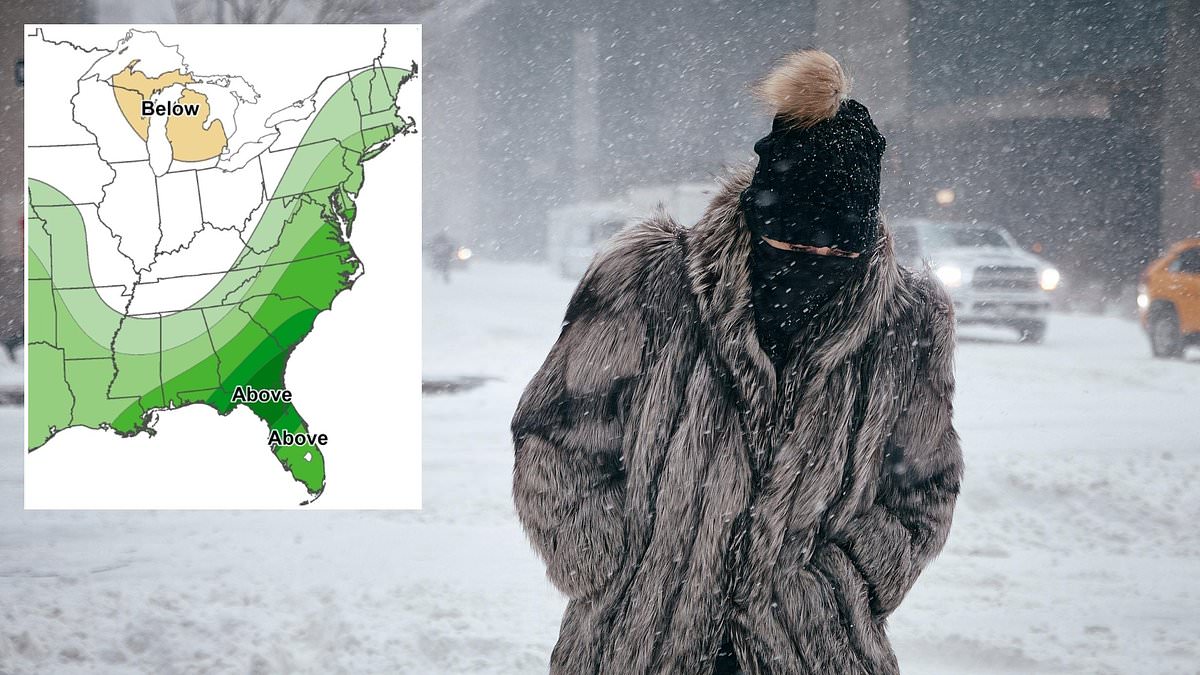
That map shows a growing chance that the entire US East Coast will see above-average precipitation this winter, from southern Maine to the tip of Florida and stretching across the country into Alabama, Mississippi, Louisiana and Texas as well.
On the West Coast, California is also expected to see above-average precipitation this winter, which likely means feet of snow in the Sierra-Nevada mountains and other high-altitude areas out west.
While more precipitation than usual does not always guarantee snow, several independent forecasters have predicted that at least 19 states should be bracing for a potential blockbuster storm season.
According to independent forecaster Direct Weather: 'We do expect nor'easters to be a frequent event this year up the East Coast, and these do tend to be snow producing at least for somebody depending on where that low [pressure system] is located.'
Meteorologist Ryan Hall added that a stretch of the South, Southeast and Mid-Atlantic, including Oklahoma, Arkansas, Tennessee, Kentucky, the Appalachians, the Carolinas and Virginia could be in the greatest danger this winter.
Hall said: 'On my map, this is the winter storm battleground, and this is actually where my forecast has changed the most. I'm now a lot more confident than I was a few weeks ago that somebody in this corridor is going to get a big snowstorm or a big ice storm this winter.'

A woman battles cold and snow in New York City in January 2026. New forecasts suggest the Northeast could face another winter of extreme snowfall (Stock Image)

NOAA's seasonal outlook has been updated to account for El Nino, finding above average chances of rain or snow along the entire East Coast and southern US this winter
Hall predicted that the winter forecast in the Northeast, including Maine, New Hampshire, Vermont, Massachusetts, Rhode Island, Connecticut, New York, New Jersey, Pennsylvania, Delaware and Maryland, would likely be a 'coin flip' between rain and constant snow.
The meteorologist updated his winter forecast after NOAA's September 17 seasonal outlook showed major shifts in precipitation expected due to El Niño, the climate phenomenon upending weather patterns around the globe.
El Niño emerges when the Pacific Ocean becomes significantly warmer than usual, pushing the natural jet stream that flows over the center of the US farther south.
This leads to more moisture, rain, floods and snow in the southern half of the US, from California to Texas to the Carolinas.
However, the new NOAA map predicted that this wall of moisture will also move up the East Coast, bringing the strongest chances of heavy rain or snow to northern Florida, Georgia, southern Alabama and Mississippi, South Carolina, North Carolina and eastern Virginia.
While the NOAA winter forecast leans towards more rain and snowstorms hitting the Northeast and New England, Hall said it was still too early to tell if El Niño would make it cold enough for steady blizzards to emerge.
'It's still a tricky forecast. [Washington] DC, Baltimore, Philly, New York, Boston. I still like the storm signal and the new outlook runs that wet pattern way up into New England,' Hall explained in his September 19 forecast on YouTube.
'I think there's going to be plenty of chances over here. But that still doesn't answer the thing that everybody actually wants to know: rain or snow. And I'm going to be sticking with that same coin flip.'

Meteorologist Ryan Hall has said that millions from Oklahoma to the Carolinas may be stuck in a 'winter storm battleground' between December and February 2027

Whiteout conditions were frequently seen during the 2025-2026 winter season from the West Coast all the way to the Great Lakes (File Image)
Read More Terrifying scientific study warns 'Blackout Arc' event could plunge 5 million into total darkness
Hall noted that previous El Niño winters produced wildly different snowstorm seasons along the East Coast.
During the winter of 1997-98, an El Niño produced temperatures that were too warm and resulted in only 0.1 inches of snow falling in Washington DC. Meanwhile, the 2009–10 El Niño winter dropped over 56 inches of snow on the nation's capital.
Direct Weather, which is run by self-taught forecaster Ashton Ballou and bases its outlook on public ocean-temperature readings and seasonal computer models from NOAA, was more bullish on the chances of heavy snow along the East Coast.
Specifically, Direct Weather's September 15 prediction expected higher amounts of snow to build on the western side of the frequent storms forecasted to roll through the Northeast this winter.
'Somebody on the western edge of that storm would be likely getting major amounts of snowfall. We do expect those to be battering us all fall and wintertime long,' the forecast warned.
AccuWeather was more skeptical that this winter would end up being a record year for snow, stating that 2027 may actually end up setting records for a lack of snow.
AccuWeather lead long-range expert Paul Pastelok said in a statement: 'It may be more about rainfall this year, coastal flooding, and rivers rising. That’s something you talk more about during the spring, but it could be the opposite this year.'