
Remember me
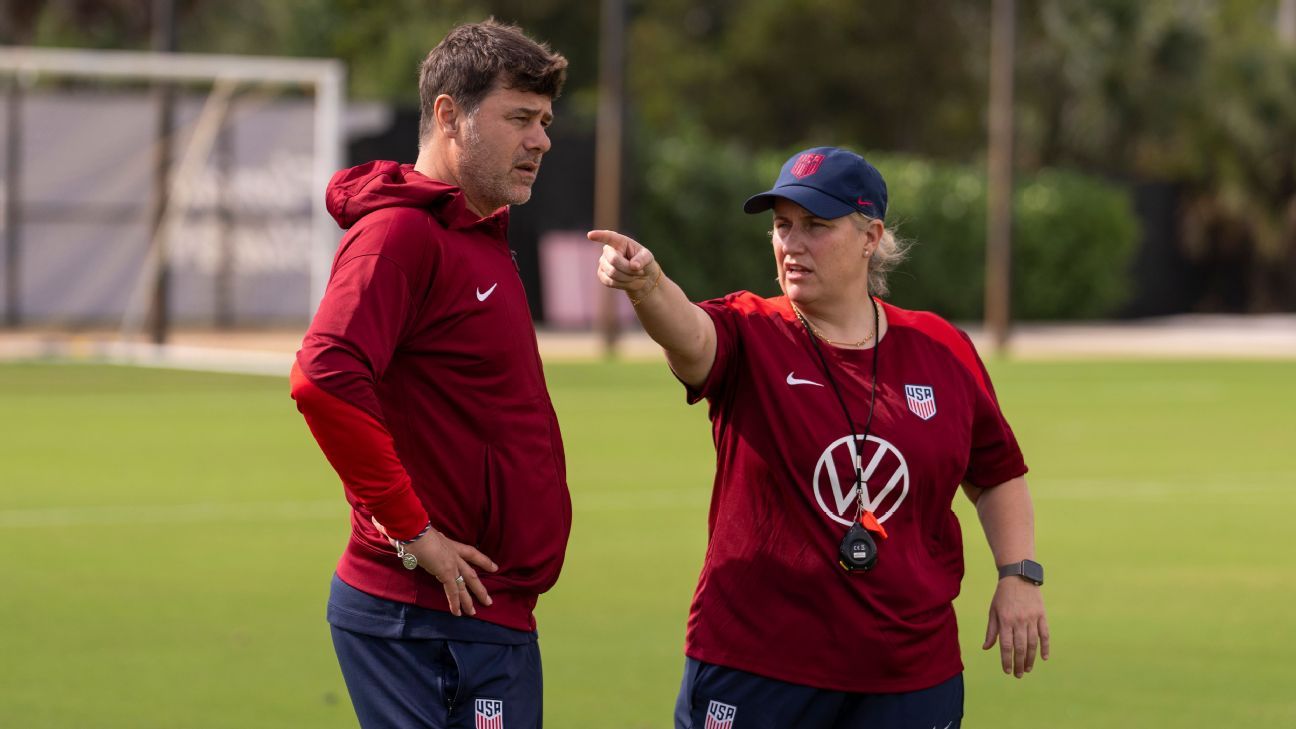

United States women's coach Emma Hayes said she is "delighted" that Mauricio Pochettino has signed a new deal to remain the U.S. men's team coach for another four years, with Hayes adding that both coaches have the ability to focus on their respective program's long-term plans.
"I think this summer, he really embraced everything that comes with the country and comes with soccer in the country," Hayes told ESPN. "I think he did an amazing job getting people to really believe in the team. I think it's just the beginning for that group."
Earlier this week, U.S. Soccer announced that Pochettino signed a new contract to stay on as the head coach of the U.S. men through the 2030 World Cup. Pochettino led the team to the round of 16 on home soil earlier this summer.
Editor's Picks

The U.S. lost 4-1 to Belgium in the round of 16 after a promising start to the tournament, which the United States co-hosted alongside Canada and Mexico.
Pochettino's record with the U.S. men is 17-12-2 (W-L-D) since he took over in September 2024, halfway through the World Cup cycle.
With a new contract in hand, he has a full cycle to prepare for the 2030 World Cup. More time could allow Pochettino to focus on the longer-term trajectory of the program. He told reporters recently that his reappointment is a chance to "have a lasting impact on the sport in the country that has welcomed us so warmly and for that impact to extend beyond results on the field," as well as work with a new generation of players that has potential.
Hayes said there are parallels to those development conversations for men's and women's soccer in the United States.
"For him, now, he I am sure is very excited to have conversations like I'm having with you now about the youth of the country," Hayes said. "And how do we raise the level for the next generation so that they are better prepared? Because I believe he has the same challenges. Might be even bigger, but he has the same challenges."
Hayes spoke to ESPN earlier this week about the importance of Americans getting experience at the U20 Women's World Cup. She has been adamant since taking the United States job in late 2023 that the program must innovate its playing philosophies and development strategies to continue to win global titles.
Hayes guided the U.S. women to the 2024 Olympic gold medal in some of her first games on the sideline after juggling those duties from afar for months as she finished her time coaching Chelsea in the Women's Super League.
"I am sure we will have many conversations about this [development], because what I don't want to do for the women's side is fall into a situation where we become a mid-major in the women's game because we don't value these things and we're just reliant on the history of the badge," Hayes said. "It's not gonna be enough.
"I think for [Pochettino] to close the gaps, he knows that creating the right youth development pathways is going to be essential. It's how we develop our players -- it's how. If you put him and I in a room for two days, I'm pretty certain our perspective on the development of players, and what we need to keep adding to a system that is quite disparate. There's lots going on in lots of different places. How are we going to start accessing the communities that are largely missing from soccer?"
Hayes said she contacted Pochettino frequently ahead of the 2026 Men's World Cup to offer her support, but gave him space since. Both coaches are recharging following the summer, but Hayes said she will speak with him over the phone or over an in-person coffee soon.
Pochettino and Hayes knew each other well from their overlapping times as coaches of Chelsea's men's and women's teams, respectively, in 2023 and 2024, and further acknowledged the player development challenges the two face.
"That in itself is like maximizing our ability to attract top talent, train the top talent in the best way possible from the earliest ages where things like your game intelligence, along with your technique, your tactical understandings come first," Hayes said. "Yes, you need to have the physical component, but it shouldn't always be the highest order; it should be the other way around. Along with, 'OK, what does the journey of a top level soccer player look like?' And map back from that.
"And it will be exactly the same conversations we're having. I'm sure he and I will have them. He's fully committed and I'm sure he will move the marker when it comes to youth development."
Hayes added that she "absolutely" learned lessons from the 2026 Men's World Cup that she will apply to her team at the 2027 Women's World Cup. Hayes was an analyst for British TV during the World Cup and saw several games in person.
She said she observed how hydration breaks, substitution patterns and new rules designed to prevent game delays affected how matches were played.
"All I kept thinking as I've gone through this is: Are FIFA preparing everyone on the women's side for this level of quality in officiating and the speed of VAR?" Hayes said. "The speed of VAR is something that I'm going to really advocate for so that decisions are taken, it's transparent and we move on. But also for officials to be hot on the things that are designed to disrupt the game or slow the game down. I picked up a lot on that."
The U.S. women do not often play games using VAR. They will utilize VAR for their two October friendlies against Spain at the request of Hayes, to help prepare her team for the World Cup next summer in Brazil.