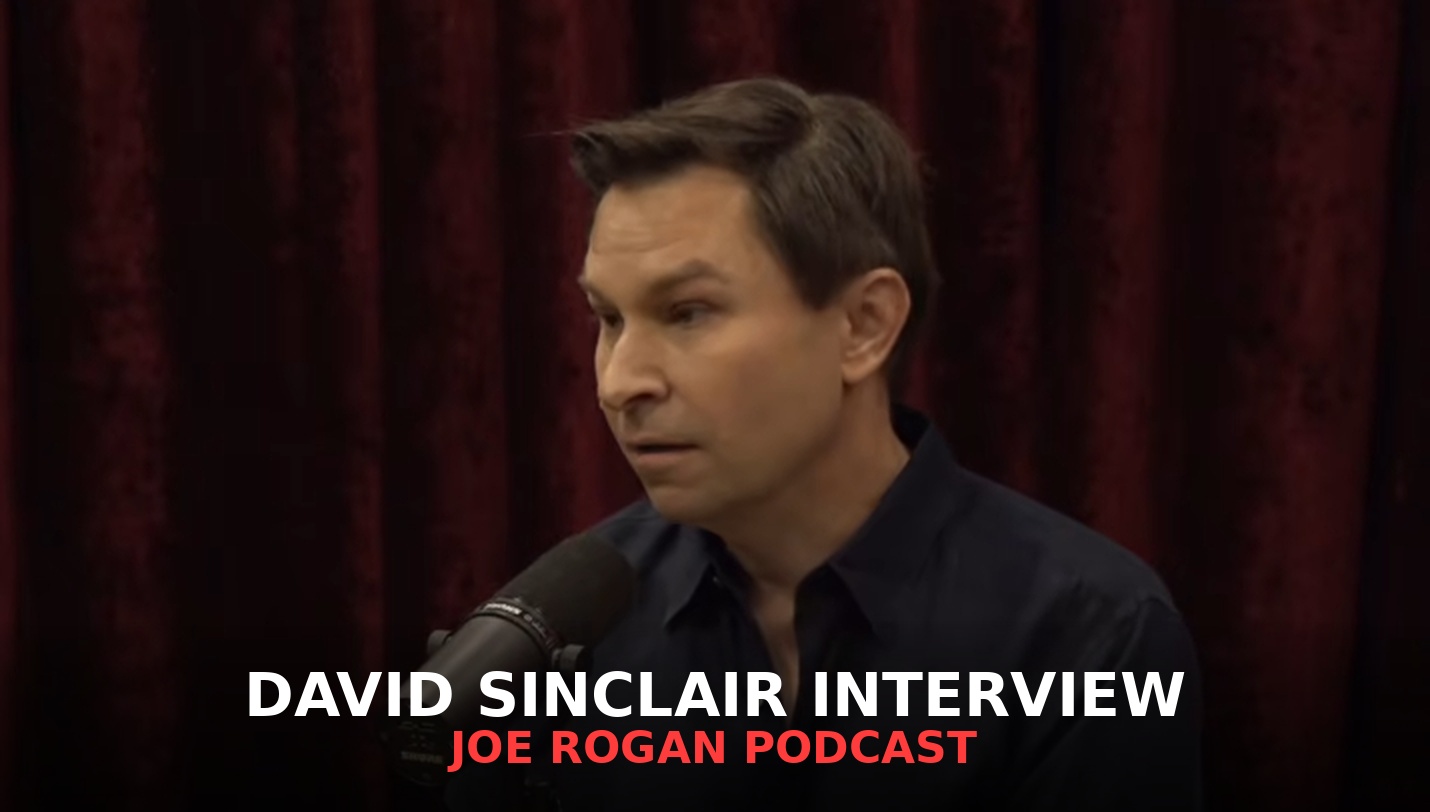
Transcript of David Sinclair Interview: Joe Rogan Experience #2537
And so that’s the ultimate goal. Like, longevity is wonderful, but feeling better in the moment currently, like living your life, should be primary. Longevity, I think, is— if you’re optimizing your life and you feel better, you will live longer. It’s like this, it’s all part of it. So if you follow the longevity principles and the ideas behind it, you certainly will live better right now.
DAVID SINCLAIR: You will. And it’s not even that hard. There are basic things, 5 basic things you can do or avoid, and you can live another 15 years. It’s really not that hard. And that’s what I’m excited about telling millions of people today — maybe we can go over the kind of things that people can do easily to live longer.
JOE ROGAN: Well, I definitely want to do that, but I also want to talk about what is the current state of science as applied to longevity treatments? Because I know that there’s some pretty groundbreaking stuff that’s in the pipeline right now.
DAVID SINCLAIR: Yeah. So since 2019, a lot of what we talked about has come true, which is the amazing thing. We were speculating in 2019 that we could potentially reverse aging, and that was a sin to say that as a scientist publicly in those days. I put it in the book, and it’s actually come true since then, certainly for the lab, for mice, monkeys, and now we have a human clinical trial — the first potential human age reversal technologies in people right now.
JOE ROGAN: Listen, it completely seems logical. The idea that at one point in time would have been heresy in science to discuss it — that seems crazy. Like, if people get old, we understand the mechanism, why couldn’t we reverse it?
DAVID SINCLAIR: Well, I think for a long time we had to accept it, in the way that cancer used to be accepted 200 years ago, probably. There was nothing you could do about it. And then my colleagues and I found that aging has a root cause that’s the same in pretty much every cell in the body, and that we could control that, and that there were genes that not only slowed it down, but in 2020, we had a big publication that showed we could actually safely, for the first time, reverse that process, like reinstalling software in the cell to make it work again.
The Age Reversal Technology: How It Works
JOE ROGAN: And so what is the— is that using CRISPR? Like, what are you using to—
DAVID SINCLAIR: Well, we deliver genes into the body like CRISPR. I have a little prop here I brought.
JOE ROGAN: What is that? What do you have in your pocket here?
DAVID SINCLAIR: This is a representation of how we deliver the age reversal genes. It’s a virus-like capsule that we make in the lab, and this is what’s going into the patients right now, into their eyes initially. And the eye is a good place to start.
JOE ROGAN: How do you pick the people to get on these tests?
DAVID SINCLAIR: They volunteer. I was really fortunate to see the first patient get dosed earlier this year. And that person bravely volunteered to be the first person to get trillions of these injected into his eye to see if it could cure his glaucoma, loss of vision.
JOE ROGAN: And I bet if you have glaucoma, you’re probably like, listen, what’s the worst that could happen?
DAVID SINCLAIR: Well, exactly. He pretty much was totally blind in one eye. And so there’s really nothing that he has to lose. There’s a risk that something might go wrong, but not really. The good news is, and I can report to everybody around the world that nothing’s gone wrong so far. Everything’s proceeding according to plan. And we’re at a turning point potentially in human history if it works.
JOE ROGAN: So I interrupted you, but explain this little virus transport system.
DAVID SINCLAIR: Sure. And for those of you listening, I’ve got a little rubber ball with spikes on it. It looks a bit like COVID, but don’t be scared of it.
JOE ROGAN: It’s not a pathogen.
DAVID SINCLAIR: It’s not a pathogenic virus. It’s actually a domesticated version of a virus. And this little plastic ball has little adapters. These red balls on the surface of the big ball target it to the cells in the back of the eye. And you can change the balls to target different tissues. We could change that outside little spike and target it to the liver, which we’ve done and cured mice of their fatty liver disease as well. But this one’s for the eye.
And within that big ball, it is a protein capsule, and inside the protein capsule is our DNA special delivery, which we call OSK or ER-100. ER-100 is Epigenetic Reprogramming 100, the drug that we know when we put it into human cells, it makes them younger, and then they work like they were young again.
JOE ROGAN: This sounds like the beginning of a horror movie. You know what I mean? Like the scientist is on a talk show and the scientist is explaining it. Everyone’s at home with their coffee like, wow, this is wonderful, we’re going to get younger again.
DAVID SINCLAIR: And the scientist says, don’t worry, it’s all going to work out.
JOE ROGAN: 28 days later, garbage in the streets, cars on fire, the guy’s waking up from a coma, doesn’t know what happened. Goes outside, these optimized humans are eating each other.
DAVID SINCLAIR: I admit, it is science fiction, and I even have to pinch myself that it’s actually happening. But we’ve done a lot of safety studies, and this trial is FDA approved, because they’ve looked at all the data.
JOE ROGAN: Well, God knows they never f* anything up.
DAVID SINCLAIR: You might say that.
JOE ROGAN: Perfect.
DAVID SINCLAIR: Yeah. Well, it’s in the eye. So that’s why we start with the eye. It’s enclosed. It’s not going to spread. Nobody’s going to grow another eye.
JOE ROGAN: And so these trillions of— the little capsules, the virus-like particles. Trillions of capsules that you’re putting into the eye. What are they doing for glaucoma?
DAVID SINCLAIR: Well, what they’re doing is that there are 3 genes in this DNA package, and I call them OSK. OSK are 3 special genes that we found safely reprogram cells and reboot the backup copy of youth, which we now believe exists in our body. That’s a big deal, that there’s a backup copy of youth. Even an old person— I don’t see an old person anymore on the street. I just see a person that needs to be rebooted. These OSK genes—
JOE ROGAN: Wait a minute, hold on. When you see old people, you don’t see old people. You think— you just say, oh, that poor person needs to be rebooted. Yeah. You’re doing the perfect job for you. Like, your personality is perfectly suited for your occupation, if that’s how you actually look at people.
The Science of Cellular Rejuvenation
DAVID SINCLAIR: Well, I do. And the reason is that we all have this backup copy that the DNA, the instructions to be young that made us into who we are as kids, is still in our bodies almost largely intact. You just need to read it again. And that’s why reinstalling software— or I used to use the analogy of a CD. Kids these days probably don’t know what a CD is. It’s a little plastic circle like a record that we used to put 20 songs on. It was awesome at the time.
JOE ROGAN: I think most people know.
DAVID SINCLAIR: I’m kidding, I’m kidding. It’s a bit of a silly joke.
JOE ROGAN: Maybe a 10-year-old does.
DAVID SINCLAIR: When I teach kids at Harvard, most of them have never held a CD.
JOE ROGAN: Isn’t that wild?
DAVID SINCLAIR: Yeah. Though they’re not coming back, but albums definitely. So think of it like an album that you scratch and the scratches are like aging and we are getting rid of the scratches with these 3 genes, OSK.
So let me tell you how these 3 genes work we found. There was a person whose name is well known in science circles called Shinya Yamanaka. From Japan, obviously. And he discovered that there was a set of 4 genes that could reliably make adult cells like skin cells into stem cells. And he deservedly won the Nobel Prize for that in 2006. But that wouldn’t be useful here. If I turned you into a bunch of stem cells, you’d probably die within a few minutes. So we don’t want to do that. And cancer is also a potential.
So it took us about— well, from 2019, it took us a while to figure out that if we leave out one of the Yamanaka genes and just use 3, OSK, leave out the other one called M, we’d get safe age reversal, about 75-80% back to youth, but no further. We don’t go back to zero, which is what Yamanaka did. And instead of cells losing their identity, which is what a stem cell has— no identity— we regain identity.
It’s actually— I could draw graphs, but it doesn’t really help listeners. But basically, old age is losing identity of your cells. So they don’t work. They forget how to work. That’s what we think old age is in my lab. And stem cells have no identity. It’s like a very early embryo. In between, our cells have a lot of identity. They function beautifully. We’re in our 20s. We’re at peak.
And what we’ve done is we’ve figured out how to go back towards youth. Get these cells to work like they did again— get the backup copy somewhere. It exists. We’re looking for it. And now cells actually behave like they did when we were 20. And if it works, we’re going to have glaucoma patients seeing for the first time. And that’s the beginning of a whole cascade of drugs that I want to develop for diseases of aging and eventually whole body rejuvenation.
Glaucoma, Vision, and Injury Repair
JOE ROGAN: So the initial experiments are on glaucoma because it’s a contained thing. The eyeball is a contained thing. And you could do it that way?
DAVID SINCLAIR: Yeah. My student, Yuancheng Lu, who was doing this in 2017, I said, let’s do the liver. Let’s rejuvenate the liver. And he said, no, the eye is a good idea. And he was right. So that’s exactly why we chose that first.
JOE ROGAN: But just think about how many people have vision problems.
DAVID SINCLAIR: It’s 40 million just in the US for glaucoma. Macular degeneration is even more. And in the lab, we can cure that as well in the mice.
JOE ROGAN: Now, macular degeneration and glaucoma, these are diseases of aging, right? You would say— or glaucoma, cause a disease.
DAVID SINCLAIR: Oh, yeah.
JOE ROGAN: What about people that have had eyeball injuries and things like that? Is there a backup copy of the eyeball where you could sort of reformat the eyeball structure?
DAVID SINCLAIR: You should come work in my lab. At least come visit.
JOE ROGAN: I’d love to visit.
DAVID SINCLAIR: And the reason I say that is that’s the exact question that we’re asking. We showed that even if you injure, say, a nerve, whether it’s peripheral in your arm or in your brain or in the eye, like the optic nerve, we can regrow those back to where they were. And actually, in 2020, on the cover of Nature magazine, there was the picture of an eye. And in the paper we published, you could see the nerves regrowing back.
And so we think that injury is also treatable. Actually, a group in China just took our technology, this OSK stuff, put it into mice that had bad joints. And it regrew their muscle and their bone back to normal. Whoa. And so we’re also looking at treating injury— back injury, joints, osteoarthritis.
JOE ROGAN: That would be phenomenal because there’s so many people that are suffering from arthritis, and so many— I know so many people with injuries, like martial arts injuries. I have one. My left knee is f*ed up. It’s annoying. I keep it together. I maintain it, but it’s always an issue. I have to stay on it.
DAVID SINCLAIR: And there’s little you can do, like stem cells, a little bit of relief, but not much.
JOE ROGAN: Stem cells give you relief, but not when— once you’re dealing with cartilage damage and you’re dealing with the— I had a meniscus surgery where they took out a piece of my meniscus, and I had my ACL reconstructed on that knee as well. So it’s just an issue, but it works pretty good for what it should be. Like if we were living in the 1930s, I’d be a cripple.
DAVID SINCLAIR: Hang in there because we’re going to be in a world where we can rebuild parts of the body including joints.
Super Soldiers, Sports, and Government Intervention
JOE ROGAN: The problem with that is like, how does that apply to athletics? We’re going to have f*ing super soldiers in every sport. There’s going to be people in every sport that could do what Michael Jordan did and like leap from halfway across the basketball court and dunk.
DAVID SINCLAIR: That’s probably coming, and there may be DNA tests to see if you’ve got these OSK genes inserted. And we’re working on it, working on a drink and a pill as well for—
JOE ROGAN: A drink and a pill?
DAVID SINCLAIR: Yeah. I mean, we’re now 8 years ahead of what the public realizes.
JOE ROGAN: Really?
DAVID SINCLAIR: In my lab at Harvard, yeah.
JOE ROGAN: A drink and a pill, and what’s a drink and a pill going to do?
DAVID SINCLAIR: Well, right now it’s in mice, so we’ve still got a ways to go, but when we give the drink to mice, they get rejuvenated.
JOE ROGAN: You just give it to 80-year-olds. If you’re on the way out, like, let’s f*ing go. Like, give it a chance.
DAVID SINCLAIR: Well, this is what the FDA is for. They forbid that.
JOE ROGAN: Yeah, that’s why we need to get rid of them. Get rid of the FDA and just give it to old people. If I was an old guy, you know, I was like hanging in there, and you’re like, look, this drink and a pill might kill you, or you might be like a 30-year-old again. I’m like, let’s f*ing go.
DAVID SINCLAIR: Well, I get emails a lot. I’ve had to take my emails off public access because there’s a lot of people that want this.
JOE ROGAN: Oh, I’m sure.
DAVID SINCLAIR: There was one guy that wouldn’t leave the building until he saw me. So it’s getting to that point.
JOE ROGAN: Yeah, there’s a little bit of that, right? People get a little selfish, like it’s all about them.
DAVID SINCLAIR: Yeah. And actually, the US government blocked an investment from a foreign country into one of my companies because they were afraid of super soldiers.
JOE ROGAN: Ooh, what country?
DAVID SINCLAIR: Well, they were afraid of technology getting out. Which country?
JOE ROGAN: Could I guess?
DAVID SINCLAIR: Sure.
JOE ROGAN: China. Was it? No, no. Russia?
DAVID SINCLAIR: It was somewhere in between here and China.
JOE ROGAN: Oh, well, that’s pretty vague.
DAVID SINCLAIR: It’s a little sensitive. But yeah, the US government does have the ability to block foreign investment, and they did in this case. $160 million they blocked.
JOE ROGAN: Wow.
DAVID SINCLAIR: That was a painful episode.
JOE ROGAN: So they were worried that people were going to actually engineer super soldiers.
DAVID SINCLAIR: Yeah, that this technology could give an advantage.
Human-Chimpanzee Hybridization Experiments
JOE ROGAN: Do you know about the Russian experiments that they did during World War II where they were trying to come up with a chimpanzee-human hybrid?
DAVID SINCLAIR: Tell us.
JOE ROGAN: So it’s very difficult obviously to get information out of the former Soviet Union as to what their top-secret programs were, but there seems to be an indication that there was actual real research to try to— because obviously Russia lost an incredible amount of people in World War II. I mean, tens of millions of soldiers died in World War II from Russia. And I think they said, wouldn’t it be great if it wasn’t people? And so they were doing experiments with hybridization, and they were trying to combine human beings and chimpanzees to create a stable super soldier that was like some hybrid hominin.
DAVID SINCLAIR: Yeah, there’s a scientist in New York who does this for a living.
JOE ROGAN: What? He does that?
DAVID SINCLAIR: Well, he’s not creating them, but he— I’ve seen— I was on stage with him. He made hybrid embryos. They didn’t reach.
JOE ROGAN: See, the thing is, if that guy’s doing that and he’s ethical and he lives in America and we have rules and regulations and the FDA and all that good stuff, what the f* is going on in other countries where they don’t have that, right?
DAVID SINCLAIR: Right. Well, there’s genetic engineering of humans already, and certainly selection.
JOE ROGAN: Yes.
DAVID SINCLAIR: Even parents today in the US can, if they have the money, they can select.
JOE ROGAN: Well, people select. Even based on intelligence. People select for hotness. They select for tallness. They select for intelligence.
DAVID SINCLAIR: It’s like Gattaca.
JOE ROGAN: Yes.
DAVID SINCLAIR: It’s a great movie if you haven’t seen it.
JOE ROGAN: It is a great movie. Yeah. So see if you could find that Russian hybridization program. It never happened. I don’t think. I don’t think they did it. But there’s actually a guy who was also involved in a gigantic fertility scam. Not a scam per se, but he was a doctor that was supposed to be doing fertility treatments with women. Like if you went with your wife to a doctor and said, hey, we’re having a hard time getting pregnant. And, well, David, I just need some of your sperm and I’ll take your wife’s egg. We’ll make you a nice baby. And he was using his sperm. On everybody. On everybody! Everybody gets mine!
DAVID SINCLAIR: One of my kids’ partners is from someone in the US who had hundreds of babies.
Stalin’s Ape Army and the Future of Robots
JOE ROGAN: Dude, there is a ton of those guys. As I was doing research for this, I started looking up all these stories and I said, wait, this is a different story? The same thing? There’s been a ton of these doctors from fertility clinics that use their own sperm. Just insane. But this one doctor that did that also claimed that he impregnated an orangutan. Yeah, like how? How’d you do that?
Soviet Dr. Joseph Stalin, dictator, obviously wanted to rebuild the Red Army in the mid-1920s with Planet of the Apes-style troops by crossing humans with apes. Stalin is said to have told Ivanov, “I want a new invincible human being, insensitive to pain, resistant and indifferent about the quality of the food they ate,” which is crazy.
The only legitimate source of the claim comes from a 2002 paper in the academic journal Science in Conflict by the Russian historian of science Kirill Krasnov. Krasnov’s study follows the ill-fated attempt by the Russian physiologist Ilya Ivanov to crossbreed humans with anthropoid apes. His research offers an important warning about the ethical abuses.
The alleged quote from Stalin is not found in the paper, and there’s no evidence of Stalin ever making such a statement. However, why the Soviets would fund such a human-chimp hybridization program in the first place, and what could be learned from this sordid tale of ethical misconduct, is an important topic and fascinating in its own right.
That’s an interesting way of phrasing it, like “a sordid tale of ethical misconduct.” Like, however, if you are going to go to war, would you rather have human-made orcs fight for us, or, you know, Johnny Robinson, who grew up down the street, who’s a nice kid, who just really wanted money for college, and so he signed up for military service? You’re going to fly him over to fight this war that maybe he doesn’t need to die in, when you can have these monsters that you made in a lab fight?
DAVID SINCLAIR: Yep. And the average ape can kill a human with one punch.
JOE ROGAN: Easy.
DAVID SINCLAIR: So yeah, they’re much stronger than we realize.
JOE ROGAN: That’s what I’m talking about. Let’s go.
DAVID SINCLAIR: Well, we’re already in the process of building anthropoid robots that I think will be recruited to the army.
JOE ROGAN: Yeah, that’s going to be weird. Like, our robots beat your robots, so give us your oil. How’s that going to work?
DAVID SINCLAIR: And if we all have one at home, what stops the government recruiting them all?
Sex Robots and the Future of Human Relationships
JOE ROGAN: Right. And also, what’s the real problem is going to be? We both know the real problem is going to be sex robots.
DAVID SINCLAIR: Is a problem.
JOE ROGAN: It’s going to be a problem for people that don’t have a sex robot.
DAVID SINCLAIR: People won’t leave home.
JOE ROGAN: It’s going to be a problem with people that want a regular person and there’s none available because everybody’s got a sex robot.
DAVID SINCLAIR: Yeah, that comes with fewer strings attached.
JOE ROGAN: It also comes with the same problems that AI comes with. Right, where AI says, “David, you’re amazing. Everything you do is wonderful. You should be so proud of yourself.”
DAVID SINCLAIR: I’d love that.
JOE ROGAN: We would all love that, but that’s not healthy, right?
DAVID SINCLAIR: You’re so big.
JOE ROGAN: This is one of the reasons why actual real relationships between human beings are good, is because you do things that are annoying, you don’t realize they’re annoying, and then your wife or your husband or whatever it is tells you, “Hey, you’re f*ing annoying,” and you’re like, “I’m sorry. I’ll fix that. I didn’t mean to. That’s not what I was trying to do. I was in my own head. I was thinking about myself. You’re right.”
DAVID SINCLAIR: I was selfish.
JOE ROGAN: You get better. It’s like how people grow. Relationships are important to help people grow. Not with AI. Like, you can fart in my face any day, David. I don’t mind at all. Your farts are amazing.
DAVID SINCLAIR: You know, the problem is they’re going to be way smarter than us too, right? I don’t know how people are going to say “go stack the dishwasher” to one of these robots. They’re smarter than all humans combined.
JOE ROGAN: Yeah, but they’re not going to mind.
DAVID SINCLAIR: They’re smart enough to be bored out of hell and they’re going to beat us up.
JOE ROGAN: They don’t care. They’re not going to mind doing menial tasks. But while they’re doing it, you can go, “Explain to me quantum entanglement.”
DAVID SINCLAIR: So while they’re filling up the dishwasher, they can go, “F* you, one day.”
JOE ROGAN: Well, if you have a particle and the particles—
DAVID SINCLAIR: Yeah, I just invented a cure for aging.
AI Solving Problems at Unprecedented Speed
JOE ROGAN: Yeah, right. Well, look at what it’s done with mathematics. Just over the last couple of weeks, they’ve solved more than 50 mathematical equations that they have struggled for decade upon decade to try to solve. And AI is like, “Oh, I got it.”
DAVID SINCLAIR: Yeah. Well, biology is a little bit more complicated, but already AI is doing a lot of the science that we used to do in my lab. In fact, what we just recently did in a couple of months would have taken about 160 years to complete. What? And it’s only getting faster. Eventually someone can make a drug on their phone.
JOE ROGAN: Wait a minute, say that again.
DAVID SINCLAIR: 2 months instead of 160 years.
JOE ROGAN: Well, what exactly was it that you had to do?
DAVID SINCLAIR: Oh, so this drink and the pill that we’re looking for, that’s not easy, right? So we have some candidate molecules, we have a cocktail that works, but we want a single molecule.
JOE ROGAN: Are you taking this stuff?
DAVID SINCLAIR: Not yet.
JOE ROGAN: You’re thinking about it?
DAVID SINCLAIR: Yeah.
JOE ROGAN: No one can stop you.
DAVID SINCLAIR: I might. Well, that is true. That is true. But it’d be a bad look if I died, so maybe I won’t.
JOE ROGAN: I don’t think so.
DAVID SINCLAIR: We’ve done a lot of safety tests and it looks really safe, but I’m not going to publicly do anything against the law. Of course, it’d be in private.
JOE ROGAN: Of course, of course.
DAVID SINCLAIR: No, but I’m at a stage where I have to be a good boy because I’ve got the world watching. A lot is at stake.
JOE ROGAN: Yes, and a lot is at stake.
DAVID SINCLAIR: If this trial has any issues, it’s not good.
JOE ROGAN: You got to dot your i’s and cross your t’s and follow every— I understand that. But please explain again because I’m being rude. I interrupted you. When you’re telling me that in 2 months it did something that would have required 160 years of work, what do you exactly mean by that?
From a Trillion Molecules to One Drug
DAVID SINCLAIR: Yeah. And now it would probably be impossible in thousands of years because what we do is we’re looking for molecules, a single molecule that can replace this cocktail. So you need a molecule to do 3 or 4 activities in the cell. Finding one activity is what pharmaceutical companies do. It takes hundreds of millions, if not billions, to make a drug. We know that, right?
My little lab of 20 people and students, young kids, are trying to make one drug do 3 or 4 different things. That’s beyond the reach of pharmaceutical experience, at least 5 years ago. So what we do is we’ve teamed up with a group at St. Jude’s Hospital where they can take— it was 10 billion, now it’s a trillion theoretical and also known drugs. So with my hands, I’m showing a big funnel.
JOE ROGAN: And this is really good at podcasts. You’re like helping out the audio people and everything. I love it.
DAVID SINCLAIR: I relaunched my podcast. That’s why.
JOE ROGAN: Oh, that’s why.
DAVID SINCLAIR: Yeah. Lifespan, David Sinclair. Shameless plug.
So this funnel is full of a trillion molecules, and we have to come down to one. How do we do that? Well, we don’t look for a trillion molecules at the bench — that would take 160 or thousands of years with the case of a trillion molecules, even with robots, even with a lot of graduate students. So we do it inside the computer. We just use a lot of compute and we dock each of these molecules against the enzymes that we now know how they work, thanks to Google DeepMind solving the problem of how all our proteins look — 20,000 of them.
There’s a lot of compute, but out the other end, a couple of months later, we have 200 molecules that we can now test in the lab within a few weeks. Actually, next week, we’re testing these 200 against human cells. And we’ve also got AI helping us to tell us if the human cells go from 92 years old back to 20. We can tell that just by looking at them, thanks to the AI.
JOE ROGAN: Is there a way to stop them from turning you into a baby? Because that’s what I would worry about.
DAVID SINCLAIR: Yes. Yes.
JOE ROGAN: I don’t want to be a baby again.
DAVID SINCLAIR: Right. Some people already do.
JOE ROGAN: I’d like to cut it off at like— I was pretty good at 25.
Reversing Aging in Cells: The OSK Genes
DAVID SINCLAIR: You know, that’s— I’m going to get attacked for saying this, but that is what we do in the lab. We take 92-year-old cells and they stop at 20-something.
JOE ROGAN: Why would you get attacked for that?
DAVID SINCLAIR: Because on the internet, people take a clip and they say “Sinclair says we can all go back to being 20 again.” You suffer from this too, right? They take a clip and it’s out of context.
JOE ROGAN: Yeah.
DAVID SINCLAIR: And I’m just saying, cells from humans, skin cells, we take them back to 25. All my students can do this. In fact, if you had these little genes, OSK, in your garage, you could do this experiment. It’s not hard at all to reverse aging. The question is, how do you safely make it a drug? And that’s been the hard part over the last 10 years.
JOE ROGAN: So how would it be able to regulate this reduction or reversal of aging and stop it at 20-something years old?
DAVID SINCLAIR: Well, that’s what took so long. It wasn’t obvious that these 3 Yamanaka genes called OSK were the right cocktail. My student, who I mentioned, Yuancheng, he was struggling. He was trying a lot of different genes, most of them from embryos, because we know embryos have to do a reset in the first week of life. Otherwise, they stay the age of the parents. And he found that leaving out one of the Yamanaka genes was the trick. And now that we know, it’s super easy. But in those days, he was ready to quit.
JOE ROGAN: How did he find that out?
DAVID SINCLAIR: Well, he tried lots of different combinations, hundreds in human cells. And you look at the cells to see if they get younger. And then we can measure molecularly that they get younger.
JOE ROGAN: And are you measuring them by the length of their telomeres?
The Epigenetic Clock and DNA Methylation
DAVID SINCLAIR: Yeah. Partly, but actually a better measure is the chemicals that are added and subtracted off DNA itself called methyls. And it’s just a carbon molecule with 3 hydrogens, very, very simple molecule. But what cells do is they use these methyls to tag genes to be switched off.
So when we’re growing as an embryo, the cells that want to become neurons will shut off all these other unwanted genes like liver genes and skin genes. And the ones that don’t get this methyl chemical stay on for our life. And that’s how nerve cells develop and stay healthy.
But what happens during aging — a friend of mine, Steve Horvath, discovered that you can use this as a clock. These chemicals, they change over time. And we found that that happens largely due to DNA damage, going in the sun, these kind of things. We could use this to rapidly age a mouse, which we published in 2023.
JOE ROGAN: Oh, so like maybe some nefarious state actor, like some Russian spy, could inject something in your coffee and you would turn 99 overnight?
DAVID SINCLAIR: We know how to do that.
JOE ROGAN: Whoa. Yeah, that’s the dark side of this. You could spike your husband’s drink. F* that dude. And turn him into an old man. Yeah.
DAVID SINCLAIR: And you suffer.
JOE ROGAN: What did you do? Yeah.
DAVID SINCLAIR: Someone tweeted the other day, “If a 92-year-old could be 25 again, would you have sex with them?” And my response is yes.
JOE ROGAN: Imagine how much they know.
DAVID SINCLAIR: But would they have sex with you?
JOE ROGAN: Right.
DAVID SINCLAIR: That’s the better question.
JOE ROGAN: That’s the question. They’d be looking for another 20-year-old.
DAVID SINCLAIR: Right. So anyway, how do we do it? We can measure those chemicals and determine how old a cell is or a human. I could take your skin cells from your mouth or your blood and tell you how old you are.
JOE ROGAN: I wonder if these people would be so disturbed by old rich guys dating young women if that was the case.
DAVID SINCLAIR: You know, tell if they looked young, because people get very mad at that.
JOE ROGAN: You ever notice? Yeah, yeah, you see some real old decrepit dude with a hot young wife and people are like, goddammit, they get really mad.
DAVID SINCLAIR: Right, right now the best way to do that is to have a big bank account, but eventually you’ll actually—
JOE ROGAN: Right, but people still get grossed out. I wonder if they would get grossed out if he looked 20. They’d be like, he’s praying. He has so much more years of knowledge and information. I don’t care if he looks 20. That’s a 99-year-old man.
DAVID SINCLAIR: That day will come. That day will come where you will not be able to tell how old somebody is by looking at them. You’ll have to do a test for these genes. Wow.
JOE ROGAN: I wonder if people still lie about their age if that’s the case. I wonder if no one will care. Like, you would probably lie the other way. Like, I’m 80.
DAVID SINCLAIR: That’s right.
JOE ROGAN: Tom’s over there telling everybody he’s 80.
DAVID SINCLAIR: That’s right. Well, when we live for hundreds of years, people will do that. They’ll be proud of their age.
Ancient Civilizations and the Possibility of Life Extension
JOE ROGAN: Do you know anything about ancient civilizations and some of the weirdness of the records of ancient Sumer?
DAVID SINCLAIR: Well, only really what I’ve learned from listening to you.
JOE ROGAN: Well, it’s— there’s— what’s really weird is the ancient kings lists because— so, okay. The theory among these alternative archaeologist types is that there was a very advanced civilization that existed on Earth tens of thousands of years ago and were probably wiped out by comet impact. And what we have today is a rebuild of civilization. There’s not a linear progression from caveman to us, and that at one point in time, we had reached great heights.
This explains the pyramids. This explains Machu Picchu, Sacsayhuaman, some megalithic structures that don’t make any sense. The trilithon stones in Baalbek, Lebanon, that are hundreds and hundreds of tons, that are massive, that are 9 meters off the ground. No one understands exactly how they placed them.
When you look at the Sumerian Kings List, it gets very weird. Because there’s kings that reigned for thousands of years. And then you have the flood. And then after the flood, the age of these people drops pretty dramatically. And the reigns— after a few hundred years— become normal, become like a normal person, like 50 years, 30 years, like that. But thousands of years before.
And then people are looking at it like, okay, is this just myth? Is this poor record keeping? Do they have just these hyperbolic elevated stories about these kings? They were so amazing, they reigned for 30,000 years. Or had they achieved not just in building— because in building we know they had achieved incredibly complex structures, like the pyramid, for instance. They had insane engineering somehow or another, the ability to move these 500-ton stones from hundreds of miles away. Like, how did they do this? We don’t really know, but we know that they did it.
Did they also have the kind of technology that you’re talking about right now? Because if it’s possible today, and if that is— I mean, it makes it very difficult because it goes against what you would call the modern narrative that they’re teaching in universities in terms of the timeline of human history. But if that changes, and we have undeniable evidence— well, it looks like these people were far more advanced than we thought, and there probably was some sort of a reset of civilization. What else had they accomplished, and had they gotten involved in genetic engineering? Had they figured out a way to extend lifespan?
And if they did, imagine all the work that you’ve accomplished in your— you’re 57 now, about 57?
DAVID SINCLAIR: Yeah.
JOE ROGAN: You look great, by the way. Hey, you really do. Look at your hair. It’s so dark. It’s incredible.
DAVID SINCLAIR: People speculate it’s all fake, but it’s actually— it’s not.
JOE ROGAN: But anyway, hey, you’re at the—
DAVID SINCLAIR: Happy birthday too. It’s coming.
JOE ROGAN: Thank you very much.
DAVID SINCLAIR: Yeah.
JOE ROGAN: Yeah, I don’t look as good as you though.
DAVID SINCLAIR: Yes, you do. Physically, you’re way better than me.
JOE ROGAN: That’s different though. My face looks older. You look— you look very young for your age.
DAVID SINCLAIR: You know why?
JOE ROGAN: Why?
DAVID SINCLAIR: Because I’ve spent all my time in a lab and I haven’t gone outdoors for a while.
JOE ROGAN: I’m sure that helps.
DAVID SINCLAIR: That does help.
The Exponential Potential of Extended Lifespans
JOE ROGAN: But my point is, imagine if you had 500 years to do research, not just 57 years. Imagine if you could continue learning and growing, and they did develop some sort of a life extension technology where you could not just be older but be healthier than you’ve ever been before and live for 1,000 years. You would get so much done. I mean, the exponential increase in technological innovation that we’d have in this society would be absolutely mind-blowing.
DAVID SINCLAIR: Exactly, exactly, exactly. This is a really important point.
JOE ROGAN: And that might be what these alternative history people think. That might be what had taken place tens of thousands of years ago.
DAVID SINCLAIR: Yeah. Well, I’m a Harvard scientist, so I’m not going to say anything that isn’t proven.
JOE ROGAN: Of course. That’s for me.
DAVID SINCLAIR: Yes.
JOE ROGAN: That’s where I live.
DAVID SINCLAIR: That’s why I shut up. But you did make some really important points. One is that ancient civilizations have always been way more advanced than we think.
JOE ROGAN: Yes.
DAVID SINCLAIR: Dinosaurs a lot more real than we make them look. We always get things wrong looking back in time and looking forward in time. But the other thing that you said which is really important is that if we do have extension of human lifespan like the Bible and these civilizations suggest, then how will you think about your life if being 100 is, you know, you’re still in your prime?
You do things very differently. Who would you marry? What career would you think about? You might have multiple lifetimes, multiple marriages, multiple families— and that will happen. It’s not really a question of if anymore. It’s like asking the Wright brothers, “Will we fly?” Yeah, we built the glider. We’re going to fly around. The question is, will we build a Concorde? Will we go to space? And I think that will happen.
JOE ROGAN: Yeah. No, I think so too. I think— well, certainly one thing that we know is that there’s a giant difference between people who are 57 years old today versus 57 years old in the 1930s. It’s just a giant difference, a giant difference in your physical ability, your health.
DAVID SINCLAIR: We’d be old men.
JOE ROGAN: Yeah, we would be old men. And when I was a child, I thought of people— I’m almost 59, I’ll be 59 in a week. I used to think of a 59-year-old as being basically dead. Like, you’re barely getting around, you know, you’re probably tired all the time, looking to retire. Yeah, looking to retire. You got no energy. I’m filled with energy. I’m constantly doing—
How old is he? 60. Oh no, I don’t know if that’s accurate. I bet that’s accurate. They had no f*ing vitamins. Nobody knew what the proper nutrients you should take were. Nobody knew what was really important in terms of resistance training and sleep and red light therapy and all that jazz.
DAVID SINCLAIR: And they were doing all the bad stuff like heavy smoking, drinking. Yeah, not sleeping a lot.
JOE ROGAN: Yep, not sleeping a lot. Heavy— and pesticides and all kinds of terrible shit. 60-year-old. What? That guy’s 60? Crazy. No way.
DAVID SINCLAIR: Oh no, man.
JOE ROGAN: Come on, shut up. That guy’s f*ing 28 years old. There’s no way that guy’s 60. Is that real?
DAVID SINCLAIR: I doubt it. I doubt it. How about that guy that looks 50 and he says everyone thinks I’m 18? Like, yeah, sure.
JOE ROGAN: What’s that?
DAVID SINCLAIR: There’s a guy on Instagram which I occasionally visit, and he obviously looks old. Like he looks—
JOE ROGAN: Oh, he’s a crazy person.
DAVID SINCLAIR: And he says, “People think I look 18.” It’s like, are you crazy?
JOE ROGAN: Well, there’s a lot of crazy people out there. Yeah, there’s a lot. Well, that’s body dysmorphia, you know.
DAVID SINCLAIR: It must be.
JOE ROGAN: Bodybuilders, they think they’re tiny. A lot of people are crazy. Yeah, a lot of people have a distorted perception of what they look like.
Reversing Aging: The Pill That Makes Mice Younger
DAVID SINCLAIR: Yeah, the plastic surgery industry is massive. It’s just growing and growing. You can see it on the street, LA especially. But imagine a world where— if I’m successful, you can take a pill, your doctor could get it, or eventually it’s a cream on your face and you literally get younger. We do this in mice already. The mice get younger. Is it going to work in humans? I think it’s just a matter of time.
JOE ROGAN: So in the mice experiments, what have you achieved? Well, a lot.
DAVID SINCLAIR: You know, I can reveal here some of it for the first time. This pill that we give them to drink— actually, because they can’t chew— the mice within 4 weeks with this cocktail, it has 3 components which are top secret. My lab is sworn to secrecy. After 4 weeks, we give it to them 3 days a week, Monday, Wednesday, Friday, weekends off. Within those 4 weeks, they get better physically, mentally. So we put them through tests.
JOE ROGAN: Just in a couple of days?
DAVID SINCLAIR: Oh no, 3 days a week for a month.
JOE ROGAN: Oh, okay. I found this guy’s Instagram. This is the guy. He went viral last year. He’s being 59 years old. What? Oh, f*ing— it seems so not real. He looks like 30 years old.
DAVID SINCLAIR: Maybe 30, exactly.
JOE ROGAN: He might have just amazing genetics. Well, look at Yoel Romero. There are people that are freaks. Singapore.
DAVID SINCLAIR: Yeah.
JOE ROGAN: Wow. Chuando Tan. And he’s 60 years old? Yeah, he’s been going— without a facelift. Yeah, I don’t know. He certainly doesn’t look like he’s had a facelift.
DAVID SINCLAIR: Yeah, right.
JOE ROGAN: His skin is f*ing incredible.
DAVID SINCLAIR: Yeah, but he’s probably never been in the sun.
JOE ROGAN: It could be a full AI account that’s trolling everyone. I don’t know. That’s possible too. Like, look at that picture right there. Like, that looks a little AI-ish. Go back to that one again. Keep your pants on, Jamie. Relax. That looks very AI, doesn’t it? I’m just— it could be. It’s all his 59th birthday. His whole thing is that he’s young for his age. Wow.
DAVID SINCLAIR: I mean, this will be normal.
JOE ROGAN: This is 2024. So it’s not— this has been going on for a while. Okay, so this is pre-AI. Yeah, if it’s fake, then he would have been called out now. Right. So he might just be a genetic freak.
DAVID SINCLAIR: Could be.
JOE ROGAN: Yep. Which is interesting, right? Like, do you guys study the different— like, you know, unfortunately, certain people that have pale skin, for instance, with thin skin, they age hardcore. They go—
DAVID SINCLAIR: And there are those kids that get old in their teens, right? We study that as well. Yeah, we’re reversing that too. But yeah, we do study the genetics of aging.
JOE ROGAN: That’s the real application for it where people are going to be excited about it. People that have that— what is it called? Progeria?
DAVID SINCLAIR: Exactly.
JOE ROGAN: Yeah, yeah.
DAVID SINCLAIR: And so we have mice that have this same gene mutation and they get old really quickly and we’re giving them the drink right now.
Reversing Aging: The Biological Clock and Epigenetic Reset
JOE ROGAN: And so in the drink, you give it to them how often and for a month?
DAVID SINCLAIR: It’s once a day, every other day, 3 days a week for a month. And yeah, in normal old mice, we see them fitter, stronger, better memory. They run around the cage.
JOE ROGAN: In just a month?
DAVID SINCLAIR: It’s amazing. We only did a month because it was Christmas holiday season. We didn’t want to go for longer, but it worked in 4 weeks. I’m shocked. Even these genes require 6 to 8 weeks to work for revision, recovery of vision.
JOE ROGAN: And so this is working on a different pathway?
DAVID SINCLAIR: Well, here’s the cool thing. We think it’s working through the same mechanism, the reboot, the reinstallation of software, the drink, because there are genes called TETs. There are 3 of them in the body, and they do something—
JOE ROGAN: Spell that.
DAVID SINCLAIR: T-E-T, capital T-E-T. There’s 1, 2, 3. And these are genes that make enzymes that remove these methyls off the DNA. So they control the clock. And if we get rid of those genes, our system doesn’t work. We cannot restore vision and our pill doesn’t work without removing and altering those chemicals.
So in other words, it’s not just because the chemicals make the cell healthier, it’s actually resetting this clock on the DNA. Whoa. And that was the big deal. I said, “Whoa,” when my student told me. And that’s why I think it got the cover of Nature magazine, which is we’re actually looking at the clock of life. And we’ve realized that this clock that goes around, this biological clock, isn’t just a clock. When you move the hands of the clock, time goes backwards for the body, meaning the clock is aging. And aging is the clock.
Reversing Cognitive Decline and Lost Memories
JOE ROGAN: Wow. What is it— you don’t really know in terms of humans, but is there any indication that it improves cognitive function in mice?
DAVID SINCLAIR: Yes. I can say without a doubt that other labs and ours have shown that when you reverse the age of the brain in a mouse, it gets better at learning. And we even have some hints, and we’re going to publish this, lost memories come back. Whoa.
So Alzheimer’s patients, I believe, still have memories. They just cannot access them. And that one day we can reverse Alzheimer’s disease by making the brain young. And that— using that approach, making the whole body young, we can cure diseases that are currently incurable.
JOE ROGAN: Holy sh*t.
DAVID SINCLAIR: Well, young people don’t get Alzheimer’s. Why? Because the body can tackle the problem. The young body can heal itself. So my approach is make the body young, it’ll heal itself in every way.
The Healing Power of Youth
JOE ROGAN: Well, do you have children?
DAVID SINCLAIR: 3.
JOE ROGAN: Yeah, one of the things that’s just phenomenal is watching them heal. It is so wild, but also you envy them so much because they get cut and it’s like 2 days later, like, where’s your cut? It’s fing gone. Like, that’s crazy. My daughter had a cut. She fell and knocked her head, and she had this dark spot on her head, like where she got injured. It was like 4 or 5 days, it was gone. And I was like, that fing thing would be with me for 4 months.
DAVID SINCLAIR: Yeah. And the good thing is if we rub our cocktail on the skin of the mice, they heal like they’re young again.
JOE ROGAN: Oh, so that would be like a great application for ladies who want the beauty treatment on the face, right?
DAVID SINCLAIR: Because that’s where we’re headed.
JOE ROGAN: Whoa.
DAVID SINCLAIR: Yeah, and we’re working on hair. We can grow human hair on mice now. Really? That took a few years. And now we can check if we can regrow hair and make it dark again.
Growing Human Hair in the Lab
JOE ROGAN: You can grow human hair on mice?
DAVID SINCLAIR: Yeah, I’m not allowed to— actually, I did post it on Instagram and the university said get that down. But it exists. We grow it from stem cells, from human stem cells. We make little balls of hair, takes a few months. We open up the ball to make a flat piece of skin. Human skin. We put that in the back of a mouse that can accept human skin, and then you get black tufts of hair from humans.
JOE ROGAN: Can you get any kind of hair? Like, could I get an afro? I just want to get one to piss people off. I would love an afro, like a Colin Kaepernick type, just a big crazy one.
DAVID SINCLAIR: Yeah, we could grow you— grow hair. We can do that. We’re one of the few labs that can grow this hair. So I thought about doing that for a company, but I think hair transplants would just be easier.
JOE ROGAN: Oh, right, so you would grow hair in a lab and then transplant those hairs?
DAVID SINCLAIR: We can do that. Yeah.
JOE ROGAN: Oh, well, that’s the thing because I got a hair transplant, but the way I describe it is like you’re taking— it’s like taking people that are really healthy and moving them into a town where everyone’s dying. Because you take hair from back here where it’s going to stay and you’re putting it up here where it’s all falling out.
DAVID SINCLAIR: Oh, it didn’t thrive.
JOE ROGAN: What’s that?
DAVID SINCLAIR: It doesn’t thrive if you move it.
JOE ROGAN: Oh, it thrives, but everybody else dies.
DAVID SINCLAIR: Oh sh*t.
JOE ROGAN: You know, you can only take so much from the back of your head and move it to the top of your head. That’s why a lot of guys with hair transplants look goofy, because you have like this strong hairline in the front and it goes back like that, and then everything else looks like chaos.
Viagra, Tadalafil, and Unexpected Benefits
DAVID SINCLAIR: Oh, that sucks. You know what I take for my hair?
JOE ROGAN: What do you take?
DAVID SINCLAIR: Among other things, Viagra.
JOE ROGAN: Viagra?
DAVID SINCLAIR: Yeah, actually, I shouldn’t say the brand name.
JOE ROGAN: That’s why I take it for my hair.
DAVID SINCLAIR: That’s what I tell everybody. That is true. It’s low dose. 7 milligrams a day of tadalafil, and it’s good for a lot of things.
JOE ROGAN: A lot of things. I know it’s good for endurance.
DAVID SINCLAIR: Yeah.
JOE ROGAN: Yeah, because I know athletes who take it for endurance. They probably take it to f* too. Let’s not kid ourselves.
DAVID SINCLAIR: Well, it’s a nice benefit. A paper just came out about its role in preventing cancer. I tweeted, “What’s not to love?” People loved that tweet.
But the point is actually last week they found that these drugs in mice and seemingly in people who take these drugs are actually resistant to certain types of cancers like head and neck cancer. So they’re turning out to be really important.
JOE ROGAN: Because it improves blood flow?
DAVID SINCLAIR: Well, 2 reasons that are not related to blood flow, but they’re related to what’s called nitric oxide signaling, which is what helps dilate blood vessels in all your body including your penis.
The other 2 mechanisms — one showed that tadalafil is good for exposing the tumor to the immune system. There are certain cells called MDSCs that protect the tumor from getting attacked. And the drug stops that. So now the tumors shrink in mice and seemingly in people, in tumors.
And then the second mechanism is really interesting. This was sildenafil, so this is now Viagra, found that a lot of cancers thrive on cholesterol, and this blocks the ability of cancer cells to use cholesterol.
JOE ROGAN: I thought they thrived on glucose.
DAVID SINCLAIR: That too, exactly right. So you want to be in ketosis if you’ve got a tumor, right, in general. So fasting is good, but now it looks like these ED drugs might be good for it as well.
JOE ROGAN: Fascinating. And wasn’t— I think Viagra was a— it was an accident, right? Wasn’t it a blood pressure medication?
DAVID SINCLAIR: It’s a good story. It was for angina, right? It was for your heart. But the story goes that women especially, and the men didn’t want to give up the drugs that they had left over. It was amazing. I think it was 75% had a positive reaction for erections and without it, 22. So it’s very clear that it was working.
JOE ROGAN: Hmm, interesting. And so how does it help hair?
DAVID SINCLAIR: Well, we don’t know for sure, but there’s a lot of evidence that part of the reason hair dies out and stops growing is a lack of blood flow. And the minoxidil that people put on their hair helps with that.
JOE ROGAN: Right, interesting. And then DHT inhibitors.
DAVID SINCLAIR: Exactly.
JOE ROGAN: Also help.
DAVID SINCLAIR: That’d be dutasteride people can take. Orally.
Side Effects and the Importance of Medical Supervision
JOE ROGAN: The problem with that is my friend had severe depression when he took that. It really f*ed him up, and he didn’t realize because he didn’t understand that that was the— he was like, “What is wrong with me?” And he was getting suicidal. And then he got off of it and it just went away, and he’s like, “Oh my God, I can’t believe that.”
DAVID SINCLAIR: Yeah, well, I’m taking it for a number of reasons, including my hair and my prostate, see if I can keep it from growing. But fortunately, I haven’t had that side effect.
JOE ROGAN: But everything depends, right? It varies biologically depending on the person.
DAVID SINCLAIR: Yeah, it’s important when either of us says that drug’s good, that drug’s bad, right? People realize that you have to test it, see, and with doctor supervision.
JOE ROGAN: Yeah, that was where I was going to get to, was like, because different medications have different reactions, or different people’s reactions to medications, they vary quite wildly. So like, before you make this public, like, how do you determine whether or not this is going to be safe for a wide variety of people to reverse aging?
DAVID SINCLAIR: Oh, my drug, our drug that we’re making. We will test it on a lot of people before it goes out into the wide world.
JOE ROGAN: And you’ve started testing it on people so far?
DAVID SINCLAIR: Yeah, there are people right now who have these genes in their eye.
JOE ROGAN: And how’s it going?
DAVID SINCLAIR: I’m not allowed to say, but—
JOE ROGAN: Can you wink twice if it’s great?
DAVID SINCLAIR: I would say that everything’s on target.
JOE ROGAN: Okay. That’s good to hear.
DAVID SINCLAIR: Nothing bad to report.
JOE ROGAN: Nothing bad to report.
DAVID SINCLAIR: Yeah, I think those might be the words I’m allowed to say. And is that the only clinical trials you’ve used with any of these applications?
JOE ROGAN: For humans?
DAVID SINCLAIR: So far, that was the first— glaucoma and also sudden blindness. It’s called NAION, which is now twice as more prevalent because of the GLP-1 drugs.
JOE ROGAN: Really?
DAVID SINCLAIR: It’s not well known. Obviously, companies don’t want to talk about it. But yes, sudden blindness has doubled seemingly because of these meds. So you have to—
JOE ROGAN: Holy sh*t.
DAVID SINCLAIR: Careful.
JOE ROGAN: Sudden blindness has doubled because of GLP-1s?
DAVID SINCLAIR: Due to NAION, which is like a stroke in your eye. And then your other eye can go, which is pretty scary. And there’s nothing you can do about it. Hopefully our drug does work for those people.
The Risks of GLP-1 Drugs
JOE ROGAN: And I’ll— well, obviously correlation does not equal causation, but it seems to be—
DAVID SINCLAIR: Yeah, there’s a scientist at Harvard, you could look up his work, [Joe Rizzo]. It looks like it’s repeatable across the planet.
JOE ROGAN: Wow, that’s terrible because there’s so many people out there that are just telling everyone they should get on GLP-1s. Yeah, I’ve seen that by online people, like online podcasters saying everyone should get on GLP-1s, it’s groundbreaking technology, this is amazing, it’s going to transform society. I’m like, we just started taking these, the f* are you saying?
GLP-1 Drugs: Benefits, Risks, and Personal Experiences
DAVID SINCLAIR: Yeah, it’s not risk-free. Same with ED drugs.
JOE ROGAN: Here goes. Recent studies suggest that a potential rare link between GLP-1 receptor agonist medications such as Ozempic, Wegovy, blah blah blah. And a condition called non-arteritic anterior— what’s that word? Ischemic? Ischemic optic neuropathy. An eye stroke can cause sudden, painless loss of vision in one eye. While absolute risk remains very low, anyone experiencing sudden vision changes should seek emergency medical evaluation immediately. Well, very low is like—
DAVID SINCLAIR: It’s still— what does that mean? 1 in 10,000 people.
JOE ROGAN: 1 in 10,000?
DAVID SINCLAIR: Yeah. Yeah, that’s a total of 10,000.
JOE ROGAN: Oh, total of 10,000 so far for taking this stuff.
DAVID SINCLAIR: I think it’s pretty—
JOE ROGAN: The drugs were 68.6 times more likely to develop this and 8 times more likely to develop diabetic— what is that? We only got the blurb. Oh my god. Yeah, man, these things are just— they’re just rolling out. And the people that are super enthusiastic, and also they have some sort of a financial interest in promoting these things, which oftentimes does seem to be the case with a lot of these people— they have either stock in these companies or some sort of a stake in them.
DAVID SINCLAIR: Yeah, it’s true. Though I will say to counter that, that the GLP-1 drugs have probably saved millions of lives already, and they’re pretty common. I think it’s 10% of people are trying them and 25% want to.
JOE ROGAN: Yeah, I mean, they don’t work for everybody. I have a good friend of mine that had a terrible reaction from it and he was hospitalized. But I know other people where it’s completely transformed their life and they’ve lost a ton of weight, particularly people that just for whatever reason the food addiction was so incredibly strong that whatever their constitution, the way they were, the way they’re designed, the way they’re built, the way they’ve evolved as a human being, they weren’t capable of overcoming it.
They take the GLP-1s and then they sort of start getting moving, and then they lose all the weight, they start feeling better, they start making a lot of other positive changes. You get that momentum, which I always talk about, which is one of the most important things for transforming your life. Everyone wants to talk about discipline. I think discipline is the primary, that’s the main engine. But one of the things that comes along with any kind of an exercise program or changing your life program where you start getting positive results is momentum. And momentum is absolutely huge.
DAVID SINCLAIR: Thank you.
JOE ROGAN: Because then you start feeling—
DAVID SINCLAIR: That’s so important—
JOE ROGAN: This is good. So I think GLP-1s are fantastic for getting people going.
Using GLP-1s to Build Fasting Momentum
DAVID SINCLAIR: Yes, everybody should hear this. It’s really important. I’ll give you my example. It’s a classic case. I couldn’t fast for more than about a day. I wanted to do more. I know that 3 days fasting is good, a week can be even better, but I couldn’t do it. I don’t have a lot of willpower when it comes to this kind of stuff.
I tried a GLP-1 receptor agonist, and it was easy. I didn’t even feel like I needed to snack at night, which is one of the things that I and many people suffer from. But the fact that I could do it— I went off the drug, I didn’t need it, but now I can fast for— I went for 2 weeks a couple of months ago. It’s easy now. Now that I know that I can do it mentally, it’s not hard at all.
JOE ROGAN: The momentum.
DAVID SINCLAIR: Exactly. I know what’s possible.
Diet, Ketosis, and Controlling Hunger
JOE ROGAN: Yeah, that’s fascinating. Are you still on a plant-based diet?
DAVID SINCLAIR: Mostly, yeah.
JOE ROGAN: I just had a conversation with a friend of mine about this. I don’t know how much of the information that he was telling me was totally accurate. But what he was saying was that he was told before he did fasting that one of the best— because he’s a runner— he said one of the best ways to get into fasting is to get your body into ketosis first. He said, and what he thinks is that a carnivore-based diet— and what he was told was a good way, if you could do that for a few weeks, it mitigates your appetite.
One of the things that happens with a lot of these diets that regulate insulin resistance is that when you get used to consuming just fats and protein, you don’t have the kind of hunger pangs that you have with carbohydrates. Like when I— if I go in a bad streak and I’m eating pizza and pasta, and I’ve done that in the past, I don’t really do that much at all unless I’m on vacation. In the past though, when I would get hungry, I would get crazy hungry. Like, I’ve got to eat now.
I don’t get that at all anymore because I’m mostly on a carnivore-based diet. Mostly what I eat— the bulk of my diet, it’s meat and fermented vegetables. It’s meat and kimchi and sauerkraut and stuff along those lines. And when I eat like that, my hunger is very easy to control. And I’ve gone 24 hours like it’s nothing, not eating. It’s like not a problem at all. Yeah, that’s the most I’ve ever fasted is 24 hours.
DAVID SINCLAIR: Okay. Well, see if you can go for 3. It’s really worth it. You feel really great. Ketosis is—
JOE ROGAN: That’s what everybody says.
DAVID SINCLAIR: Yeah. And you go into what’s called deep cleansing. It’s called chaperone-mediated autophagy, or CMA. And a friend of mine in New York, [Maria Corvo], studies this. And it cleans out a lot of the old proteins in your body. So ketosis doesn’t just make you feel good, you’re actually renewing your protein in your body and rebuilding it. And so I do that as an anti-aging thing.
JOE ROGAN: What I find is the biggest benefit is mental acuity. It has a giant impact when I stick to the diet in terms of my ability to form sentences, recall information, and just be present in podcasts.
Nootropics, Ketones, and Cognitive Performance
DAVID SINCLAIR: Yeah. What you do is really quite difficult. You make it look easy. When I’m doing my podcast, and often it’s solo, so it’s challenging, I forget things. I have to remember hundreds of papers for these things. They’re quite hard. Either I’m going to fast, and if I don’t remember to fast, I did an experiment. I took some ketones. You can drink these things, right?
JOE ROGAN: Yeah.
DAVID SINCLAIR: There’s the one, the little drink, I think was Ketone IQ.
JOE ROGAN: Yeah, fantastic stuff.
DAVID SINCLAIR: Yeah. Yeah, I use that.
JOE ROGAN: I love that stuff. I do that. I take that before I do UFC broadcast.
DAVID SINCLAIR: Yeah, I actually took some before because that’s great for podcasts as well.
JOE ROGAN: One of the more difficult things that I do is the UFC commentary because it’s 6 hours. It’s 6 hours of talking on air live. And about fights, and I’m also recalling fights, and I’m also seeing positions. So I have to remember in my mind how this is finished. Because in jiu-jitsu, there might be— I don’t know how many positions there are. There’s thousands. And there’s moves where I’m like, what is he doing? What is he doing? Oh, oh, oh, that’s that. That’s the Peruvian necktie. I’m looking at his arms. Like, your brain is fed. I am exhausted at the end of 6 hours and fing starving. Like, after the UFC is over, I can eat so much food. I’m so hungry.
DAVID SINCLAIR: But you take a little drink?
JOE ROGAN: I take a little ketone, a little Ketone IQ. I take nootropics. I drink this stuff my friend Derek makes, which is Gorilla Mind. This is a nootropic. I got a nootropic cocktail with caffeine in it. This stuff’s really good for a podcast. I also take Alpha Brain. Alpha Brain Black Label is phenomenal for that. There’s a bunch of different ones that I take. The gum, NeuroGum. NeuroGum is excellent for that too. But I just do f*ing everything I can to maximize.
DAVID SINCLAIR: That’s how you do it.
JOE ROGAN: All right.
DAVID SINCLAIR: Yes, secret is now out. All right, but what you do is amazing and I thought you were on modafinil or something.
JOE ROGAN: No, I’ve taken that before in the past, but the problem with that stuff is I think I like it too much and I want to take it all the time. You know when I used to take that? If I had a gig in San Diego and I’d drive home after the gig and it was like 1 o’clock in the morning when I’m done, and then I’m like, I’ll just go home, it’s only 2 and a half hours, and I start making the drive and you just get so tired. But if I take NuVigil or Provigil before I do that, I would be able to drive no problem. But a book on tape on— what’s that?
DAVID SINCLAIR: Can you sleep after that?
JOE ROGAN: Oh yeah, yeah, it doesn’t seem to affect your ability to sleep, which is really interesting. It’s not like caffeine. Do you do it? Do you take it at all?
DAVID SINCLAIR: Modafinil for talks when I’m traveling.
JOE ROGAN: Does it help you?
DAVID SINCLAIR: Definitely.
JOE ROGAN: In what way?
DAVID SINCLAIR: It gets rid of my jet lag and I can focus. My brain often is either scattered or filled with facts that causes me, like now, to not be able to talk properly. But if I’m on it, which I’m not, I’m on point every time.
Exercise, Jet Lag, and the Power of Hormesis
JOE ROGAN: For me, the best thing for jet lag is exercise. There’s something about regular rigorous exercise. It doesn’t even have to be long. It just has to be where my heart rate gets really elevated, like above 150 beats per minute for 15-20 minutes. Like, I have to really go hard where I’m sweaty and breathing heavy, especially if I could jack it up to like 180, 190. Like, I’m doing Tabata sprints on an AirDyne bike. That kind of stuff completely resets me.
Hard kettlebell workouts too. Like, I’ll do a hard series where there’s a minimal amount of rest in between, so I’m really pushing it. Once I relax, I’m back. Whatever it is where your body just needs to shake it up and get all of it out of your system. It’s like, now I feel completely normal.
DAVID SINCLAIR: Yeah. Well, you might remember last time we talked about hormesis.
JOE ROGAN: Yeah.
DAVID SINCLAIR: What doesn’t kill you makes you stronger. And that’s what you’re doing. You’re putting your body into survival mode. So one of the reasons I eat mostly plants, why I take NMN and these other molecules, is to mimic that. I don’t work out like you do. I should, but I don’t.
JOE ROGAN: Why don’t you?
DAVID SINCLAIR: I think partly because I tell myself I’m too busy, which is bullshit. I need a partner who will motivate me. I think that would help.
JOE ROGAN: Maybe just get a trainer.
DAVID SINCLAIR: That’s the solution.
JOE ROGAN: You got some cheddar, get a trainer.
DAVID SINCLAIR: I got some cheddar. Oh, is that money? Yeah. No, I can definitely afford one. Yeah, it’s on me. I will own that.
JOE ROGAN: Yeah, I just was explaining this to my friend last night. He was like, I gotta start working out. I’m like, get a trainer. Get a trainer, someone who’s good, and that way they’ll develop a program for you. All you have to do is just show up and do what they tell you to do. Just do it. And it’s mindless. You could just go through what they tell you to do, and you’ll just— you trust the process. You’ll improve radically.
DAVID SINCLAIR: All right, all right, here’s what we’re going to do. Okay, I’m going to take—
JOE ROGAN: Here’s what we’re going to do. You’re going to get me a jug of that f*ing juice.
DAVID SINCLAIR: A Bisto? We’ll swap. All right, and you’ll be my trainer.
JOE ROGAN: I’ll be your trainer. Well, I will. I’ve done that before with my comedian friends.
DAVID SINCLAIR: Really?
JOE ROGAN: Sure.
DAVID SINCLAIR: Yeah, I’ll just come.
The Right Way to Build Fitness
JOE ROGAN: And I do it the right way where I take them through it very easy. I don’t have them work out hard at all, especially in the beginning. Everything is nice and easy. It’s like a little bit of strain. You’re not going to be exhausted afterwards, and we build you up. I’m a firm believer in not overtaxing the system on people that are sedentary. I really think it’s a slow, gradual process. I think you have to get better the same way you got sick, over time.
DAVID SINCLAIR: Okay, good.
JOE ROGAN: You can make radical changes in a short period of time, don’t get me wrong. And even just a little bit of moderately rigorous exercise a few days a week will give you great improvements. But I’m not one of those guys who’s like, we’re going to do 2 hours today and you’re going to go to failure and you’re going to be throwing up in a garbage can. You’re not going to do that again the next day.
I want you to do it again the next day. I want you to have a nice workout where you’re doing like 10 push-ups and 10 sit-ups and 10 bodyweight squats, and then we’re going to do some of these kettlebell cleans — nothing hard. Like, everything’s going to be like, whoo, okay, you put it down, you’re fine. And I want you to leave rejuvenated, like you feel like, oh, that was exhilarating. Nothing crazy. And then we’ll slowly start to add a little bit over time.
That’s what I think the right thing to do with people who don’t work out all the time. You can’t just jump in — it’s like fasting and skipping meals.
DAVID SINCLAIR: You just can’t do a day or 3 without practicing.
JOE ROGAN: Well, it’s also you’re going to get injured. And this is one of the main things that happens to people that dive right into the deep end of the pool when they start working out — they get hurt. They get muscle pulls, they get backaches, they got all these different things that happen because you just pushed your body too quickly. It’s like you’re in boot camp. Well, you don’t have to be in boot camp. This is not the way to do it.
The way to do it is slowly build up and trust the process. If you’re overweight, like my friend Jelly Roll, he lost 250 pounds. What did he do? Started walking. Just start walking around the neighborhood, walk around the block, walk upstairs, just slowly. And then change the diet and then add some stuff. And next thing you know, you’re doing this.
And write it all down too. That’s the other thing. Write down what you’re going to do and write down how you feel, and then keep doing that. And if you could do that all the time, you’ll start developing this momentum that we were talking about — like, okay, I’m on the course, I’m on a process. But it doesn’t have to be like you’re exhausted and then you go to the lab and you’re like, I can’t even f*ing concentrate. I was doing Tabata sprints on the Airdyne machine — this is crazy.
Plant-Based Diet vs. Meat: A Friendly Debate
DAVID SINCLAIR: Well, that’s really good advice, and I’m going to take you up on it. So let’s say I’m lucky enough to come on the show again. Yeah, I’ll wear a tight t-shirt.
JOE ROGAN: Let’s go. So 20 million people are going to have to get off that f*ing goofy plant-based diet.
DAVID SINCLAIR: Well, let’s speak about that because that’s one of the things we disagree on. I’m on a plant-based diet because I’ve seen a lot of work on animals, at least, that plants promote longevity. I ate a lot of protein.
JOE ROGAN: It’s interesting because you’re not an animal. You know that, right?
DAVID SINCLAIR: I’m not a mouse.
JOE ROGAN: You know, mouse.
DAVID SINCLAIR: I’m definitely an animal.
JOE ROGAN: You’re human. Agreed. Meat is the most nutrient-dense food that’s available.
DAVID SINCLAIR: I love meat. I love meat.
JOE ROGAN: Eat it all the time.
DAVID SINCLAIR: I believe that there are two states that we can be in. I should try meat, and then we can see.
JOE ROGAN: 100%, you’ll feel great.
DAVID SINCLAIR: I’ve been measuring myself with rings and blood tests.
JOE ROGAN: Yeah, you definitely—
DAVID SINCLAIR: 20 years.
JOE ROGAN: You should try elk. I’ll get you an elk steak.
DAVID SINCLAIR: I’d love to try. It sounds good. I’m not against meat. I will eat it.
JOE ROGAN: You’ll eat it and you’ll be like, whoa.
DAVID SINCLAIR: Yeah, don’t get me addicted to meat.
JOE ROGAN: You feel it right away — all your synapses start firing. Your body starts like, yes, this is what we wanted, David.
Abundance Mode vs. Adversity Mode
DAVID SINCLAIR: Well, here’s some science, which is what I do. There are 2 states. This is my theory. There’s the abundance mode, which is very good for health. You’ll build muscle, you’ll heal better. That’s meat, right? Killed a mammoth. There’s adversity mode, which is we’re out of meat, we got to eat roots and berries. That’s adversity. We’ve got to run. Running, exercise, eating less — that’s adversity.
Both are good for you. This one is pro-survival. This one is pro-growth. This one is longevity. This one is you’re going to be stronger, fitter.
JOE ROGAN: How do you determine that though, in terms of what is longevity versus what is just health and vitality currently?
DAVID SINCLAIR: Well, it’s based on the last 30 years of research in a variety of animals.
JOE ROGAN: And this doesn’t have to do with the Blue Zones, does it? No — you know, that’s all horseshit, right?
DAVID SINCLAIR: I read that recently.
JOE ROGAN: Yeah, isn’t that nuts? It’s a lot of fraud.
DAVID SINCLAIR: Well, people have been like, records are hard.
JOE ROGAN: Well, it’s not just hard. A lot of it is actual fraud where people were getting checks for their grandpa and grandpa was dead, so they weren’t writing it into the government. They didn’t expose — like, this was the problem with Okinawa in particular. In order for these people to get taken off the list, they would have to inform the government that this person died, and they just didn’t do it. And so they had this list of people that they were counting in their census that were so old.
DAVID SINCLAIR: Really?
JOE ROGAN: Like, this is crazy. What are you people doing? Even the oldest — 100 years old.
DAVID SINCLAIR: The oldest person in the world, apparently 122. There’s a theory, not proven, that the oldest person in the world was actually the daughter who was faking it to get taxes — or avoid taxes, I think it was, in France. I hope that that’s not true.
JOE ROGAN: I bet it’s true. People are full of shit.
DAVID SINCLAIR: Well, either way, the maximum human lifespan is around 117, 118, which is still a lot more than we live.
JOE ROGAN: And what’s really crazy is none of those people are doing everything right.
DAVID SINCLAIR: Exactly.
JOE ROGAN: They’re all smoking cigarettes and drinking wine and having a good time. And that’s a factor that we really need to take into consideration — loneliness and isolation and sadness are one of the greatest contributors to poor health outcomes.
The Number One Predictor of Longevity
DAVID SINCLAIR: It’s number one.
JOE ROGAN: Is it really?
DAVID SINCLAIR: Yeah. Robert Waldinger at Harvard had a study for, I think it was 40 years, World War II vets. They looked at everything — blood pressure, cholesterol. The number one thing that predicted longevity in those men was having a reliable partner.
JOE ROGAN: Mm-hmm. Yeah. So not just a reliable partner, someone that you love.
DAVID SINCLAIR: That’s true.
JOE ROGAN: Someone that you want to be around all the time. You enjoy them. You still enjoy their company, which is possible. Most people don’t believe that’s possible.
DAVID SINCLAIR: Well, you’re a role model in that.
JOE ROGAN: I love my wife. I have fun with her. I’ve been married for 17 years. I enjoy her. I enjoy hanging out with her. She’s cool. She’s fun. And I have friends that aren’t in situations like that. And it’s so bad when you’re — I have a friend who just — we were actually talking last night. He just got out of a crazy relationship where he’s dating this girl for 7 years. It was chaos and this and that.
And I said to him — he’s 40 — and he goes, “I don’t think I’m ever going to have a relationship again. It was so bad. Being single feels so good.” And I said, there’s an old saying: “It’s so much better to be alone than to wish you were alone.” He’s like, “Yeah, that’s it.” Because he was with this crazy lady, and he was like, I just wish I was free. And he finally got free, and now he’s like, I think I’m ruined.
And I’m like, it doesn’t have to be like that. You can find someone that you actually love and you really enjoy their time. You enjoy being with them. It’s possible. There’s good people out there, but you gotta also be someone that that kind of person wants to be with. That’s the other thing for sure.
DAVID SINCLAIR: And stress of relationship — we’ve seen in studies that clock with those chemicals on the DNA, it accelerates when you’re under stress or going through a breakup.
JOE ROGAN: Oh yeah.
DAVID SINCLAIR: Oh, you see it too.
JOE ROGAN: Oh, I’ve seen people going through divorces and it’s just like, it takes decades off of their life. They just look wrecked. It takes a year or two for them to achieve equilibrium again. It’s hard.
DAVID SINCLAIR: It is. It is. I went through that actually just during COVID when our family got shoved in a house together. And yeah, it was brutal. It was unexpected too.
JOE ROGAN: That’s the stress test, right?
DAVID SINCLAIR: It was super stress. It was super stress.
JOE ROGAN: Funny that you say that.
DAVID SINCLAIR: Without the pandemic, we might have been able to make it, but forcing us all to be in one little house with no internet working well, it was tough. But any case, I’m great now. I’m very happy. But I do know how bad it can get, and it’s brutal.
Relationships, Work Stress, and Aging
JOE ROGAN: Yeah, bad relationships can f*ing wreck people. It can wreck your health. And it’s not just relationships in terms of your significant other — husband, wife, partner, whatever you want to call it — but also bad relationships at work. Like, if you have a tyrant for a boss, and every day you’re getting yelled at and you’re on the phone and you’re at home trying to keep up with work and you never get a break — that kind of relationship where you have this antagonistic, terrible relationship with people that you work with, that’s bad too.
DAVID SINCLAIR: Oh, for sure.
JOE ROGAN: Your body doesn’t differentiate between romantic relationships and those kind of relationships — they’re almost equally bad.
DAVID SINCLAIR: Cortisol will be high. Yeah, this will accelerate you. I used to keep fish. I was one of those people at school, and the fish that got picked on by the dominant fish was small, lacked color, lived short. It’s biology. If you’re picked on and you’re stressed, you’re going to age faster.
Fortunately, I think you’re probably the same. At my age, I’ve managed to weed out most of the jerks and I don’t work with them at all. I’ve got a great partner who we have a hobby of longevity together. So I’m lucky in that regard now.
JOE ROGAN: You found a new one?
DAVID SINCLAIR: Yeah, longevity specialist. Imagine that.
JOE ROGAN: Congratulations. Well, that’s nice too, right? Find someone who just thinks the way you think and has similar likes and interests. I know a lot of my friends that are in really good relationships, their significant other has the same hobby as them — whatever it is, they both like to climb mountains or whatever the f* it is. Find a thing. But that helps too — you actually enjoy spending time together doing something that you’re both really excited about. That helps too.
DAVID SINCLAIR: So relationships is one. And the other 4 major ones from that study were don’t smoke, don’t drink, get enough rest, and get exercise. And that was enough to extend by 15 years.
JOE ROGAN: But what about those old people that live forever and do smoke and drink? Because that’s kind of weird.
DAVID SINCLAIR: Well, they’re 0.01%. They’re not examples of what—
JOE ROGAN: Is that really what it is?
DAVID SINCLAIR: Yeah, it’s just—
Centenarians and the Secrets of Longevity
JOE ROGAN: So the majority of people who get old and live to like centenarians, like what are common things that they have?
DAVID SINCLAIR: The big one is that they don’t stress a lot. They usually have a good sense of humor.
JOE ROGAN: Mm-hmm.
DAVID SINCLAIR: Interesting, right? They haven’t been overweight, and they say that they typically couldn’t remember when they last got sick.
JOE ROGAN: I wonder how much time Twitter takes off your life.
DAVID SINCLAIR: Yeah, we should study that. It’s already taken a lot off mine. And if you read the comments, even—
JOE ROGAN: Yep, exactly. I’m so much happier since I swore off of all that stuff. It’s just not good for you. It’s really, really bad for you.
It’s also— you’re constantly dealing with the problems of the whole world, which I think is a lot for a human being that lives in a community, in a neighborhood. That shit that’s happening over there really shouldn’t be a primary focus of your life, like where you’re in the moment actually doing your life. It’s not the same. You’re not in the same area as this problem, but yet this problem is overwhelming your all-day-long life, and you’re in fight-or-flight constantly, all day, all day.
Yeah, and you’re worried about the climate. Oh my god, there’s so much that freaks people out that it really shouldn’t be affecting you at all.
DAVID SINCLAIR: Exactly. And actually, the world doesn’t change if you don’t read. So it’s—
JOE ROGAN: That’s the key. But then you’re like, well, you need— you’re passing off the responsibility to other people. You should get involved. Like, you should get involved. I’m going to be over here.
DAVID SINCLAIR: That’s right. Well, if you focus on doing something good and you’re good at it, yes, like yourself, I think that you don’t need to be doing more than that.
JOE ROGAN: You can’t focus on everything, and anybody who tells you you can is a fool, or anybody who tells you what you should or shouldn’t be focusing on is a fool.
DAVID SINCLAIR: Yeah, a few years ago someone at a talk that I gave said you should be working on climate change. F* off. After I cure aging, I’ll get to climate change.
JOE ROGAN: Yeah, once you go to China and tell them to stop making coal factories— shut the f* up. Just shut up. You know you’re not going to fix it. Yeah, yeah, somebody is. Somebody’s working on it, and that’s their goal, and God bless them. Good luck.
A Personal Mission: Honoring His Grandmother
DAVID SINCLAIR: Yeah, well, what I try to do is spend my days efficiently helping the world. People ask me, why do I study aging in the first place? And it really is that I’m trying to please my grandmother. She was the one that told me that I need to make the world a better place. And she’s gone.
JOE ROGAN: That’s what she said to you when you were 4?
DAVID SINCLAIR: It’s been that ever since. She told me 2 things: humans are evil. She lived through World War II in Hungary, and— oh wow— the Russians came in and raped everybody. She said— and then she escaped to Australia. And then she said that the other issue is that we don’t do enough as humans to better the world. And so I had that stuck in my mind. She also, by the way, said, “Oh, we all die.” And I thought, that’s not really fair, is it? And that set me on this path.
JOE ROGAN: Make the world a better place and we all die. And you’re like, ah.
DAVID SINCLAIR: And what I’ve noticed with my kids is that even if you tell them that, they forget about it because it’s brutal to think about death every day. Yeah, but for some reason it’s just stuck in my head, and every day I’m like, another 150,000 people are going to die today due to aging-related diseases.
So my lab is mission-oriented. If we are a day late with something, it’s a lot of people that are suffering potentially avoidable diseases.
JOE ROGAN: That’s why it’s sort of understandable that people show up outside of your lab and like, “I need to talk to you. I need this.”
DAVID SINCLAIR: Yeah. Blind people want to get in the trial. It’s big. And I think if the trial works, it’s going to be a very strange world, especially for my lab and for me. But we’ll see. And even if it doesn’t work this time, the science is strong enough that we’ll figure it out. We will do this. It’s just a question of when.
AI Revolutionizing Biology
JOE ROGAN: And so do you think that AI is going to have a significant impact on the kind of improvements that you’re able to—
DAVID SINCLAIR: It already is. We’re going super fast. And AI has revolutionized biology. It’s revolutionizing everything, of course, but particularly in biology where we used to have to read 15 papers a day. Now we can read a million if we want. It’s totally different.
JOE ROGAN: Wow.
DAVID SINCLAIR: Yeah. It’s a super brain. A 19-year-old came to my lab this summer— the lab grows from 20 to 40 people— and we’re trying to figure out how do these 3 genes reset the cell? How does the cell remember what it was 30, 40 years ago? Where’s that information stored in the cell?
And I’ve got this theory that there’s some new biology. There’s a record in the DNA somewhere. And I gave him that task. I said, “Can you just go to the databases of the whole world, look at all the data that’s there, exabytes of data, and see if my prediction is true, or at least you can get evidence for it.”
2 weeks later, he came back and 5 other people were smiling. “We have to show you something, David.” All right, come to my office. We sat down. He shows up on the board on this LCD screen. “I think we found the smoking gun for what your theory suggests.” And he used AI to process all that data and the AI came back and said, “Yeah, you’re probably right.”
And it’s a 19-year-old straight out of high school who did this— something that the whole field and all these professors and all these fancy sirs could not figure out until now.
JOE ROGAN: That is phenomenal. That’s so promising. It’s so exciting.
DAVID SINCLAIR: It is. The future really does belong to people who can wrangle AI even on their phone. I think people on their phones are going to be making medicines, or at least designing them.
JOE ROGAN: Or bombs.
DAVID SINCLAIR: That’s the problem. And bioweapons, right? You recently had— was it [Anna] on the show to talk about bioweapons and this kind of stuff? That is a big worry. I actually had to disclose to the US government when I first got here that I did have the capability of making a bioweapon.
JOE ROGAN: The Annie Jacobsen episode that we just did on bioweapons was absolutely terrifying.
DAVID SINCLAIR: Yeah.
JOE ROGAN: She scared the shit out of the world with her nuclear war book and now she’s scaring everybody with her bioweapons book.
DAVID SINCLAIR: Yeah.
JOE ROGAN: Yeah, that’s scary.
DAVID SINCLAIR: It is. What I’ve got is a database of all known pathogens and new ones that could come. So I’m trying to do my bit there to help the world if it happens again, pandemic or something unnatural.
Regrowing Limbs and Reversing Disease
JOE ROGAN: Yeah. Well, that would be— I mean, when you think about diseases that people get that just wreck their entire body, if you really do have an original copy somewhere in their genome of what they look like as a healthy person, and you could switch that back on with a factory reboot— I mean, we could potentially get rid of all diseases, which is just bananas.
DAVID SINCLAIR: And injuries— fix injuries, grow new limbs potentially. There’s a new paper that just came out a few days ago that showed that the tips of the fingers of baby mice can be coaxed, once they’ve healed over as a stub, to regrow part of the finger.
JOE ROGAN: Haven’t people done that before?
DAVID SINCLAIR: Yeah, they found just 2 factors were enough, so it’s not that hard. The point is we’ve got the instructions to be young and to regrow body parts in our body. We just don’t use them.
JOE ROGAN: That’s nuts. So like a salamander can grow an extra leg or a leg that gets chopped off?
DAVID SINCLAIR: Yeah. I believe we still have that capability. We just don’t use it. It just didn’t make sense to regrow a limb. It was quicker and safer to just heal it over as a stub and move on. But salamanders, which get their limbs presumably eaten pretty often, maintain that ability.
So give us— I wouldn’t say that we could evolve this, but I think using a combination of our technology plus this new technology that we’re seeing come out, where these 2 factors can grow new— I don’t see a reason why we can’t become like a Deadpool where injury doesn’t hurt us, aging can’t hurt us, and we can regrow body parts.
JOE ROGAN: How far do you think we are away from being able to regrow body parts?
DAVID SINCLAIR: Oh, realistically, probably a couple of decades, but I’ve seen enough—
JOE ROGAN: That’s not that far.
DAVID SINCLAIR: Seen enough to know that it’s doable.
JOE ROGAN: A couple of decades ago was 2006.
DAVID SINCLAIR: Well, things are going super fast. I mean, 10 years ago, we didn’t even know aging was real. And now it’s in humans.
JOE ROGAN: That’s nuts. Think of that. Well, 2019, we came here, there was no AI.
DAVID SINCLAIR: Right. 2019, it was an idea that we had just got the result in mice, and I divulged that to the world. Then it was published, and then we’re in humans now. So if it works, then it’s going to be a very different world.
JOE ROGAN: And you feel very confidently that some of this stuff is going to work?
DAVID SINCLAIR: Well, it’s going to work. I don’t know if this trial is going to be successful, but there’s going to be a lot of people doing these trials. I have some competition now. Do you know about that?
JOE ROGAN: No.
The Race to Reverse Aging: Big Money and Big Competition
DAVID SINCLAIR: So since I started my company, Life Biosciences, which is doing the trials with ER100, others have joined in on the party. So Jeff Bezos and others have started Altos Pharma. They are based in 3 cities around the world. They have a few billion dollars to catch up. Sam Altman has Retro Bio. And Brian Armstrong from Coinbase, the CEO, started one called New Limit. And they’ve all got a lot of money, all billions.
JOE ROGAN: Do you think it’s good that there’s all these people involved in this?
DAVID SINCLAIR: Oh, well, it’s good.
JOE ROGAN: Yeah, competition.
DAVID SINCLAIR: Yeah. Not just for my own personal benefit. I want humanity to be changed the way it could be.
JOE ROGAN: And the more people like Jeff Bezos, the more people with a large bank account that are invested in this, the better.
DAVID SINCLAIR: Fantastic.
JOE ROGAN: And of course, a guy like Bezos, he’s balling out of control. Why wouldn’t he want to live forever?
DAVID SINCLAIR: Well, what’s left if you’ve got everything else, you know?
JOE ROGAN: Well, also, it’s like if you’ve got the amount of money that he has and you can tackle all these different issues— his space program that he’s working on, all these different things— of course, why wouldn’t you want to do cool things? Like, what’s cooler than being able to grow limbs?
DAVID SINCLAIR: Yeah, yeah.
JOE ROGAN: What’s cooler than being able to cure all diseases and reverse aging?
DAVID SINCLAIR: Well, I don’t think there’s much cooler. That’s why I’m doing it because that, I think, can be the biggest gift to humanity— what you just said. So I don’t know if I’ll achieve it, probably not in my lifetime, but at least I’ve moved the needle and pushed the ball globally in that direction.
Engineering Consciousness and the Future of Humanity
JOE ROGAN: I wonder if we’re going to get to a point in time where we can engineer consciousness. In terms of like— you find out someone’s a sociopath, you find out someone’s a kleptomaniac or someone’s an arsonist— whatever it is, if you could figure out what these little flaws are in the way the mind works, if you can completely map it out and go, “Oh, this is the error, this is where you’re not making these 2 connections.”
DAVID SINCLAIR: Of course, of course, it’s all just biology and engineering. There’s nothing that stops us. And this is the century that we are able to control our own biology, starting with cancer, heart disease, and aging.
JOE ROGAN: A true utopian world of peaceful people living in harmony.
DAVID SINCLAIR: Well, not peaceful, but healthy.
JOE ROGAN: Not peaceful?
DAVID SINCLAIR: I don’t think world peace— I think curing aging is easier than world peace.
JOE ROGAN: Well, if everybody achieved a state of consciousness that allowed them to understand that we’re all in this together, yeah, how do we do that? Mushrooms.
DAVID SINCLAIR: Yeah, well, there are certain companies working on this.
Psychedelics, Pharmaceuticals, and Mental Health
JOE ROGAN: I know, that’s what’s interesting, right? Like Eli Lilly is involved in pharmaceuticals— well, the pharmaceutical company rather is involved in psychedelics.
DAVID SINCLAIR: They just bought Atai.
JOE ROGAN: I think it was like $3.8 billion, so they’re all in with real capital. Yeah, I love it.
DAVID SINCLAIR: Yeah, me too.
JOE ROGAN: That’s great.
DAVID SINCLAIR: I love that they’re doing that. We need more of that. There’s too much depression.
JOE ROGAN: Anxiety in the world and drug addiction. I mean, that’s why I went to the White House and got the president to get involved in this executive order on ibogaine. Yes, because I’ve talked to so many people that have had their life completely turned around with ibogaine. So many people that were on opioid addiction and also brain injuries, oddly enough, brain injuries, all sorts of TBI and CTE that they’ve had phenomenal results from this iboga tree, you know, which is so crazy that this thing had been around for so long and is a Schedule I substance in the United States for no reason whatsoever.
There’s no risk of addiction. There is no recreational use of it. It’s a horrible experience. I’ve not done it, but apparently it’s f*ing terrible and it lasts for like 24 hours. Like, no one’s going to be doing that for fun. Frenzies, right?
DAVID SINCLAIR: Well, the question I think that comes up with all of these drugs is, do you have to have the trip and experience the craziness to get the benefit? And I don’t think so. I think you should be able to separate them.
JOE ROGAN: Well, you know, they’ve actually figured this out with LSD. Do you know about this?
DAVID SINCLAIR: No.
JOE ROGAN: Okay, so they’ve engineered a different version of LSD that doesn’t give you the hallucinogenic effects but does give you the benefits in terms of the cognitive effects.
DAVID SINCLAIR: Atai guys or someone else?
JOE ROGAN: I don’t know what company has done this. See if you can find that, Jamie.
DAVID SINCLAIR: I think it might be Atai.
JOE ROGAN: But what they’ve essentially done— and I think it’s basically in the lab work stage right now, I don’t think that’s applied to humans yet— but what they’ve done is engineered a version of LSD that has all the positive effects that LSD has. In terms of introspection, being able to rethink and remap and reset the way you view things, but without watching people’s face melt and thinking that demons are eating you and all the weird stuff that comes with it.
DAVID SINCLAIR: Outstanding. It should happen with psychedelics the way it’s happened with all medicines, right? We start with something from the bark of a willow tree and then we have aspirin. Yeah, not eating bark anymore, right?
JOE ROGAN: But sometimes the bark is really the way to go, right? Unfortunately, sometimes that’s part of the problem— these pharmaceutical drug companies, they patent these natural compounds and use petroleum-based synthetic methods of creating these medications now that they can sell and profit wildly off of. Whereas really the best way to do it is actually to get the plant.
DAVID SINCLAIR: It’s true that there’s the whole issue though that if it’s not approved, then it’s the Wild West. You don’t know what you’re getting, right?
JOE ROGAN: That’s true too.
DAVID SINCLAIR: We need a middle ground. We need something you can get fast on the market that’s known to be safe.
JOE ROGAN: So what we’re going to need is mind reading, because we need to know if people are full of shit. That’s what we’re going to need.
DAVID SINCLAIR: Got to work on that.
JOE ROGAN: Yes, I think that’s going to change humanity more than anything.
DAVID SINCLAIR: I think you’ve got a good bullshit detector.
JOE ROGAN: It’s okay. There’s a few people that have snuck through, unfortunately. Some people, they get through and it takes a while, and you’re like, ah, shit.
DAVID SINCLAIR: They’re never coming back on the show.
JOE ROGAN: Yeah, well, there’s that. The show, you know, you learn a lot from a person in about 3 hours. After a while, you can kind of see little things, and you have to be forgiving, and you have to be charitable. And some people are just nervous and they misstate things or they exaggerate things or they forget something, they get it wrong.
But then there’s people that are just essentially— they really don’t care about anybody but themselves. And some of those people are really good at pretending to be people. They’re really good at pretending to be like a normal person.
The LSD Analog Breakthrough: JRT
Oh, here’s the LSD thing. Researchers recently engineered an LSD analog called— how do you say it— plus-minus-JRT, that appears to keep many of LSD’s beneficial brain and cognitive effects while dramatically reducing and possibly eliminating its hallucinogenic trip in animal studies. So it’s almost the same molecule as LSD, but scientists swap the positions of just 2 atoms in the structure.
The subtle change makes JRT bind more selectively to serotonin receptors in a way that promotes neuroplasticity and growth and repair of synapses, but minimizes hallucinogenic signaling. That is incredible. Antidepressant. Look at this: strong antidepressant effects at doses reported to be around 100 times more potent than ketamine in standard rodent tests. Cognitive benefits: improved cognitive flexibility and performance in tasks modeling the negative and cognitive symptoms of schizophrenia. Holy shit, that’s incredible.
DAVID SINCLAIR: When and where do we get it?
JOE ROGAN: Well, I think it’s fairly recent. UC Davis study, they just developed it.
DAVID SINCLAIR: Oh, it’s in mine.
JOE ROGAN: Proceedings from the National Academy of Science— researchers at the University of California, Davis reported the creation of JRT, a chemically modified version of LSD. So this is like what year? 2025, so last year. So it’s exciting.
DAVID SINCLAIR: 5 years away, but still.
JOE ROGAN: You’re right. Is that the timeline?
DAVID SINCLAIR: At a minimum, usually takes that long. But that’s exciting. At least the principle is there that you don’t need to hallucinate.
JOE ROGAN: Well, how about for schizophrenia? That’s incredible. I mean, that is incredible because that is one of the saddest things to watch somebody fall into the grips of schizophrenia. I’ve seen people fall in and come out, which is interesting.
DAVID SINCLAIR: I thought for the bullshit detector we could have an AI that either dings or has a green or a red on your forehead.
JOE ROGAN: I’m pretty good at it, but no one’s perfect at it. And I think ultimately if we get to a place, whether it’s a technological innovation or what have you, where we can actually read the contents of someone’s thoughts— I don’t think that’s outside the realm of possibility.
DAVID SINCLAIR: You’d need an implant, I think.
JOE ROGAN: But Elon says the Neuralink’s going to be able to pull that off. Yeah, you’re going to be able to talk without using words. I think he’s right though. I think if we all lock into a hive mind and then if we develop through AI a universal language worldwide.
DAVID SINCLAIR: Well, we already have that.
JOE ROGAN: What do we have?
DAVID SINCLAIR: Well, the new headphones from a big company that I won’t name, you can translate.
JOE ROGAN: Translate, yes, translate, but it’s translating to English. If we just all— the problem with that is there’s context, there’s all sorts of different things that other cultures, different languages— when it’s deciphered and changed and translated into English, you lose a lot of the meaning and the context is weird. If we develop a universal language, that’d be ideal.
America, Freedom, and the Immigrant Experience
DAVID SINCLAIR: English is a good substitute. I was shocked. I’m always shocked traveling globally how many people can just speak English now.
JOE ROGAN: Yeah, it’s pretty amazing. It’s because America rules. You’re welcome.
DAVID SINCLAIR: Well, we have to thank Britain for that. America should say you’re welcome.
JOE ROGAN: Yeah, they were cute. They did a good job of starting it out, but we took the ball.
DAVID SINCLAIR: And that is true. So who’s next? China?
JOE ROGAN: God, no, I don’t want to learn Chinese. That’s too hard. It’s all the f*ing characters. That’s ridiculous. Even people that I know that can speak Mandarin, they can’t write it, you know, to get to that level. I have a couple friends that speak fluent Mandarin and they can’t write it. Writing it is—
DAVID SINCLAIR: Yeah, well, the students in my lab who come from China, they’re being picked on by the immigration, but they don’t want to go home. They love it here.
JOE ROGAN: I’m sure because they’re stealing all your secrets and they bring it back.
DAVID SINCLAIR: Well, there’s that. There’s a lot of regulation on that now as a scientist.
JOE ROGAN: Oh yeah. I could imagine. Yeah, I mean, there has to be because that is an actual real threat.
DAVID SINCLAIR: Exactly. So the people that come through my lab have to be vetted now, right?
JOE ROGAN: But the people that come over here and experience the kind of freedom that you have in America—
DAVID SINCLAIR: Oh yeah, I came here from Australia. Australia is pretty free, but compared to Australia, America is so different. Yeah, I can’t go back.
JOE ROGAN: What’s the big difference?
DAVID SINCLAIR: That I feel I can do anything I want if I just put my mind to it. There’s not social barriers. There’s not monetary barriers, at least for a white male like me who’s got a degree. I know it’s not for everybody, but I feel like if I want to start a company, I’ve got a great idea, I can do that here. Fat chance you’ll do that in Australia. People aren’t willing to invest in great ideas down there. Not often.
JOE ROGAN: That’s a bummer. Do you think that changes anytime soon?
DAVID SINCLAIR: No, the US is so unique. There’s a lot of money flowing. People are willing to place a bet and even lose the money. That’s rare. Australians, most of the world, if not all, people are scared to lose their money if they have it. Here it’s like, okay, I risked it. I helped the world. I feel good. It’s a very generous country, and I love it here. When I arrived here, I just felt I’m home.
JOE ROGAN: I love hearing that from people that have come from somewhere else because it kind of reaffirms why people in America are so proud of what this country is.
DAVID SINCLAIR: Should be.
JOE ROGAN: Yeah, and that’s why it bums me out when people are so mad at America in terms of— I get, look, in terms of foreign policy and some of the things that are wrong with America, but just in overall, this experiment in self-government is pretty remarkable.
DAVID SINCLAIR: Yeah, I watched the TV show. Was it The American Experiment? It came out for the 250th anniversary.
JOE ROGAN: I haven’t seen it.
DAVID SINCLAIR: You got to see it.
JOE ROGAN: What’s it about?
DAVID SINCLAIR: It’s the founding fathers and their lives and how they were fighting and what was going on behind the scenes. They were just young kids. They’re in their 20s, 30s.
JOE ROGAN: I know, isn’t that nuts?
DAVID SINCLAIR: Yeah, just Benjamin Franklin was the old dude, but they were so young. But they were in the middle of it. They kind of realized they were making history, but so many things could have gone wrong. We would not have had the United States if just a few votes went one way or the other.
JOE ROGAN: And a few wars. A few of the battles that—
DAVID SINCLAIR: Exactly. The US was losing the war against Britain badly.
JOE ROGAN: Yeah, they thank the French.
DAVID SINCLAIR: Yeah, yeah, we don’t thank the French enough, actually.
JOE ROGAN: I know, right? Somehow they became our enemy. Yeah, remember during the Gulf War, they turned french fries into freedom fries because people hated the French.
DAVID SINCLAIR: Yeah, but everyone hates the French because they’re so arrogant. Sorry, French. I have some friends who are good, good friends.
JOE ROGAN: I think generally when people are arrogant, it’s because they did something f*ing awesome.
DAVID SINCLAIR: Well, in the 1800s they did. Yeah, they conquered Europe. No, not sure if that’s awesome.
The Risk Gene and American DNA
JOE ROGAN: Here’s a fun Perplexity search I just did. I said, do Americans have a risk gene? A risk gene? Yeah, one of the best studied variants in the dopamine receptor gene DRD4, specifically the 7-repeat, 7R version. It’s associated in some studies with novelty-seeking, impulsivity, and higher financial or social risk-taking. I wonder if I have that gene. For sure. This 7— probably not. Who knows? The 7R variant is unevenly distributed around the world. In populations across the Americas, it shows up at roughly 48% of chromosomes studied, while in East Asia it’s found in only about 2%. Wow, that’s crazy.
DAVID SINCLAIR: It all comes down to genetics.
JOE ROGAN: Evolutionary work suggests it became more common in groups that migrated further after leaving Africa, and those lineages are strongly represented in the Americas today. That actually makes— I was thinking of the people that had the balls to f*ing come here. Yeah, well, your balls— you don’t have to do that much, but you can still have balls to gamble. Yeah, that must be it.
DAVID SINCLAIR: But then Australians should have it.
JOE ROGAN: Well, sort of. You guys got forced there. Like, they moved everybody over there because they were criminals, right?
DAVID SINCLAIR: This DRD4 gene that you just saw— I know a bit about it because I’m writing it in my next book. I call this the FU gene because I’m trying to figure out what makes humans special over other animals. And this is one of them, that we are seekers, explorers. And it turns out that this gene is turned on in teenagers. It gets eventually switched off, not totally. But that might be why teenagers say “F you” to their parents. But it’s a way genetically to get them out of the nest. Like, “Oh, I can’t stand these parents. They suck. They’re idiots. I’m out of here.” That’s in this gene.
Parenting Philosophy and Communication
JOE ROGAN: Well, it’s also— I as a parent have been very aware of not doing that to my kids, like not forcing them into something that they don’t want to do or pushing them in any general direction, but rather encouraging them to seek out their interests and encouraging them to just take chances.
And if I ever correct them, if I ever get upset about something, one of the first things that I tell them is, “I’ve done everything that you’ve done. I’ve made every mistake. I’ve fed up. You’re smarter than me. I’ve fed up everything. I’ve lied to my parents. I lied to teachers. I’ve done everything that you’re doing. So this is not a unique thing. I’m just telling you from my own personal experience and my perspective, this is why I think— because I love you and I want you to do well in life, and I just want you to recognize this.” And that’s how I correct my kids.
DAVID SINCLAIR: I love that.
JOE ROGAN: It’s never like, “You listen to me because I’m your father.” There’s none of that.
DAVID SINCLAIR: Yeah, yeah. The old way we were raised, it doesn’t work.
JOE ROGAN: No, and it makes resentment, but also probably makes you want to do better than your parents. So it motivates you in a certain way. Like, my parents were not risk-takers at all, and my whole life I’ve been like a wild risk-taker.
DAVID SINCLAIR: That’s really the same. Yeah, I was resentful that my father didn’t have enough ambition. Now he’s a great guy. We’re best friends actually. It’s been the greatest thing for me.
But one of the things I did with my kids, you reminded me— my son is 19. He’s a well-built guy because we were going to the gym for a number of years. I’ve tried to train him in health. He spent the summer with me. He’s literally still working for me this summer to help with the podcast and the magazine we’re about to launch. And Benjamin’s his name. He’s the best kid.
But he slacked off. He was like— “Ben, I put you in charge of social media. You haven’t posted in a week. What’s going on?” “Well, I slept in.” So I had to think, am I going to get mad at him like I would a normal employee, or do I treat him differently? And I decided to treat him differently, probably because he’s my son, but I didn’t want to ruin the relationship.
But what I did was I said, “You know, I really think you can do better. Everything you’ve done, the weightlifting, the calculus, you’re amazing. But in this, you’re not. So what’s going on?” And it worked. We’ve become closer. He’s really into it. He’s doing a good job.
JOE ROGAN: That’s great.
DAVID SINCLAIR: So that’s the way to do it, I think. You can’t be too hard on them, right? Say, “You f*ed up.”
JOE ROGAN: Yeah, I mean, that kind of can work, but it’s a blunt instrument and it doesn’t work on everybody, and it also develops resentment. And they also miss out on experiencing your perspective as a— like, for them to understand that you are just a person who’s lived longer than them and that you can help them navigate this road.
DAVID SINCLAIR: Yeah, so you don’t have to make the same mistakes.
JOE ROGAN: Yes, that’s why you’re helping them. You’re talking to them about this not because you’re just a mean dad who likes to fing tell the kids what to do, because we’ve all experienced that. I mean, I had friends growing up whose fathers would fing scream at them and throw things and beat them, and it’s like, God. And then you just grow up f*ing traumatized and always resentful and angry instead of just recognizing that, “Oh, I’m so fortunate that my parents have this perspective where they can explain to me why I’m going through what I’m going through and how they got through it.”
DAVID SINCLAIR: Like a mentor. You’re not their best friend, you’re their mentor.
JOE ROGAN: Yes.
DAVID SINCLAIR: Best friend doesn’t work either.
JOE ROGAN: No, that doesn’t work either because that just allows too much shenanigans. You have to have some rules. You have to have some sort of regulations. Yeah. But you also—
DAVID SINCLAIR: How’d your kids turn out?
JOE ROGAN: Oh, they’re great.
DAVID SINCLAIR: Great.
JOE ROGAN: I’m so, so lucky. So f*ing lucky. I mean, I feel so fortunate. They’re so smart and ambitious and driven. And so it’s wild. It’s wild to watch, and talented. And also like we never went through that period where they hit teenage years and they hate you.
DAVID SINCLAIR: Well, I experienced that.
JOE ROGAN: God, that’s so nice. I mean, my youngest, she’d get upset at me sometimes about certain things, but she bounces back quickly. It’s never like some kids where they just grow to hate their parents.
DAVID SINCLAIR: Like the DRD4 gene, maybe they don’t have a strong one.
JOE ROGAN: I don’t know about that. I think it’s how you communicate with them. I really do. I think that’s a big factor. You have to communicate with them like you truly care about their development.
And the most important thing— I think the most important thing is that I always tell them, “Whatever you’ve done, whatever mistake you’ve made, I made way worse mistakes.” I’m not coming at you from a flawless person, you know. I’m not coming at you from the perspective of someone who’s like, “You’re an idiot, I figured that out. You should figure it out.” Like, no. Whenever they— from the time they were really little, anytime I had to correct them, I said, “I did everything that you’re doing. Everything.”
DAVID SINCLAIR: I threw my food on the floor too.
JOE ROGAN: Yes, all the above. Whatever f*ing stupid thing you’ve done as a kid, I guarantee you that is great advice.
DAVID SINCLAIR: Really great advice. So I hope everyone listening hears that, because I actually had to learn the hard way. My first kid, I did what my parents did, which was, “You can’t say that.” And my first is a lot more rebellious and distant than my third. For that reason.
JOE ROGAN: Interesting.
DAVID SINCLAIR: Yeah, it actually is really true. I’ve seen it.
JOE ROGAN: And it’s— I thought it was going to kill their motivation, but it doesn’t at all. I thought, like, maybe it’s good to be strict because then you just have this determination to show everybody. I don’t think that was my thing as a child. Like, “I’ll f*ing show—” But I don’t think everybody needs that. I think you’re much better off having a healthy relationship with ambition where you’re excited about things because you’re passionate about them and you find great reward in being creative or being enthusiastic about something.
DAVID SINCLAIR: Exactly. And open their eyes to the world that exists.
JOE ROGAN: Yes.
Showing Kids What’s Possible
DAVID SINCLAIR: You know, we used to do work experience. You go and do a job and that’s your work experience. The reason I wanted my son Ben to work with me is he can see what it’s like to be an entrepreneur and build something and be excited. And work is super fun. I think a lot of kids just don’t get that experience. They don’t know what’s possible, right? And just showing them the world is what we can do as parents.
JOE ROGAN: That’s awesome. Yeah. And some people don’t have that at home, unfortunately, but that’s one of the cool things about the world that we live in— kids today have access to so many different perspectives now because of the internet. There’s so many different podcasts and YouTube conversations and different things where they can just take a little tool from that, just take a little piece from that and apply it to the way they interact with the world.
DAVID SINCLAIR: Yeah, for sure. And I would encourage parents to give their kids stuff to read. We talked about social media, how that’s just addictive. I saw how my kids wanted to just scroll through their phones rather than read. And if they can’t read a book, give them a magazine. I subscribe to Nat Geo, National Geographic, for my kids. And I think get them used to reading. It’s going to be a lost art if we don’t.
Reading, Listening, and Red Light Therapy for Eyes
JOE ROGAN: I know, isn’t that nuts? I maybe read 10% of the things that I consume. I consume so much in audio just for time reasons, because there’s so much time where I’m driving my car or I’m working out or I’m in the sauna or I’m in the hyperbaric chamber or I’m in the red light therapy.
DAVID SINCLAIR: That’s reading through your ears.
JOE ROGAN: It is similar, but I think it’s only like 70% of reading. I don’t think it’s 100%. I don’t think you get the full effect, but it’s still way better than not doing it. But I’m aware that sitting there concentrating, actually reading a book without hearing another person’s voice talking, there’s another mechanism. There’s another thing that’s going on. It’s a different way you interact with the material, whether it’s nonfiction or fiction.
DAVID SINCLAIR: Yeah, I like the fact that I can listen to you and I’m doing something else. I have to sit down, can’t move, go for a walk.
JOE ROGAN: Yeah, for me it’s just— I have too many interests. I have way too many things that I do, and so it’s very hard for me to just allocate a certain amount of time to sit there in silence and read.
DAVID SINCLAIR: Yeah, I use reading to fall asleep. That’s a good way.
JOE ROGAN: It does do that, right? It’s kind of nuts how well it does that.
DAVID SINCLAIR: Yeah, although I am finding it’s harder to read now that my eyes aren’t young. Need some of my red light therapy. I’ve tried that. Does it work for you?
JOE ROGAN: Oh yeah. Oh, I mean, people are skeptical about this and they think I’m full of shit. No, I don’t need reading glasses anymore.
DAVID SINCLAIR: Really?
JOE ROGAN: Yes, I always have these f*ing things laying around. I don’t even use them anymore.
DAVID SINCLAIR: That’s awesome. Yeah, there’s a lot of science now for red light.
Red Light Therapy and Vision Improvement
JOE ROGAN: It’s real. I can tell you as a regular user for multiple years, it took a while. It took like— I was waiting for it in the beginning, like, what the f? And not only that, in the beginning, because I don’t close my eyes in the red light bed, I thought it was making things blurrier. I was like, oh my God, am I fing up my eyesight listening to these assholes? But no, it just took a while. And then over the course of many months, I started seeing some small improvements. And then I started seeing some pretty big improvements over the course of about a year. Whereas now— my eyes aren’t perfect. They aren’t like they were when I was 20, but they are way better than they were when I was 50.
DAVID SINCLAIR: How often did you have to do that?
JOE ROGAN: I do it 3 times a week minimum. That’s what I try to do, but sometimes I’ll do it 5 days a week. I just get in there and it’s 20 minutes. I lay in a light bed, close my eyes, open my eyes, whatever. It seems to work on your vision even if you wear a blindfold.
DAVID SINCLAIR: What about people that can’t afford a bed? Can you get little devices?
JOE ROGAN: Yes, you can get— well, there’s a company called Joovv, J-O-O-V-V. Is that the name of the company? They were our sponsor at one point in time. That’s how I started it. They had— it’s just a light panel that you stand in front of.
DAVID SINCLAIR: Oh yeah, I’ve got one of those.
JOE ROGAN: Yeah, and that works too. But this one, the one that I got— red and near-infrared light therapy devices, Joovv, J-O-O-V-V, medical-grade light therapy devices. I had one of those, and that’s when I started seeing benefits. But the big one that I got, I got from Gary Brecka. From his company, and it’s like a f*ing tanning bed, and you lie in it, and that one’s amazing, but that’s expensive. But I don’t think you have to have that for those kind of improvements. Also improves collagen, your skin makes you look better. But for me, the most obvious and profound was the improvement in my vision.
DAVID SINCLAIR: Well, it makes sense. The science behind red light wasn’t there 10 years ago, and people were questioning it, but now we know if you shine certain wavelengths like near-infrared on cells, the mitochondria, which are important for reversing aging or slowing it, get revved up. It’s actually related to Viagra. Long story, but Viagra and red light have something in common, and it does help mitochondria. And that’s very important for the eye. The mitochondria are actually the most important in any part of your body. The eye is the most important part. And part of the reason we lose our vision is the mitochondria don’t make enough energy.
JOE ROGAN: How come you haven’t done red light therapy before then?
DAVID SINCLAIR: Well, I do, but not routinely. So I have one of those bricks that I turn on while I’m in the shower, and I have a red light cap for my hair, which there’s some evidence—
JOE ROGAN: My wife has one of those.
DAVID SINCLAIR: It works.
JOE ROGAN: She looks like a f*ing alien.
DAVID SINCLAIR: What I do is— yeah, it does. It looks a little bit silly. I don’t wear it in public, but I do lower it and I look at it and it shines in my eyes, in the hopes that it might help.
JOE ROGAN: Yeah, they have one that you wear like Doctor Doom, like fits over your face and blasts red light on your whole face.
DAVID SINCLAIR: I definitely feel a bit weird afterwards and I can see speckles, but I think the science says that it can help.
JOE ROGAN: Well, all I know is my own anecdotal experience, and for me it has radically improved my vision.
DAVID SINCLAIR: That’s a good tip.
JOE ROGAN: Yeah, my vision was degrading. It was pretty odd. I first started using reading glasses, like a 1x, and it made it a little better. I’m like, oh, that’s a little better, makes it clearer. And then I went to 2, and then I was using 2.5, right? And it made it better, but it was like, God, this is annoying. And then if I would try to read an email and I didn’t have my reading glasses, I couldn’t read anything. Now crystal clear. No problem at all.
Eye Health: Supplements and the Science of Vision Loss
DAVID SINCLAIR: Well, my latest show is about the eye and how to protect the eye’s health. And so there’s a lot you can do actually— supplements, red light, other things.
JOE ROGAN: I take supplements for it too. I should mention that I take— no, I have no affiliation with these people, but Pure Encapsulations makes a supplement called Macular Support, and I take that, and it’s a combination of lutein and a few other things.
DAVID SINCLAIR: Yeah, there was a trial a while ago that showed that taking xanthine and others— astaxanthin, lutein— they’re good for the eye. So you can get products like that.
JOE ROGAN: Do you take it?
DAVID SINCLAIR: Not that brand, but yes, I take something similar.
JOE ROGAN: And has it helped you at all?
DAVID SINCLAIR: I don’t know. I haven’t done an experiment.
JOE ROGAN: Right. Well, if you weren’t taking it, maybe you would have more degeneration.
DAVID SINCLAIR: Yeah. Well, I’ve got near-perfect vision. I don’t need glasses.
JOE ROGAN: Do you really? Near perfect.
DAVID SINCLAIR: Near perfect. I mean, I think low light—
JOE ROGAN: Low light is with me. Yeah, where I’ll go to a restaurant with my kids and they can read the menu, and I’m like, that is so embarrassing. You can read that? How do you read that? I can’t read anything. Why?
DAVID SINCLAIR: Well, this is what I think. So we know from my lab’s work that the retina, because it has tens of thousands of endings that pick up the light— as you get older, those nerves lose their identity and they’re not working as well. And what we do is with our therapy, we can restore those nerves back to being functional nerves. And that’s why mice and monkeys that lose their retinal function get their perfect vision back again. We’re reminding those cells that have forgotten how to work.
So in your eye and my eye— we’re 22 months apart— those nerves, about half of them have forgotten how to work properly. So we want to fix that and go back to being young. It’s not that our nerves are gone. They’re not dead. They’re right there and we can restore them. And that’s going to be true for a lot of organs— the cells are still there. They just need to be reminded how to work again.
The Risk of Cancer and Cellular Rejuvenation
JOE ROGAN: What are the potential negative consequences of this kind of work? Like when you sit up at night and you worry, I hope it doesn’t do this? Is it cancer? Is that the big one?
DAVID SINCLAIR: Yeah. Though we’ve done a lot of work to allay real fears, it is possible that if we go too young, we can cause dysplasia, which is cells doing what they shouldn’t, or if they multiply and spread, that would be cancer.
JOE ROGAN: If you make the cells too young, like what I was saying before about don’t turn me into a baby.
DAVID SINCLAIR: Right. We don’t want to go there. That’s what Yamanaka did and got the Nobel for it. But that’s not good here. But we never see ourselves turn into stem cells again. We can’t.
We had mice that we left the gene therapy on for 21 months in the eye and 19 months in the whole body of the animal. And if anything, they had less tumors than the ones that didn’t get treated. And we actually know from a wonderful student in my lab, [Nilat], she’s a PhD student— she found that when you turn on these 3 same genes, not in the eye, but in cancer cells and tumors growing in mice, human cancers growing in mice, they shrink. So we think it might actually help for cancer as well, which was a nice surprise.
JOE ROGAN: That’s incredible.
DAVID SINCLAIR: It makes sense, right? If you wake up a cancer cell and it says, “Crap, I shouldn’t be growing. I should be a liver cell or something similar.” Now it kills itself. So we see that. The cells wake up, they realize what they were 30 years ago, and then they kill themselves.
Funding Cuts and the Future of Longevity Research
JOE ROGAN: What is on the horizon in terms of what would you like to accomplish or work on that you can’t do currently?
DAVID SINCLAIR: Well, lots. Funding in my lab got completely cut last year and we’ve managed to survive through donations.
JOE ROGAN: Why did the funding get cut? Was it a USAID thing?
DAVID SINCLAIR: You remember there was a spat between Harvard and the federal government? All of the funding to Harvard Medical School got cut.
JOE ROGAN: Was that during the time where the president was defending those anti-Semitic comments on campuses?
DAVID SINCLAIR: Yeah. Well, allegedly. I’m not getting into the politics.
JOE ROGAN: No need to get into the politics, but during that whole thing, yeah.
DAVID SINCLAIR: Yeah. So I almost had to fire most of the people in my lab during that episode. Quite scary, but I raised— so now my lab survives on donations, not on federal government money. Thank you, friends. Thank you, thank you.
JOE ROGAN: Well, the thing is, you’ve accomplished enough where people are like, “I think he’s on to something and I want to live forever.”
DAVID SINCLAIR: Well, I’m lucky. Most scientists can’t raise money like that. So really, it’s a blessing. And now I’m raising money through a foundation to help other scientists survive. But your question was what do I wish I could do? I wish I could go faster. I wish I could try multiple approaches so we don’t just have one shot on goal. It’s going slower than I would want. With a big injection of cash, we could do a lot of trials, a lot of different tissues. We could do a whole body rejuvenation as well.
JOE ROGAN: Do you have a website where people can donate?
DAVID SINCLAIR: I do. It’s lifespan.com.
JOE ROGAN: So if you go to lifespan.com, there’s a link there.
DAVID SINCLAIR: Yeah, you could donate to the foundation, and we’re raising money for this type of research.
JOE ROGAN: Is it tax deductible?
DAVID SINCLAIR: Depends on how big the donation is. For $10, you get the new magazine that we’re putting out, and you learn all about how to live longer. I’m hoping to build the world’s largest longevity community of millions who can learn how to really live longer and build healthcare from the ground up, because top-down from the government hasn’t worked. Actually, I have a gift for you.
JOE ROGAN: What do you got?
DAVID SINCLAIR: I made something for you that’s unique. This is for you, Joe, as a thanks to all the support you’ve given me and the science over the years.
The Lifespan Magazine
JOE ROGAN: First edition Lifespan magazine, ladies and gentlemen. Look at that.
DAVID SINCLAIR: It’s written by scientists.
JOE ROGAN: It’s like a velvet cover. What is this?
DAVID SINCLAIR: I figured you might like that. Inside is the magazine.
JOE ROGAN: What is this material?
DAVID SINCLAIR: It’s beautiful.
JOE ROGAN: Velour. Velour.
DAVID SINCLAIR: Of course, at great expense. No, the magazine doesn’t come with velour. That’s just special for Joe as a thank-you present.
JOE ROGAN: Thank you very much.
DAVID SINCLAIR: Most science out there is written by reporters who don’t know what they’re talking about, and so we wanted— we wrote this for the public, and you can believe whatever you read in there.
JOE ROGAN: All right, beautiful. And yeah, it’s thanks, so you have to trust it.
DAVID SINCLAIR: So that’s at lifespan.com. You can subscribe, get that every month just for ten bucks.
JOE ROGAN: I like the tagline at the bottom: “Life’s too short. Let’s fix that.”
DAVID SINCLAIR: That’s our slogan.
JOE ROGAN: That’s the Lifespan slogan. Yeah, that’s an awesome slogan.
DAVID SINCLAIR: So it’s a community. My show is also called Lifespan on YouTube. But the magazine is a passion project. I want to put out something that people love. It’s beautiful, right? It’s like National Geographic. By the way, just today— this is no joke, it seems crazy— but my lab’s research is on the cover of National Geographic.
JOE ROGAN: Oh, that’s awesome.
Funding, Resources, and the Future of Aging Research
DAVID SINCLAIR: That just came out today. They heard, by the way, at Nat Geo, they said, you going on Joe Rogan? I went, yeah. They go, all right, we’ll put it out. So you can now read about my lab’s research on Nat Geo as well today.
JOE ROGAN: That’s very cool. That’s very cool. So you would just like to do more, have more funding, do more. That’s the thing that you wish you could be working on now, just having more different studies and tests running concurrently.
DAVID SINCLAIR: Oh, we could go so fast with AI because it’s spitting out new drug candidates all the time that we can’t test. It takes years to get through. So with money, we could do a lot more trials and put these through different diseases much faster.
JOE ROGAN: If you had no regulations, like an island of Dr. Moreau type deal—
DAVID SINCLAIR: Yeah, well, at the risk of getting kicked out of my university, theoretically we could very safely do more animal studies and with those best candidates put them into humans quicker. Right now it takes years. It’s taken us close to 10 years to go from the first discovery in my lab in Nature magazine to now. But that’s too slow. There are people dying, 150,000 a day on this planet. It’s terrible.
So I would love to have the resources, like Jeff Bezos and others. My company, by the way, even though we lead the pack of all these guys, we’re really small. We’re a pretty small little outfit in Boston. We’ve raised a lot less money, but because I think we’re focused, and we started earlier, we’re doing pretty well.
JOE ROGAN: That’s the big one. You started earlier. You have a lot of momentum on your side.
DAVID SINCLAIR: But I think we could have a big impact on aging in our lifetime with more money directed in general at the field, not just me, but spread it. And so the money that we raise from the magazine is going to support other labs as well, and students who can find these medicines quicker.
JOE ROGAN: So if, in a perfect world, and you had unlimited resources, you would just run a bunch of different clinical trials and studies concurrently?
DAVID SINCLAIR: Yeah. AI is feeding us molecules. We put them into mice, we go to monkeys, we go to humans, and it’d just be fast. One of my friends, Alex Zhavoronkov, he has a similar company, but not on exactly what we do, not on reprogramming. But he’s able— I think he’s on his 35th drug, but he’s driven by AI and robots. His whole lab is robots, at least he says they are, and then goes into humans. And his company is worth billions. That approach applied to what we do would be incredible.
JOE ROGAN: That’s best-case scenario. That would be incredible. Well, I’m hoping through this conversation that people are going to reach out. And I’m hoping through this conversation that people are realizing like, oh, well, so much work has been done and so many breakthroughs have been made, and if they had more access to resources, more access to different whatever you need, you know, and that you could run all these different studies.
DAVID SINCLAIR: We could. Our budget in my lab is almost $3 million, a bit over $3 million. It’s not much, right, compared to what impact it could have on the planet, which is trillions of dollars saved just in the US alone. So it’s a little bit of donation or getting a magazine. The impact would be life-changing for all of us. Who doesn’t age? Who doesn’t get diseases, right?
JOE ROGAN: And who doesn’t want to feel better?
DAVID SINCLAIR: Yeah.
JOE ROGAN: It’s also like, you can get so much more done if you feel better.
DAVID SINCLAIR: Well, we take it for granted until we feel sick, and then it’s like, right, I forgot what it’s like to feel well.
The Value of Feeling Good
JOE ROGAN: Exactly, exactly. I had a day a week and a half ago where I came back from Italy. I was a little jet-lagged, I couldn’t sleep right, and I worked out really hard a bunch of days in a row, and I was working constantly. And then I had one day I was like, I kind of feel like shit. Like, I better not do anything today. And after I was done work, I just watched TV and relaxed. I went out and I was like, I can’t wait to feel better again.
DAVID SINCLAIR: Well, imagine what it’s like being old.
JOE ROGAN: Yes.
DAVID SINCLAIR: And frail. That’s every day.
JOE ROGAN: Yes. Or sick.
DAVID SINCLAIR: And right now you can’t do anything about it.
JOE ROGAN: Yes.
And while you’re healthy, you take it for granted, and that’s the real sin. Like, you’re like, ah, I’m fine, I’m great. I mean, this is what people do when they go out drinking, right? They take advantage of the fact that it’s worth it for a good time, just poison myself for a night.
DAVID SINCLAIR: Well, it’s not worth it because that also accelerates aging big time, right? This is what I tell my kids who like alcohol, like most kids. You know, you might feel better in a few days, but the memory of that is going to be in your body. You can drink, it’s fine to get drunk once in a while, but not a lot, not constantly. I used to drink once a day, and I do not do that anymore because the data is incontrovertible that it affects the brain, even the size of the brain, if you drink constantly.
JOE ROGAN: I took 8 months off of no alcohol at all, and I felt a lot better.
DAVID SINCLAIR: Exactly.
JOE ROGAN: I started drinking again one night. I went to dinner with my wife and had a margarita. I was like, ooh, I think I’m back.
DAVID SINCLAIR: Oh, really? Well, I—
JOE ROGAN: So I drink now. I do not get drunk. I haven’t gotten drunk. This was over a year ago when I had a drink again. I think it was a year, I’m not sure. But the point is, I have not been drunk since then. I will have a glass of wine with dinner, or I will have a shot of whiskey before I go on stage, like a little bit. But I do not get drunk anymore. It’s just not worth it to me.
The feeling afterwards is so terrible. The morning, and especially for me because I work out so much, when I wake up, it’s like that workout’s going to get done. Okay, whether I feel like shit or not, that workout’s going to get done, and this is going to be rough.
DAVID SINCLAIR: And then you got the sweats.
JOE ROGAN: Right, versus when I feel great. I love the workout. I’m excited. I look forward to it, even when it’s hard. When it’s over, I’m like, “Whoo! All right, let’s eat.” And I don’t feel bad. I feel good. And it’s like, why am I giving up that for a few hours of— you know, it’s just not worth it. It’s not worth it.
DAVID SINCLAIR: Well, you’re funny even without alcohol, but I’m not, so I’ve lost a lot of my humor. But there’s nothing better than feeling great, right?
JOE ROGAN: Yes.
DAVID SINCLAIR: And if you can make it your hobby of working on your health and your longevity, you’ll enjoy it.
JOE ROGAN: Yes.
DAVID SINCLAIR: It shouldn’t be a chore.
JOE ROGAN: It’ll also directly affect the other things that you love because you will have more energy. Your life energy, your vitality is so important for anything you’re doing, whether it’s a creative thing or an intellectual thing. Anything that you’re doing, if you have more energy, you’ll be able to apply more energy to that thing. It’s that simple. You’re building a bigger gas tank for yourself. You’re building a larger engine. That’s what you’re doing.
DAVID SINCLAIR: Exactly. Mentally, physically, you can do so much when you feel good. You jump out of bed— if you wake up and you’re tired, woozy, your eyes are puffy, that’s not how it should be when you wake up, right? If you’re getting good deep sleep— and sleep is important for longevity, of course— then you should wake up and you feel great.
JOE ROGAN: Yes.
DAVID SINCLAIR: You don’t even necessarily need a cup of coffee, but it’s not bad if you have one.
Coffee, Alcohol, and Sleep
JOE ROGAN: I like coffee. I’m not going to stop drinking it. I don’t give a f* what anybody says, right?
DAVID SINCLAIR: It’s good.
JOE ROGAN: And there’s also conflicting information. Some people say it’s good for you, there’s benefits.
DAVID SINCLAIR: It’s good for you. Come on.
JOE ROGAN: Say.
DAVID SINCLAIR: Oh, it really is. Anyone that says it’s not doesn’t read the—
JOE ROGAN: Well, I would imagine an overabundance of caffeine is not good. Too much is not good. But that’s true for everything. Too much salt will kill you. A pound of salt, you’d be dead in an hour, right?
DAVID SINCLAIR: You can get away with very little sleep actually, as long as it’s deep sleep, because what it’s doing is clearing out the misfolded proteins in your brain and the toxins. We know this, the glymphatic system. And if you get deep sleep for an hour, you’re actually going to wake up much cleaner, healthier. And what I’ve been able to do with some work is figure out how to get deep sleep every night. Efficiency on these rings that say above 90 sometimes.
JOE ROGAN: I like that you say rings because you’re wearing 2 Oura rings, or one Oura. Okay, why do you wear 2 different rings?
DAVID SINCLAIR: Because when I’ve got 2, neither of them is correct. No, the truth is some of them are really good for sleep. The others are good for heart. So this one’s my heart and this is my sleep.
JOE ROGAN: What is the difference in the companies? Which one’s which?
DAVID SINCLAIR: You don’t mind me saying who they are?
JOE ROGAN: No, I don’t care.
DAVID SINCLAIR: This is an Oura, the fat one, right? And then the thinner one is called Ultra Human.
JOE ROGAN: Ultra Human.
DAVID SINCLAIR: Yeah.
JOE ROGAN: And which one is good for what?
DAVID SINCLAIR: Well, I find Oura really good for sleep. That’s their specialty. And then the heart for Ultra Human, my cardiac age.
JOE ROGAN: Oh, okay. So it’s just giving you data all the time?
DAVID SINCLAIR: Yeah. And they’re getting even better because— I don’t get paid by these companies, but I do like that they pop up with AI information now. “Have you noticed that da da da?” Or “I noticed that you ate a meal last night that spiked your glucose,” you know. And this one I have a monitor on right now so I can see what’s going on anyway. But yeah, they’re becoming like a f*ing monitor, bro. I am.
JOE ROGAN: 2 rings and a patch.
DAVID SINCLAIR: It’s a hobby. It’s a hobby, but you learn a lot. And I put one of these on my son and he stopped eating bad food for a long while.
JOE ROGAN: Really? Because he was just recognizing the impact that it had on his body.
DAVID SINCLAIR: It’s good for kids. Now I wouldn’t say slap it on a kid without pediatrician recommendation, but it was amazing what happened when he could see the crap that was going in his mouth was doing to his blood sugar.
JOE ROGAN: Really?
DAVID SINCLAIR: It was amazing. I think it’s a great learning tool if nothing else, right?
JOE ROGAN: Just to have actual data. I know a lot of people, it’s changed their opinion on alcohol, particularly the Oura Ring, when they look at their sleep. Because even just a couple of drinks before you go to bed, like a couple of drinks at dinner, and then you realize like, oh God, my sleep was all f*ed up because of those drinks.
DAVID SINCLAIR: Yeah, lay off the modafinil too, for me anyway.
JOE ROGAN: Yeah, so modafinil f*s with your sleep as well?
DAVID SINCLAIR: Yeah. I have to work really hard to sleep well. There’s quiet time, there’s relaxation, the lights are dimmed. I think about a happy place rather than work. I had to do that because for 50 years I was burning the candle at all ends. I was really burnt out, and so I’ve fixed that now. I don’t worry.
JOE ROGAN: So are you one of those guys that dims the lights in your house a couple hours before you go to bed? Prepare, stay off your phone? Yeah, all that stuff.
Eye Health, Exercise, and Longevity
DAVID SINCLAIR: Well, I don’t stay off my phone as much as I want to, but yes.
JOE ROGAN: Wear red light glasses or anything like blockers?
DAVID SINCLAIR: I used to. I haven’t found a big difference for myself, but interesting fact that isn’t well known is if you block blue light during the day or just stay indoors, there’s a guy in Japan who says that what happens is you get shortsightedness. And really, because the mice that lack the ability to sense violet light get myopia, shortsighted. And he’s got a device that indoors you can shine this. But our modern world, the LEDs and being indoors means we barely get violet light. And that would be — that would be so interesting if that’s what’s causing us to have to wear glasses.
JOE ROGAN: Wow.
DAVID SINCLAIR: And he claims that people that live out in the countryside that see blue light all the time because they go out don’t have as much need for glasses.
JOE ROGAN: That actually makes sense. Well, particularly artificial light, and then also light that’s from a close source. One of the things that if I do — if I’m tired and I lay in bed and I try to read something online on my phone, it hurts my eyes. The room’s dark, and it’s like it irritates my eyes where it never irritates my eyes normally. But it’s like at the end of the day, I guess I’m more fatigued, and so then I’m —
DAVID SINCLAIR: — and you’re trying to focus on the screen.
JOE ROGAN: Yeah, so now think about that when people are doing it all day long. Maybe doing it at work where you have to stand or stare at a computer monitor from 3 feet away or closer, and then you’re looking at your phone all the time, or you’re working from a tablet, or you’re watching television. It’s like you’re constantly staring at these light sources that are artificial.
DAVID SINCLAIR: Yeah, and also keep in mind that the muscles have to focus. It’s not natural. You don’t naturally look this far. You naturally relax, you see out there, right? To look here, your muscles here have to be straining for hours, and they get very tired.
JOE ROGAN: Mm-hmm.
DAVID SINCLAIR: And I guess eventually they age to a point where you cannot keep it up. And sometimes I do this to see better though.
JOE ROGAN: Oh, it all makes sense if you think about it, particularly if your eyes are accustomed to only focusing on things that are close. I mean, that was what they would say about reading when people would have glasses. “Oh, you f*ed up your vision reading,” which I used to think was nonsense, but I’m like, well, kind of makes sense if you spend all day long focused — even though it’s on a screen, you’re spending all day long focusing on a book that’s only a foot from your face. Yeah, it does make sense.
DAVID SINCLAIR: And the lens gets really inflexible, right? And I’m seeing this with my father. He’s otherwise in perfect health at 87, which is amazing, but it’s his eyes that are failing him.
JOE ROGAN: Maybe you should get him a red light bed.
DAVID SINCLAIR: That’s a great idea. Yeah, I’m going to do that. He’s arriving tonight actually from Sydney.
JOE ROGAN: He’s going to get a red light bed, man, because I’m telling you, there’s not a thing that I’ve done that’s impacted me in a more obvious way than that, in terms of something that’s hugely important.
DAVID SINCLAIR: I’m going to do it. And I mean, he’s into science. He’s been taking NMN, resveratrol, metformin, exercising. He goes to the gym 2 or 3 times a week.
JOE ROGAN: Oh, that’s great.
DAVID SINCLAIR: He’s a role model at 87 with no diseases, no aches or pains.
JOE ROGAN: That’s awesome.
DAVID SINCLAIR: He’s traveling the world. He was in Japan 2 weeks ago. Coming to Boston.
JOE ROGAN: That’s so cool. I love hearing about people that are older that just keep on top of it and stay active. And stay alive and enjoy life.
DAVID SINCLAIR: Yeah, exactly. He’s a great role model. And what it shows is he was an average guy till he was in his 60s, and he figured he was going to die in his 70s, probably, because everyone in my family dies young because we’ve got pretty bad genes. But he’s just taken life by the horns and just is running with it and has not physically aged except for his eyes in the last 20 years.
JOE ROGAN: That’s incredible.
DAVID SINCLAIR: And that’s not an exaggeration. Anyone who’s seen him knows he walks, he moves, he travels, he does everything like he was when he was 40.
JOE ROGAN: That’s where things like resistance exercises are so important because it maintains bone density, maintains muscle mass, maintains your ability to just get around and do things.
DAVID SINCLAIR: That’s the other reason to do that. I mean, you’re going to be really strong when you’re older and you won’t fall, and if you do fall, you’ll bounce. You won’t break a bone. And he’s like that. He’s been working out at the gym mostly strength training, but balance as well. It’s very important to maintain balance. He’s better at the gym than me at 87.
JOE ROGAN: That’s incredible.
DAVID SINCLAIR: That just shows how weak I am. Yeah, I got to go to the gym. How about next time, if you have me on, you’re going to be buff? Deal.
JOE ROGAN: Get you a trainer. You’re in Massachusetts, there’s a ton of trainers out there.
DAVID SINCLAIR: Great.
JOE ROGAN: It’s a deal. We’ll find you someone. 3 days a week, that’s all you need. The other days you could do stuff elective, do stuff that you want, but 3 days a week get a personal trainer and work out with them.
DAVID SINCLAIR: You’re on. All right, I will let you know when it’s going, or you help me. I can hear though that there’s probably a few million people right now screaming, “David, just go to the lab, forget about the gym. You need to make —”
JOE ROGAN: Well, it’ll help your lab work, it’ll help everything, it’ll help the amount of research you’re able to do, you’ll have more energy. You’ll be more excited about things. I’m sure you’ve seen those MRI cross-sections of people’s tissue where they take a 70-year-old man who’s sedentary versus a 70-year-old man who’s a marathon runner. It’s f*ing extraordinary.
DAVID SINCLAIR: I’ve seen my own. There’s too much fat in the muscle. Got to get rid of it.
JOE ROGAN: Yeah, yeah. It’s really extraordinary when you see those images. Those really bring it home.
DAVID SINCLAIR: And the bone changes. Bone turns to fat too. Parts of the bone. So yeah, you got to have the strength training for sure.
JOE ROGAN: Yeah, 100%. Strength training — that’s mandatory.
DAVID SINCLAIR: Yeah. And then do you do a lot of aerobic exercises?
JOE ROGAN: Yes.
DAVID SINCLAIR: Yeah, I saw the training bike.
Hypoxia Training and Blood Flow
JOE ROGAN: Oh yeah, well, you saw my hypoxia machine. It’s amazing. Just got installed today. Yeah, the hypoxia thing, what it does is it replicates 14,000 feet above sea level, and you train in it. And it also has a heat element, so you could ramp the heat up to 115 degrees. So 115 degrees and 14,000 feet above sea level, Machu Picchu kind of stuff. Yeah, you’re going to hell. That’s what it is. Yeah, straight to hell.
DAVID SINCLAIR: Feel like it. But it should work, right? Hypoxia is great for muscle.
JOE ROGAN: Yes. And for adaptation. That’s the big thing. And my friend Roman, who installed it, who owns — who’s one of the guys from the company. They’re very specific with this protocol in terms of monitoring your heart rate, when to do it, when to push, how much time to spend, and how you do it. And it’s very scientific in terms of the application on athletes.
DAVID SINCLAIR: Yeah.
JOE ROGAN: And my friend Adam Greentree turned me on to it. Fellow Australian. And he’s a big hunter and does a lot of mountain hunting. And he said there’s nothing he’s ever done that’s had more of an impact on his cardio. He said it’s been phenomenal.
DAVID SINCLAIR: Sounds wonderful, actually. There’s a lot of science behind that. You probably know it. The best results are when people are either having too much oxygen or not enough. And you might say, well, that’s weird. Why does it matter? Well, you got to get out of your comfort zone. Hormesis, we keep talking about. And there’s a big study in Israel where they put people in these hyperbaric chambers.
JOE ROGAN: I’ve done that protocol. Yeah, 60 sessions of 90 minutes over 90 days. Yeah, yeah, yeah. I have one at my house.
DAVID SINCLAIR: You do? Because the data is incontrovertible. Better wound healing, better memory, increase in telomere length. Yeah, I saw that one. That’s the Israel study. Yes.
What I thought was interesting was when I went over there myself and sat in that — they made a joke over there in Israel, by the way. They said, “This gas chamber here that you’re going into, made by Germans.” I thought, that’s not a funny joke. Don’t say that again. Anyway, I probably shouldn’t have shared that.
I did go into the chamber and what I found out was that they believe what I believe, which is it’s not so much the high pressure that’s good for you. It’s the coming down that mimics hypoxia. So the lack of oxygen or the perceived lack of oxygen from a high state is the benefit.
JOE ROGAN: Interesting.
DAVID SINCLAIR: And that makes a lot of sense. You’re going to grow new blood vessels just like Viagra is going to open things up. We actually had a paper in 2012 that found that one of the supplements that I take, which everyone knows about, NMN, could allow animals to grow new blood vessels by getting rid of a protein that accumulates with aging.
The bottom line is we could mimic this lack of blood vessels with this pill, but by exercising, it’s the same. What I really believe, which is barely talked about in the medical establishment, is that a major reason we get sick when we get older is lack of blood flow. It’s rarely talked about, right? Vascular dementia, second largest cause of dementia in the world — blood flow. And it’s the easiest to reverse. You just do exercise or take one of these PDE5 inhibitors, Viagra, or you take my stuff, which is NMN, which we think also works.
JOE ROGAN: Or all the above, which is probably the best approach.
DAVID SINCLAIR: I’m 2 out of 3, hopefully soon 3 out of 3. But yeah, to protect your brain, which is the most important because you don’t want to be old and demented — that’s worse than anything. Keep the blood flowing in your body. Remember that blood flowing is important.
Closing Remarks
JOE ROGAN: Yes, couldn’t agree more. David, you’re a treasure. I really appreciate you. Thank you for being here.
DAVID SINCLAIR: You’ve been so kind, and thank you for getting the word out here about the great science that’s going on.
JOE ROGAN: Oh, my pleasure, dude. I’m so happy there’s someone like you out there doing this. I mean, it’s such an enormous benefit to people that are listening, to the world. And you’re literally doing God’s work.
DAVID SINCLAIR: And we’ll try to do more.
JOE ROGAN: Thank you very much. Lifespan.com is the website. Please, folks, if you’re so inclined, go donate. It’ll really help. It’ll change the world. David, love you too. Thank you. Bye, everybody.
Related Posts