
Remember me




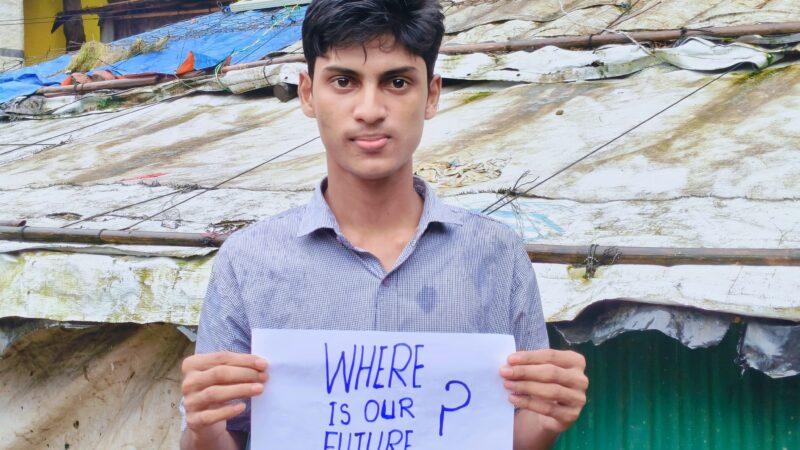
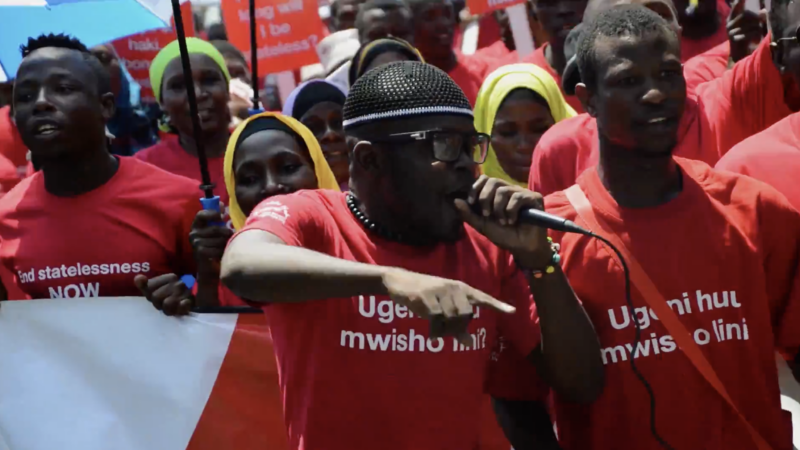


Artist Yadanar Win at a protest for Myanmar in Paris. Photo by: Stéphane Ferrer. 2024. Used with permission.
This post is part of Global Voices’ July 2026 Spotlight series, “Statelessness.” This series offers insight into the issue of statelessness and how it hinders people’s freedom of movement, educational opportunities, political access, and more. You can support this coverage by donating here.
In February 2021, Myanmar’s military grabbed power and deposed the ruling National League for Democracy (NLD). Since then, the coup has triggered a major humanitarian catastrophe as the junta waged a brutal crackdown targeting pro-democracy forces and activists.
According to a January 2026 report released by the Jesuit Refugee Service (JRS), 3.6 million people have been recorded as internally displaced persons (IDPs) due to the conflict in Myanmar. The United Nations said the number of IDPs increased this month after Myanmar’s State Administration Council (SAC) intensified indiscriminate and deliberate aerial and artillery attacks on civilian communities, schools, hospitals, and places of worship. In the first half of 2026 alone, the military conducted 477 air strikes targeting civilians and areas controlled by Ethnic Resistance Organizations (EROs). With 1,200 distinct armed groups, ACLED called Myanmar the most fragmented conflict in the world.
Legal warfare and transnational repression
Women were at the forefront of democracy and resistance in Myanmar: Now they are targeted by the junta due to their gender. Photo credit: Stéphane Ferrer. 2024. Used with permission.
Pro-democracy artists, musicians and filmmakers are among the most active figures resisting the junta. By opposing the military government, the creative class has been severely targeted through arrests, executions, and citizenship revocation.
“After the coup, those who were involved in protests were sent to prison or disappeared. Many joined liberation armies in the jungles; many fled the country. Freedom is absent for artists, activists, and journalists. The country is one of the worst places for activists, artists, and journalists. The junta is making sure that the country remains shut out from the world,” said Yadanar Win, an exiled Myanmar artist based in Marseille, France.
Yadanar is one of a handful of Myanmar artists who were forced to escape the country after the coup. While living overseas, many continued to use their art against the junta.
In response, the junta arbitrarily used the 1982 Citizenship Law to revoke the documents of exiled Myanmar opposition leaders, activists, and artists, which rendered them effectively stateless — unable to return or to proceed to a different host country, while making them vulnerable to abuse, extortion, and human trafficking.
“I left Myanmar in 2021, three months after the coup. I no longer have my Myanmar documents. I can’t see my family since the war. It will be too risky to return,” said Yadanar.
Life of a displaced creative
Yadanar in Bolzano, Italy, 2023, showcasing her exhibition on Myanmar women. Photo credit: Stéphane Ferrer. Used with permission.
As a young artist, Yadanar joined the Yangon-based underground art collective New Zero, which was established by former political prisoners. She channeled her dissent through conceptual art and performance.
In Europe, Yadanar struggled hard to learn a new language while seeking legal status and continuing her advocacy for Myanmar’s pro-democracy movement.
“I arrived in France with zero notion of the language,” she recalls on the day she landed in France. “I never thought that I would be staying here. Without mastering the language, it’s hard to talk about Myanmar beyond the obvious, like its geographic location or landmarks,” she added.
The physical safety she feels by being away from Myanmar does not guarantee peace of mind. Adapting to a new culture while navigating long and complicated red tape to obtain legal status can put one in a constant state of anxiety and depression.
“In France, administrative obligations for foreigners are handled at the Préfécture [district office]. It is very taxing, with a lot of uncertainty and confusion on paper requirements and a long waiting period,” she explains. “I learned from my fellow Myanmar artists and other artists in exile that they are experiencing the same administrative hardships. The particularity for Myanmar artists is that many in the South of France Préfecture bureaucrats were unsure if Myanmar is an actual country.”
The local administrative ignorance, she suspects, reflects the lack of adequate media coverage about her home country. This leaves the small community of exiled creatives in France isolated, overlooked, and struggling to make themselves heard.
“There are not many of us, Myanmar artists. We are very small in numbers, and our voices are not as loud as others,” she told Global Voices. “There is very little support for Myanmar artists in exile, unlike others from Palestine or Ukraine, countries that have much better coverage by the international media.”
Beyond activism, life must go on. The local job market is known to be complicated for refugees to access. One in two refugees in France is unemployed or unable to work three years after their arrival in France, even as the French job market is desperate for workers, with 74 percent of employers reporting a talent shortage. L’Institut français des relations internationales (The French Institute for International Relations – IFRI) reports that one year after obtaining their refugee status, only 42 percent of refugees living in France manage to find employment — and those that do find work often take jobs outside their area of expertise or skill level.
“For an artist in exile, producing and expressing in the long term are difficult to do. First we need to survive. This year, I might need to deprioritize art in order to ensure my daily survival. I’m working to find time and energy to ensure that my activism will go on.”
Safe havens for creatives in exileAn artist’s creativity may face a vicious cycle beyond oppression, such as lack of representation and isolation. This is why the presence of collectives that embrace exiled artists is crucial, according to Yadanar.
In France, Yadanar found connection and creative freedom among other artists with a similar plight at l’Atelier des artistes en exil, a non-profit organization supporting artists in exile based in Paris and Marseille.
“Within the collective, I got to be listened to by fellow artists and to be with one another. We share ideas, preparing exhibition projects together and being one another’s support. This year, I did two exhibitions with the collective, so far.”
Still, Myanmar artists in exile are geographically scattered in different countries and time zones. “And so far, there’s no formal association linking Myanmar artists in exile, one that unites artists yet,” she ponders while pointing out the importance of building a cohesive community of artists sharing the same culture and mission dedicated to Myanmar’s liberation.
Comments (0)