
Remember me


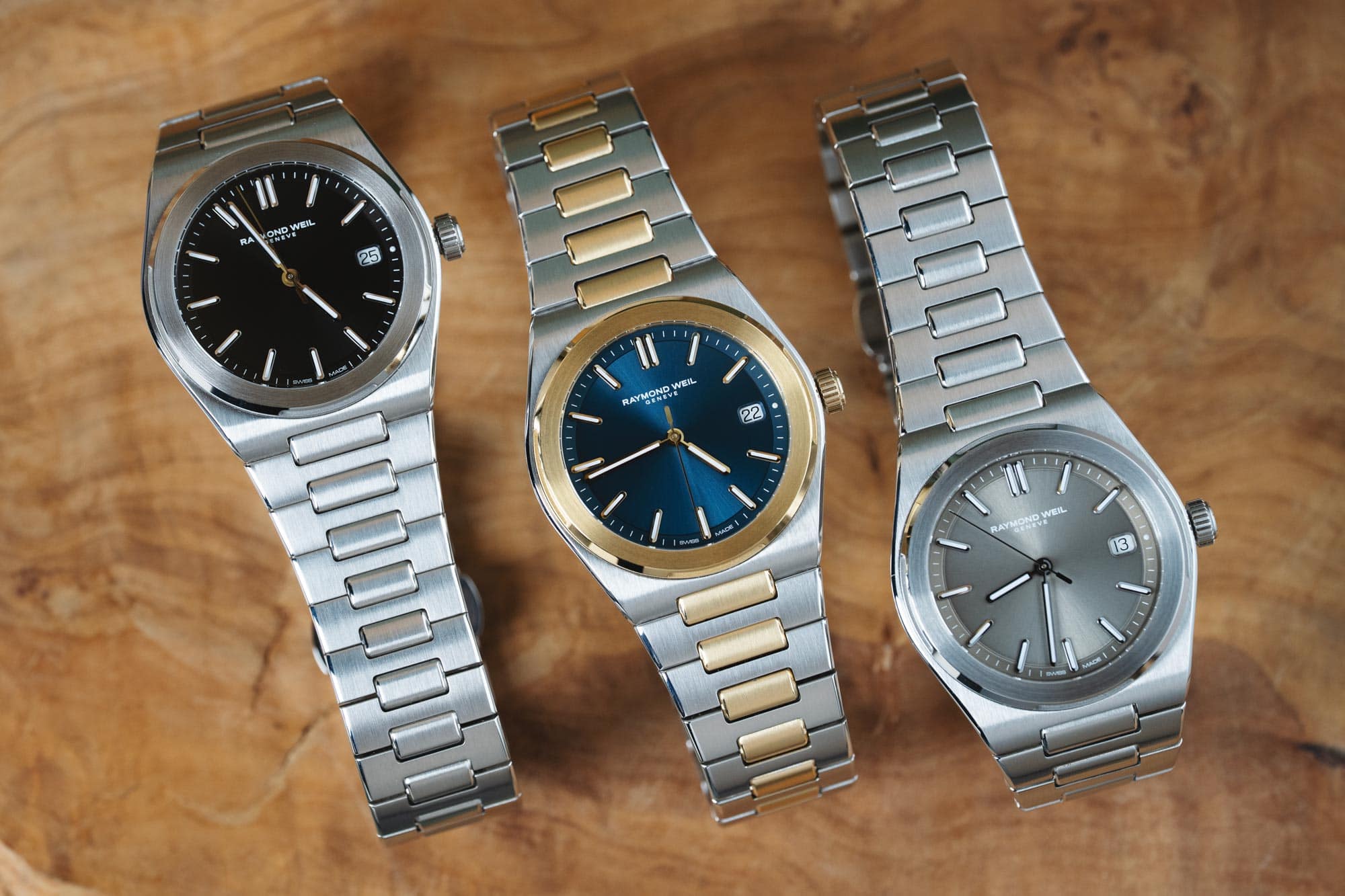
To reinforce the most important standards of the design, Gerald Genta defined the genre back in 1972 when the Royal Oak debuted: namely, a beefy bezel, stainless steel all over, and a seamless curvature from the sides of the case into the bracelet itself, which often has short center links that draw to attention the lack of lugs. The A.R.T. takes those design cues and brings them back to their original roots, starting with the centerpiece of its own beefy bezel, round and brushed and with four cutouts on the sides of the bezel that recall the Vacheron Constantin Overseas. It surrounds a range of dial colors, encompassing blue, black, and light and dark gray variants—as well as a diamond-ringed bezel and a mother-of-pearl dial. For a touch of late-seventies excess, a two-tone variant adds a pop of gold to the bezel as well as to the bracelet’s center links, with black or blue dials as options.
Out of all these variants, the light gray coloration—what Raymond Weil calls Sage Grey—was my favorite. It’s easy to assume that so much gray would blend into the mass of silver that encompasses the dial, but it manages to catch different angles of the light to seem almost radiant.


The uncluttered dial is packed with blink-and-you’ll-miss-it details. It features a sunray-brushed center section that extends to the edges, punctuated by a thin minutes track, with a lack of visual text other than the brand name and “Geneve” underneath. On blue dials, the sunburst look pops, while it washes out on black and gray dials.
Raymond Weil has captured a very Genta-esque look of long, skinny batons and hands in white, surrounded by a thin ring of polished silver: it’s a style that both the IWC Ingenieur and Patek Nautilus share (and, come to think of it, the aforementioned Overseas, not designed by Genta but his most esteemed peer, Jorg Hysek). The markers and hands are both oval-shaped, while at the 3 o’clock position, the date window also has rounded edges to match—a truly lovely little touch, especially for self-professed date window haters like myself.


Sized at 38mm, you’d be surprised that it’s indicated at that size: it wears far larger and more assertively than what’s considered a mid-sized watch. For the record, that is a compliment. Its modest dimensions encompass a comfortable 42mm lug-to-lug size and a height slightly under 10mm, which both combine for a snug fit on my twig-like wrists, with enough flex in the integral links to go wider if necessary. That tonneau-shaped case slopes down gently to 18mm at the bracelet’s clasp; said integrated bracelet being essential, it sports H-shaped links and a sharp taper to a butterfly-style deployant opening. While it’s shaped and brushed with plenty of inward flex, some microadjustment ability would be welcome — as the bracelet’s rigidity can feel stifling, especially in humid summer days where you just want to stretch out your wrist by a few millimeters.

Powering the ART is the RW4200 automatic movement, which in essence is a Sellita SW200-1: a thoroughly reliable Swiss-made movement with 26 jewels, a 28,800 vph beat rate, and a power reserve that’s good for 41 hours. It beats behind a closed caseback, which Raymond Weil can engrave for you for just $50. While display casebacks are in vogue, going this route feels more in tune with the retro Seventies feel, when there was more mystery in our lives. That solid caseback adds to a certain amount of practicality: if you do find yourself docked aboard a yacht in Bali, you can take heart in the fact that the A.R.T. is rated to 100 meters of water resistance.


Available in 38mm and 30mm sizes, and in a variety of finishes, the Raymond Weil A.R.T. series is priced starting at $1,995, helping it fit within a burgeoning category that includes the Venezianico Arsenale, the Maurice Lacroix AIKON Automatic, and the Tissot PRX, whose extensive range covers both sides of the A.R.T.’s price point.

And yet, few other watches in this modern category (again, a half-century old concept, once again made new) capture the spirit of the earliest sports watches as closely. Fifty years ago, all it took to break the norm was to simply exaggerate certain proportions, and to include a bracelet that doesn’t feel like an afterthought, but an integral and flowing component. And since then, the category has proliferated with tourbillions, exotic materials like ceramics and sapphire, even the occasional superhero tie-in. But from an era of bell bottoms and bicentennials, the A.R.T. serves a worthy ode to the advent of the sports watch, and that’s what makes it a worthy anniversary gift. Raymond Weil