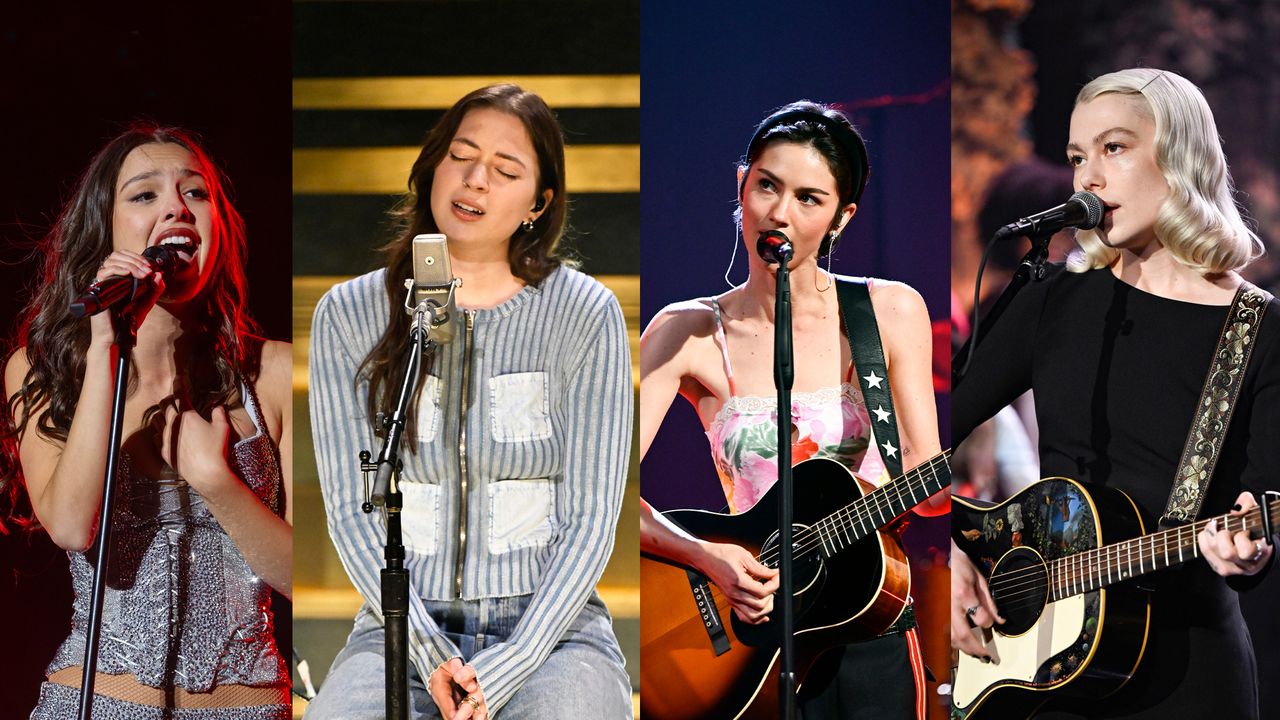
Like much that is great in modern culture, you can often thank a woman for any given year’s Song of the Summer—a typically sunny, infectious earworm meant to accompany a day in the heat like Sabrina Carpenter’s “Espresso” or Chappell Roan’s “Hot to Go!” These buoyant pop anthems have often been accompanied by their own eras: in 2019, Megan Thee Stallion’s Hot Girl Summer swept the nation, and in 2024, Charli xcx’s Brat Summer arrived. But this year, moody new albums from artists including Gen Z singer-songwriters Olivia Rodrigo, Gracie Abrams, and Lizzy McAlpine suggest a seasonal shift befitting of our own uncertain reality.
First came Rodrigo, whose batch of budding love songs morphed into a thorny breakup record. On her third studio album, You Seem Pretty Sad for a Girl So in Love, released in mid-June, she grappled with the weeds of anxiety that grew in her blossoming romance with British actor Louis Partridge, from whom she split last December. Referring to herself as “unraveled,” and a “sad shell of a woman” at various points on the record, Rodrigo ultimately comes to the conclusion that her malaise has very little to do with a man, singing on the song “The Cure:” “It don’t matter how your love feels anymore / It’ll never be the cure.”
Sharing personal demons and political passions go hand in hand for 23-year-old Rodrigo. “I am an artist, and what I do for my job is ‘this is how I feel,’ and present it to people,” she recently told The New York Times. “And I think it would just be disingenuous to be like, I don’t feel heartbroken about what’s going on in Gaza. You know what I mean?” In August, Rodrigo will host and headline her own inaugural one-day music festival called Daisy Chain Fields, a spiritual successor to Lilith Fair with an all-female lineup including Stevie Nicks, Doechii, and Mitski. All net proceeds will go toward nonprofits advocating for women and girls.
That’s also been true of Abrams, 26, who campaigned for Kamala Harris in the last presidential election and now confesses to “a new spiral every night,” on her latest album Daughter from Hell, released in mid-July. On the song “Humming,” Abrams sings about the fires that in January last year ravaged the Pacific Palisades neighborhood where she was raised. “Every kid I grew up with has lost their childhood house / No way to make sense of it, it’s why I’m making sound,” she sings. But Abrams is concerned with more than her own backyard. “There’s no one at the top to believe / What a way to feel in your twenties,” she sings of a youthful disillusionment no doubt felt by some of her pop contemporaries. “Do we stay numb?” Abrams wonders. “But you can’t when you’re seeing / How they all get off on our grieving.”
Elsewhere on the record, insecurity bleeds into her love story with Irish actor Paul Mescal: “If you could do me just a little favor, tell me I’m no failure?” Abrams sings in “Imaginary Friend,” the song on which Mescal is a credited cowriter). One might assume some thematic connective tissue to new music from Mescal’s ex Phoebe Bridgers, whose next album Lost Weekend, slated for release August 14, will be her first solo effort in six years. On the lead single “Lost Boys,” Bridgers sings about her lack of regret, but not remorse, in beginning a new chapter: “You told me you wish you were dead, but I don’t believe that,” she croons. “I still wonder how you’re sleeping / And I don’t feel bad, but I’m sorry.”