'I thought this must be what a relationship is': One in three girls experience economic abuse before 18, new research finds
One woman, who we are calling Becky, told LBC she was left with £50,000 worth of debt.
By Helen Hoddinott
Almost 1.3 million teenage girls and young women in the UK have experienced economic abuse from a partner over the last year. Economic abuse can show up in young relationships as a partner using money, gifts, or financial pressure to control choices, limit independence, prevent them from going to work or school, or make someone feel they cannot leave.The consequences can last for decades, often continuing long after a relationship has ended, with women being saddled with tens of thousands of pounds of debt as a result.One woman, who we are calling Becky, told LBC she was left with £50,000 worth of debt.Read more: Moment triple murder suspect flees UK days before wife and daughters, aged five and 15, found dead at family homeRead more: Suspects accused of ‘shooting Monaco bomber four times in back of head' are pictured along with 'torture chamber'
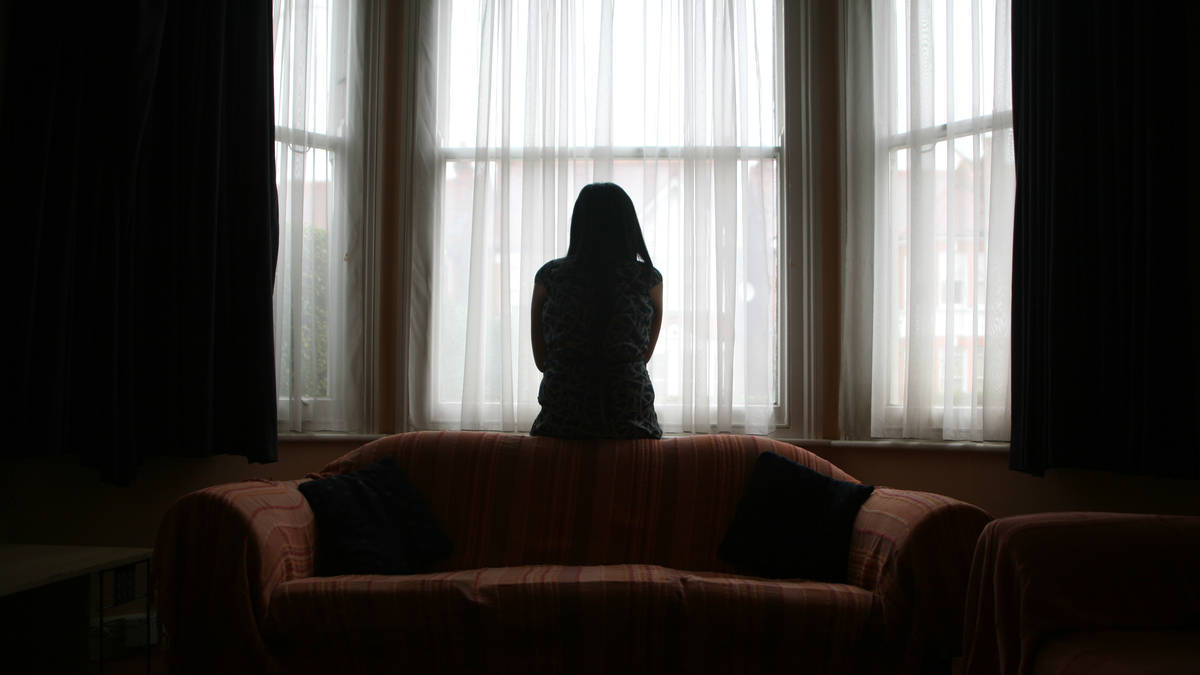
Almost 1.3 million teenage girls and young women in the UK have experienced economic abuse from a partner over the last year.
Picture:
Andrew Aitchison/In Pictures Ltd./Corbis via Getty Images
The survey of 1,900 girls and young women, carried out by Ipsos UK on behalf of Surviving Economic Abuse, suggests that more than one in three (36 per cent) aged 16 to 24 have experienced economic abuse in the last year.Alarmingly, it found that teenage girls in the early stages of a new relationship are particularly vulnerable.Responses indicated that for many, economic abuse started within weeks of a relationship starting, with 17 per cent of 16-18 year-olds saying that it started within the first month, which was more than double the rate of women aged 22 to 24.Half of those who had experienced it reported a negative impact on their mental health, such as depression or panic attacks.Last month, Home Office data highlighted that boys and young men are far less likely than older men to recognise economically abusive behaviours as abuse.Responding to the survey, almost one in five 18-24 year-old men (19 per cent) said that controlling how someone spends their money is "probably not or definitely not abuse," compared to just 6 per cent of 45–54-year-olds.
Almost 1.3 million teenage girls and young women in the UK have experienced economic abuse from a partner over the last year.
Picture:
Alamy
Sam Smethers, CEO of Surviving Economic Abuse, which collaborated with the government on the research, called the results worrying: "We think this is also part of a wider pattern of what's happening to the attitudes of boys and young men, in terms of misogyny, the kind of influences that they're experiencing online."She told LBC more research is needed to investigate why younger men are less aware of the issue, but said the ideals promoted by the manosphere could be an influence.Speaking exclusively to LBC, Becky, which isn't her real name, said she met her "first proper" boyfriend when she was eighteen years old, and said because it was her first serious relationship, she had no frame of reference for what was healthy."I'd had nothing to compare it to," she says.Her partner was ten years older than her, and initially showered her with expensive gifts, took her on holidays, and "always paid for things."
She felt "really loved, really appreciated," and the relationship moved fast.Six months after meeting him, she moved out of her parents' house and in with her partner: "When I was that age, I thought I was big and bad, and I was like, yeah, I'm gonna move house."Immediately, the relationship became increasingly controlling. She wasn't allowed to see friends, use her car, wear certain clothes, or go to the gym, and gradually became isolated."I never got that whole 'let's go on girls' holidays, let's go out with friends'. I feel like a lot of my youth was robbed."At the time, Becky was working a "really good job", but became pregnant after her partner hid her birth control. He promised to support the family financially, and she didn't go back to work after having her baby.They moved house "about 5 or 6 times, and each time further and further away from family and friends."
Almost 1.3 million teenage girls and young women in the UK have experienced economic abuse from a partner over the last year.
Picture:
Alamy
It was then that she realised that the family was in dire financial straits: "It turned out that he wasn't paying council tax, wasn't paying bills."She found out he had taken out credit cards and run up bills in her name."He had coerced me into getting an overdraft, a bank loan… he took a car out in finance in my name."His actions left Becky in £50,000 of debt."When I actually fled and moved into a house, I couldn't even get Wi-Fi because my credit was that bad," she told LBC. "I couldn't get a car, couldn't get a mobile phone. I couldn't get anything. So literally fleeing away from that situation was so tough... And I think when you start disclosing things to people, they struggle to understand because the debt was all in my name."Because her partner controlled the household finances, she also missed learning basic financial skills that many young adults gradually develop."When I left, I struggled to set up direct debits," she says."I didn't really understand finances because someone else had controlled everything."
Almost 1.3 million teenage girls and young women in the UK have experienced economic abuse from a partner over the last year.
Picture:
Alamy
Even now, almost ten years later, she says she constantly worries about money."The constant checking and looking at my bank account, the obsessiveness of what goes in and out of my bank, um, the constant worry and stress.""I hope one day I'll be able to be financially stable. However, I'm not there right now. So I don't think there's ever an end date. I think it impacts people and survivors for their whole lives. And then that impact... if you've got children, family, friends, that impacts them as well."Becky believes that educating young people about healthy relationships and the signs of financial abuse is a vital step in tackling the issue."As parents or educators, you need to be having these conversations and make it very clear about how respectful and understanding you need to be in these young relationships because you're going to have an impact on someone's life from a very young age."I think more funding needs to go into educating [people about it], you know, not just schools but colleges, universities, and workplaces. You know, everyone needs to be educated around the impacts of it because it is invisible," she added.