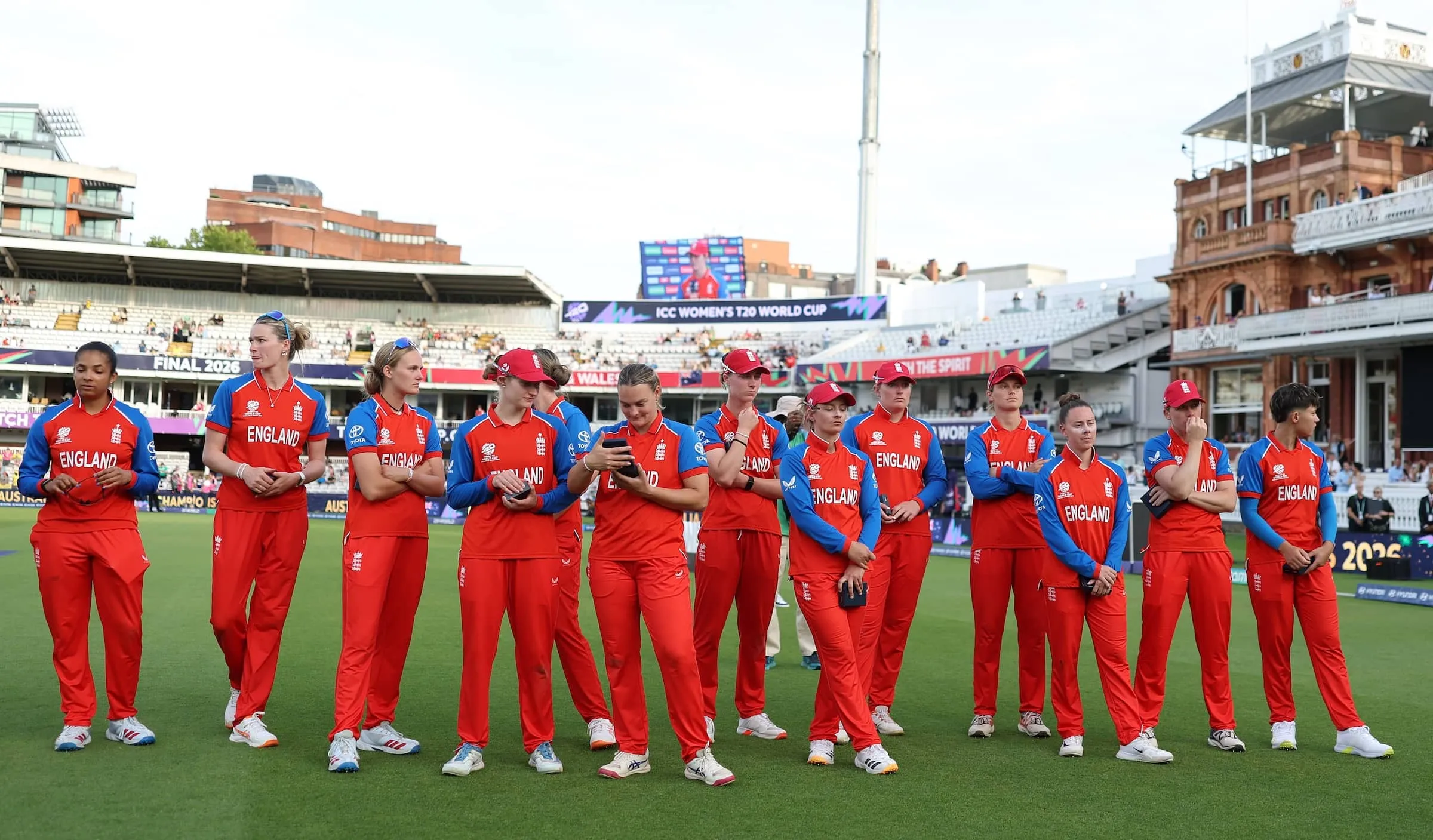
England Women’s brave Lord’s push in the ICC T20 World Cup final ended with Australia Women lifting the trophy, Beth Mooney’s ice-cool 64 guiding a seven-wicket chase after England had posted 150-4 on a grand, noisy and ultimately unforgiving afternoon.
There was plenty for England to admire in their own performance. There was effort, nerve, recovery and no shortage of defiance. Unfortunately, they had run into Australia, which in women’s cricket can often feel less like an opponent and more like a highly polished machine with a fondness for removing hope in tidy, measured pieces.
England Find Fight After Early Australian Pressure
A sold-out Lord’s crowd of more than 28,000 had come looking for a home coronation. The place had the feel of a proper occasion before a ball was bowled, with Rita Ora providing the pre-match sparkle and a summer afternoon doing its best impression of a postcard.
England, sent in to bat, needed a clean start. Instead, Australia’s opening bowlers Kim Garth and Lucy Hamilton set about making the new ball look like a committee meeting: precise, dry, and rather difficult to enjoy.
Amy Jones was the first to go, carving to backward point, before Danni Wyatt-Hodge, the tournament’s top scorer, departed in the fifth over after getting the faintest glove down the leg side to Annabel Sutherland. England were not so much collapsing as being gently, clinically restrained.
Captain Nat Sciver-Brunt tried to change the tempo alongside Alice Capsey, but Australia’s fielding was sharp enough to draw blood from a stone. By the time two further wickets had fallen inside 11 overs, England were 70-4 and the Lord’s hum had developed a nervous edge.
Kemp And Sciver-Brunt Give England Something To Defend
Then came the stand England desperately needed. Freya Kemp joined Sciver-Brunt and gave the innings a burst of oxygen. The pair added 80 in nine overs, dragging England from a position of concern to one of at least mild strategic optimism.
Kemp’s contribution mattered because it changed the mood. Until then, Australia had dictated the pace of the contest with the faint air of a side arranging furniture in a room they already owned. Suddenly England were hitting with conviction, rotating with purpose and building towards a total that could be defended if the ball swung, the crowd roared and Australia had the decency to wobble.
England finished on 150-4. It was not a total that would terrify Australia, but it was enough to make a final breathe.
Beth Mooney Turns The Chase Into A Statement
Australia’s reply began with the only thing England could truly cling to: an early wicket. Georgia Voll chopped on to Lauren Bell for nine, and for a moment Lord’s found its lungs again.
Then Beth Mooney took over.
Mooney’s innings was not frantic. It was worse than that for England. It was composed. She moved around the crease, advanced down the pitch, picked her moments and attacked without gifting the fielders anything obvious to catch. It was batting with a calculator in one hand and a small dagger in the other.
Phoebe Litchfield gave her excellent support, and the pair drained the contest of English possibility. The scoreboard kept moving, the required rate stayed civilised, and England’s bowlers were left searching for mistakes from batters who appeared deeply uninterested in making them.
Litchfield eventually fell for 48, bowled by Charlie Dean, but by then Australia needed just 34 from seven overs. That is not a chase. That is paperwork.
Australia’s Composure Proves The Difference
Mooney was eventually dismissed for 64, but the damage had already been done. Australia reached 153-3 and won by seven wickets, sealing the final with the ruthless neatness that has become their calling card.
For England, there will be frustration, of course. Finals are not remembered for effort alone, however noble. Yet this was not an empty defeat. They gave a sold-out Lord’s something to believe in, recovered from early pressure, and forced Australia to produce a chase of serious quality.
That, in the end, was the sharpest compliment Australia paid them. They did not saunter to the trophy. They had to be excellent.
England inspired the room. Australia took the silverware. And at Lord’s, beneath all the noise and colour, the old sporting truth held firm: heart gets you into the contest, but composure tends to leave with the cup.
ICC WOMEN’S T20 WORLD CUP
12 June: England Women beat Sri Lanka Women by 87 runs, Edgbaston
16 June: England Women beat Ireland Women by four wickets, Hampshire Bowl
20 June: England Women beat Scotland Women by 38 runs, Headingley
24 June: England Women beat West Indies Women by 38 runs, Lord’s
27 June: England Women beat New Zealand Women by nine wickets, The Oval
02 July: England Women beat South Africa Women by 40 runs, The Oval
05 July: England Women lost to Australia Women by seven wickets, Lord’s