Wimbledon allows Turkish tennis player to display pro-Palestine watermelon symbol on her racket - despite claiming it doesn't allow political messages on court
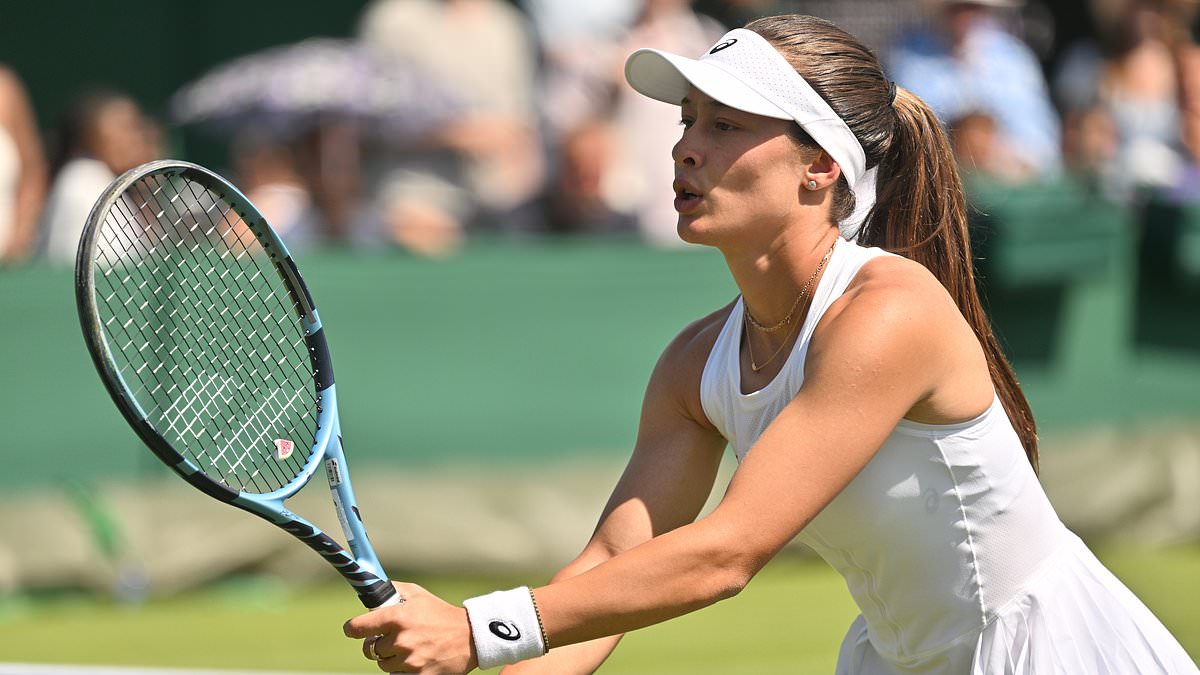
Wimbledon has ruled that a watermelon symbol widely associated with Palestine does not breach its rules on political messaging, despite a player claiming she was barred from wearing a pro-Palestine pin during this year's Championships.The All England Club said the watermelon-shaped vibration dampener attached to Zeynep Sönmez's, 24, racket did not meet the threshold for punishment, even though tournament rules prohibit political messaging from players on court.Explaining the decision, tournament director Jamie Baker said: 'We don't allow any kind of political messaging from players on court, certainly that caused any type of disruption. That has been consistent across the rules for a long time.'But in terms of the watermelon, we don't think that's meeting the threshold for causing any type of disruption... or worth any punishment.'The comments come after Sönmez revealed she had switched from wearing a Palestine pin to using the watermelon symbol on her racket after discussions with tournament organisers.The watermelon has become a widely recognised symbol of Palestinian identity because it contains the same colours as the Palestinian flag - red, green, white and black - and has long been used as an alternative emblem.Speaking to Turkey's state-run Anadolu Agency, the world No 51 said: 'I used to wear a pin. Tournaments no longer allow me to wear it. We had a discussion with the organisers because the Ukrainian flag is allowed but the Palestinian is not. 'They ultimately told us they definitely would not allow it. So, I can't wear the pin. I can use the vibration dampener, and they can't object to that. That's why I put the watermelon symbol on my racket.' The watermelon has become a widely recognised symbol of Palestinian identity because it contains the same colours as the Palestinian flag - red, green, white and black - and has long been used as an alternative emblem Zeynep Sönmez, 24, played with the watermelon on her racket during her first-round singles clash against America's Claire Liu on Wednesday.The issue has prompted questions over where Wimbledon draws the line on political symbols.As earlier this week, Ukrainian player Daria Snigur was photographed wearing a Ukrainian flag pin on top of her white tennis dress while competing at the Championships.Asked why Sönmez was told she could not wear a Palestine pin while Snigur was permitted to wear a Ukrainian emblem, Mr Baker insisted the two situations were not comparable.'The Ukrainian situation was obviously quite unique, and we were following our government guidance, and the international response. We provided support to our Ukrainian players for quite a while, so that was an individual situation.'Sönmez's distinctive racket accessory attracted attention throughout her Wimbledon campaign, which came to an end in the second round after a 7-5, 6-3 defeat by American Claire Liu on Wednesday.She then returned to the courts on Thursday in the women's doubles alongside Spain's Jessica Bouzas Maneiro, but the pair were beaten in three sets by Shuko Aoyama and En Shuo Liang. As earlier this week, Ukrainian player Daria Snigur was photographed wearing a Ukrainian flag pin on top of her white tennis dress while competing at the Championships Daria Snigur of Ukraine celebrates victory over Elina Svitolina of Ukraine during their Ladies' Singles first round match on day two of The Championships WimbledonThe 24-year-old has previously spoken publicly about her support for Palestinians. In 2024 she told the WTA's official website: 'It's a sensitive area for me. People in Palestine are suffering. I see the videos and photos and feel that there's not so much we can do.'But we can always do our best - it's like I was saying, you can be the best version of yourself. I want everyone to know that I'm standing with them.'There are bad things going on all around the world, but I feel like they're not having the attention that they need. There is something very scary going on, and I want people to be aware of it. If I can take even a little bit of attention to them, that's good.'Her stance has also been backed by Turkish Minister of Youth and Sports Osman Askin Bak, who praised Sönmez on social media, writing: 'We are proud of our athlete Zeynep Sönmez, who holds her conscience, courage, and human values above all else.'By refusing to remain silent in the face of the humanitarian tragedy unfolding in Palestine, she has once again demonstrated with her honorable stance that sport is not merely about competition; it is also a carrier of universal values.'For this meaningful sensitivity, we wholeheartedly congratulate our athlete and respectfully salute every conscientious voice that stands with the oppressed.'Wimbledon maintains one of the strictest dress codes in sport, requiring players to wear almost entirely white clothing, although organisers have previously allowed black ribbons to be worn in exceptional circumstances, including by Ukrainian player Elina Svitolina following the Russian bombing of a children's hospital in Kyiv.