Ukraine seeks €6.6 billion from EU's peace fund for military aid
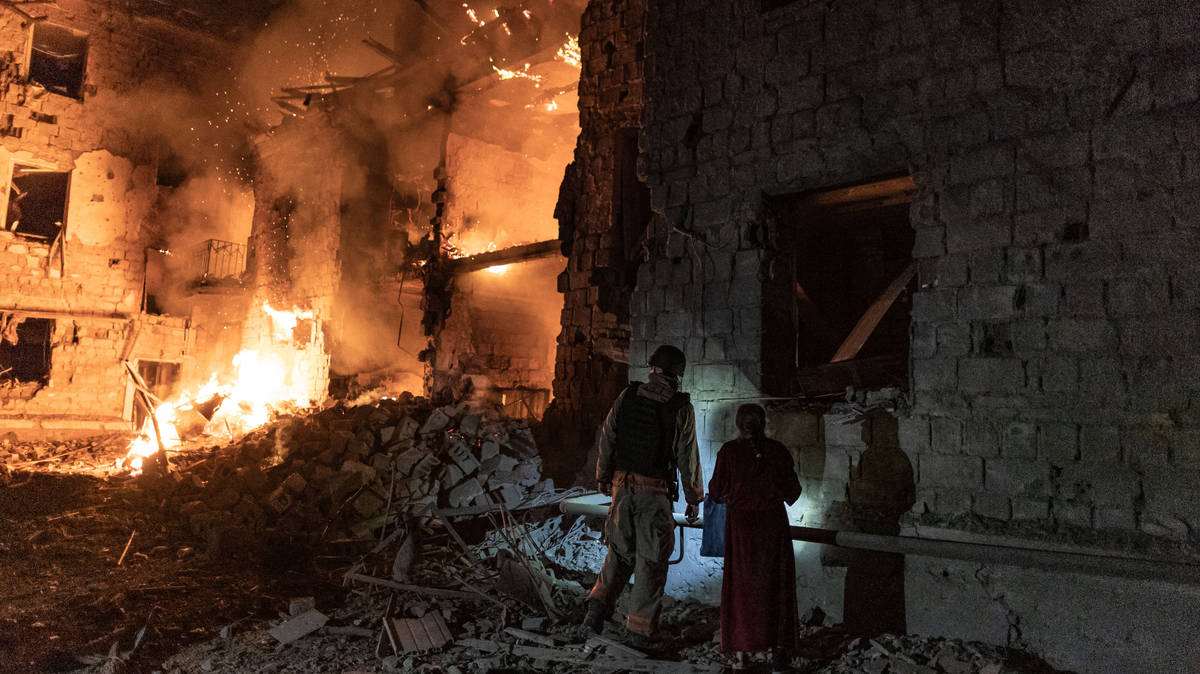
Ukrainian firefighters try to extiunghish a fire at a burning building at night following a Russian bombardment of a residential area in Kramatorsk, Ukraine, 30 June 2026.
Picture:
Diego Herrera Carcedo/Anadolu via Getty Images
Ukraine is asking its European Union partners to direct €6.6 billion (£5.6 billion) available under the European Peace Facility to military aid, to take advantage of what it sees as a six-to-nine-month "window of opportunity" on the battlefield. Ukraine's total defence need is estimated at around €136 billion this year, with the Ukrainian budget covering around €53 billion of that amount, Defence Minister Mykhailo Fedorov said.Ukraine is set to receive about €28.3 billion for defence purposes this year from the €90-billion EU loan, but even with that and Kyiv's own funding, "substantial" defence financing needs remain unmet, Fedorov said in a letter seen by Reuters, dated June 26.The funds under the EPF could become "one of the most impactful European contributions to Ukraine's defence effort this year, but only if those resources are directed where they can generate the greatest and most immediate military effect," he said.Read more: Ukraine denies Russian claims foreign gamers are being paid to fly killer drones against Putin’s forcesRead more: Russian troop build-up threatens city seen as key to seizing Ukraine's Donbas
Russia's advances have slowed this year, with Ukraine staging successful counterattacks on some parts of the frontline and leveraging its mid- and long-range attacks on Russian territory to disrupt Moscow's logistics and curb its oil revenue.Separately, Fedorov told a news conference on June 17 that he was seeking an additional $20 billion in military funding from the Ukraine Defence Contact Group — an alliance of 50 nations, also known as the Ramstein group, that provides aid to Ukraine — on top of $40 billion already committed.
Polish special services are preparing for possible Russian sabotage operations aimed at inflaming tensions between Poles and Ukrainians, Tomasz Siemoniak, minister in charge of special services, told RMF FM Radio on Wednesday.Relations between Poland and Ukraine have deteriorated after President Karol Nawrocki's decision to strip Ukrainian President Volodymyr Zelenskiy of Poland's highest state honour due to a dispute over the naming of a Ukrainian army unit after insurgents blamed for massacring Poles during World War Two.Siemoniak said Russian information warfare against Poland had intensified in recent weeks, with trolls and bots seeking to amplify disputes and influence Poland's online space."Russia's dream, the dream of the Russian services, was and is the greatest possible tension between Poland and Ukraine," Siemoniak said.
Ukrainian rescuers work to extinguish a fire at a damaged house following an airstrike in Zaporizhzhia on June 30, 2026, amid the Russian invasion of Ukraine.
Picture:
DARYA NAZAROVA / AFP via Getty Images
Asked about the possibility of a Russian provocation, including an attack targeting Ukrainians in Poland that could further inflame public sentiment, Siemoniak said such scenarios were entirely plausible."We observe the interest of people who are commissioned by Russian services in various facilities which are important from the Polish-Ukrainian point of view," Siemoniak said.He added the interest was not limited to military facilities, critical infrastructure and sites involved in military support for Ukraine, but also extended to aid organisations and other locations linked to Polish-Ukrainian cooperation.He said authorities were not suggesting any specific plot was imminent but had to anticipate attempts by Russia to exploit current tensions.More broadly, Siemoniak said Western intelligence agencies are concerned about the risk of Russian hybrid, or even kinetic attacks, against Poland and the Baltic states."Russia has an arsenal of such actions and... they are preparing them," he said. "We have to take into account various possibilities."