
Remember me

, among her litany of talents and accolades, is aware she’s not the savviest when it comes to technology. That doesn’t mean she doesn’t understand when technology begets a problem, particularly when it comes to AI.
“I know next to nothing about technology,” she told Variety in an interview last week. “But I know a problem or a challenge when I see one.”
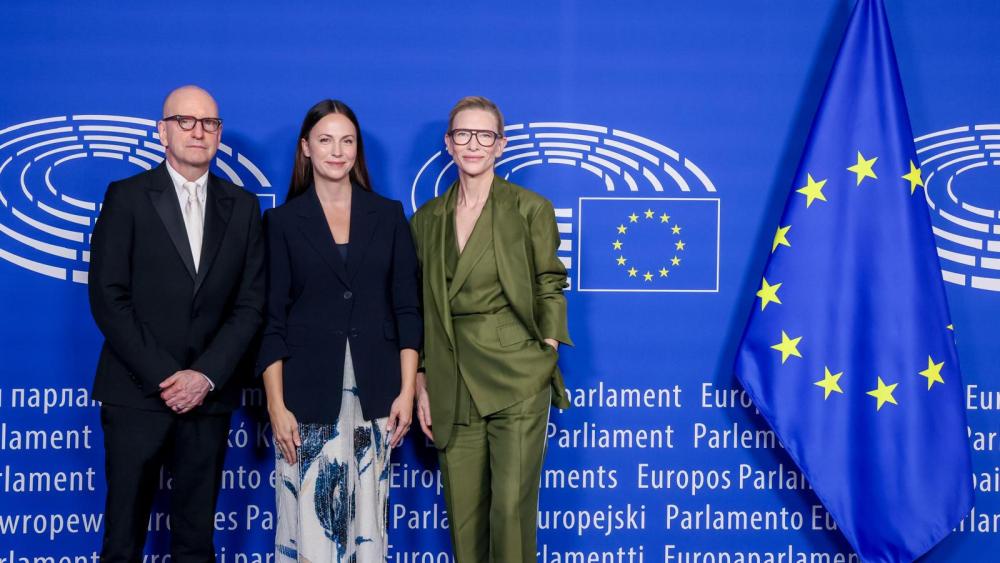
Blanchett has been outspoken about the issues arising from AI, and last week, she gave a presentation on the Human Consent Registry at the European Parliament. The registry is a free public utility tool that lets people create a record of how their name and likeness may be used by AI. The tool was created by , a non-profit cofounded by Blanchett that launched last month, and its purpose is centered on the belief that your identity is your intellectual property, and every person should be able to dictate what can — and cannot — be scraped by AI models.

“The challenge is [AI models] just keep splintering and breeding at such a rate, so I think we all feel a bit bamboozled by which part to tackle first,“ Blanchett said. “What I loved about what RSL Media were doing and why I wanted to come on board is they were offering a really simple not-to-profit open standard, a solution, that people can go in when they’re negotiating with whoever.”
Speaking before the European Parliament alongside Bulgarian member of parliament Eva Maydell, RSL Media co-founder and , the Oscar-winning director who’s an RSL Media supporter, Blanchett stressed the need for an open standard that protects how people’s identities are adopted by AI tech. The company, whose abbreviation stands for “really simple licensing,” has garnered the support of some of the entertainment industry’s boldest names, including Tom Hanks, Emma Thompson and Javier Bardem. CAA also has joined the project as a partner.
While the EU passed the Artificial Intelligence Act in 2023 and the U.S. has introduced bills such as the NO FAKES Act to combat AI-generated deepfakes, there are few codified ways people can declare how AI can use their identity. Many of the companies that offer services to safeguard people’s likenesses do so at a steep cost, requiring tens of thousands in a bid for individuals to secure their identity from AI’s potential misappropriation. The situation has led celebrities including Taylor Swift and Matthew McConaughey to file for legal trademarks on their voice and image as legal protection against AI theft.
The registry aims to fill the gap through a free, centralized hub for people to declare and protect their likeness without the need for lawyers or such costly services, an endeavor its cofounders hope offers a standard that potential regulatory efforts on AI can be built.
“If there’s going to be a solution, it’s got to be built on this kind of framework, otherwise you’re going to create a tiered system in which some people have access to these rights and protections, and the people that can’t pay don’t,” Soderbergh said in an interview. “That is exactly what we don’t want, and so this to me is a really elegant solve. It’s simple to use and simple to understand.”
The registry’s genesis stemmed from Hexum’s attempt to create an automation-forward record label that would “remove middlemen” who may exploit artists. But much of her work became issuing takedown notices to people misusing her artists’ work, leaving her little time to build the code needed for the record label and highlighting how, online, there were few avenues for people to advocate for themselves and their work.
“When the internet was built, nobody was sitting there thinking about, ‘Oh, how are we going to decide who owns what?’” said Hexum, who called protecting likenesses “a human right.” “It was a decentralized online area where you could go and share with anybody, so there was a missing consent layer to the internet, and I don’t think it became obvious that it was needed until AI.”
Users of the registry, which is open to the general public in the U.S. and the EU, can create a time-coded “identity” record in which they provide their name, profession, a short description of their identity, and several link options to help verify who they are. The system then provided a traffic light-esque model, where users declare whether AI is prohibited from (red), permitted with terms (yellow) or permitted (green) to use that person’s likeness.
The registry then produces code that’s readable by AI models scraping the internet. Hexum said RSL Media has been introduced to OpenAI and Anthropic, whose ChatGPT and Claude chat models dominate the AI space, and the organization has spoken extensively with SAG-AFTRA and talent agencies about how to register their members. As the registry grows, RSL Media plans to expand it to encompass copyright-protected works such as books, music and films.
“It’s not whether AI should or shouldn’t exist,” Hexum said. “It’s whether people have the ability to consent to being a part of that. Technology is here, it’s not going away, and now it’s just that core thing: ‘Am I OK with it? If I am, cool. If I’m not, I need a way, a practical way to say I don’t want to be involved.’”
The initiative also marks a rare marriage of advocates both for and against the technology at a time when Hollywood’s engagement with AI — whether through AI-generated actors such as Tilly Norwood, fully generated films or its use as a tool by some filmmakers — remains a third rail. Blanchett has previously said she feared AI could be “incredibly destructive” to the entertainment industry, while Soderbergh has been public about his use of generative AI in films like “John Lennon: The Last Interview” and his upcoming Spanish-American War film starring Wagner Moura.
Blanchett said she recognizes AI marks an “inflection point” in the industry and that she’s “fascinated” by its potential as a tool for completing “tedious tasks.” But where she draws the line is at the “thoughtless” approach by some who believe “human consent is impeding your creativity,” raising the risk of unauthorized use of people’s voices and likenesses and necessitating “compromise and conversation” in how it’s adopted.
“That pause is really important,” she said. “That moment for breath and thought is a really important part of the creative process. When humans are forced to career along a path creatively trying to be in the slipstream of technology, then I think it’s destructive and counterproductive,” Blanchett said.
“And then there’s this word called ‘better,’” Soderbergh added. “Is it better? Are you using this technology in a way that is allowing you to do something that you literally couldn’t do otherwise? That criteria, ‘is it better than every other option?’ So, the Tilly Norwood thing simply comes down to the fact: Tell me, I’m willing to be convinced. Tell me why it’s better to have her than an actor. I’m listening. I just don’t know. Sitting here, I’m not sure how I would think that that would be better.”
The group recognizes that AI will continue to develop, as will the risk to how it portrays everyone from Oscar-winning celebrities to everyday people. But as companies iterate on the technology, RSL Media hopes to minimize concerns that safeguards like its free registry might dampen technological progress through its public-service minded approach and accessible nature. (Members of the European Parliament were enthused by the registry across party lines, Blanchett and Soderbergh said.)
“This standard is not going to revolutionize our relationship overnight,” Blanchett said. “The more people adopt it, the more chance it has of making a real impact. But we do have to start somewhere, because thoughtlessness is the enemy of creativity.”
Her call to action is simple: The registry is free, and anyone can use it. “Preschools and universities can use it. It’s free,” Blanchett stressed.
Learn more about the registry here.