
Remember me


A.I. Artificial Intelligence is one of the strangest and most polarizing movies in Steven Spielberg's filmography, in large part because the 2001 sci-fi movie is also the brainchild of another legendary filmmaker, Stanley Kubrick. Directed by Spielberg but based on a story that Kubrick had been fascinated with and held the rights to for three decades, A.I. is the product of two cinematic visionaries with distinctive styles. Detractors of A.I., which turns 25 years old today, will sometimes point to the incongruity of Spielberg and Kubrick's tones as a reason for why the film doesn't work. There's some merit to those critiques, as the two vibes do clash at times. It's at the end, though, that A.I.'s Spielbergian and Kubrickian elements fully, seamlessly come together. The result is at once more wonderful and more horrible than anything in either's respective filmography.
Based on the 1969 short story "Supertoys Last All Summer Long" and eyed for adaptation by Kubrick shortly after, A.I. spend decades in development hell over concerns special effects technology wasn't good enough. It was delayed long enough for Kubrick to hand the project over to Spielberg shortly before his passing.
A.I. is set in a future when robots are commonplace. Most are simply tools or have limited sentience, lacking what flesh and blood folk would call emotion. David, a cutting-edge prototype played astoundingly by Haley Joel Osment, is different. He's been programmed with the ability to love. When a woman, Monica (Frances O'Connor) is distraught because her son is suffering from a seemingly fatal disease, she's given David so the robot boy can serve as something like a surrogate son or a therapeutic tool — and the line is murky.
David, sweet and innocent, is a devoted son who loves his mother, just as he's been programmed to. Monica loves him back, in a fashion, but complications soon emerge. Her real son, Martin, miraculously gets better. There's friction between Martin and David, and David's mechanical nature causes problems with other children. Eventually, Monica's husband, Henry, decides David is doing his family more harm than good and wants to have the robot destroyed. Monica can't quite bring herself to do it, instead abandoning David in the woods and telling him to go with his own kind. It's an act of twisted mercy, but David doesn't understand why his mother left him, and he embarks on a quest to become a "real boy," having been inspired by a story of Pinocchio and the Blue Fairy.
It's reductive to say Spielberg only made warm, halcyon movies with big feelings. It's also reductive, though perhaps not quite as much, to say Kubrick only made cold, calculating, intellectual films. Yet both filmmakers clearly have their hallmarks. The earnest way in which David approaches the world feels very Spielbergian, and such an outlook doesn't really belong in A.I.'s harsh, borderline dystopian world. The setting is more Kubrickian. In several scenes, whether it's a pool party gone awry, a "flesh fair" where carnivalgoers eagerly watch robot destruction, or moments when sentimentality unexpectedly breaks through the bleakness, A.I.'s seams are showing. It's disquieting and uncomfortable, and your mileage may vary on whether or not that's an intentional feature or a patchwork bug.
At the end, though, it all comes together. David and his robot Teddy Bear friend make it to the flooded ruins of New York City and find themselves trapped underwater in the wreckage of Coney Island, in front of a statue of a blue fairy. David believes this is the Blue Fairy, and wishes over and over again to become a real boy until he loses power. Then 2,000 years pass.
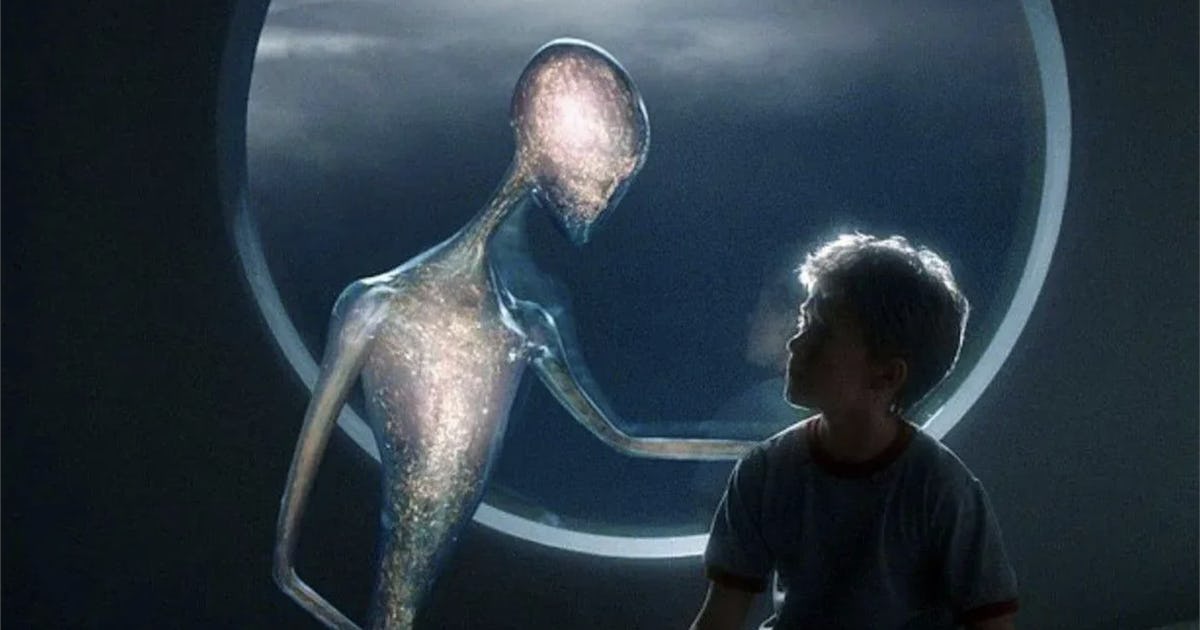
Humanity is extinct, but the hyper-advanced descendants of machines that evolved past their creators find David and power him back up. The mechas revere David for his status as a relic that actually encountered flesh-and-blood humanity and wish to make him comfortable, so they recreate the home that he lived in with Monica after scanning his memory. Then, taking the avatar of the Blue Fairy, they reveal that their advanced intellect has allowed them mastery of timelines, and they can resurrect Monica but only for one day. After that, she will fade from existence, never to be summoned again.
David has them do this, and then spends one beautiful day with his mother. They hug, they play hide and seek, he tells her about his adventures. It's perfect — everything David has ever wanted. It's also deeply uncanny and temporary. When she gets tired and falls asleep, David knows she'll never wake up. He snuggles up next to her and, for the first time, dreams.
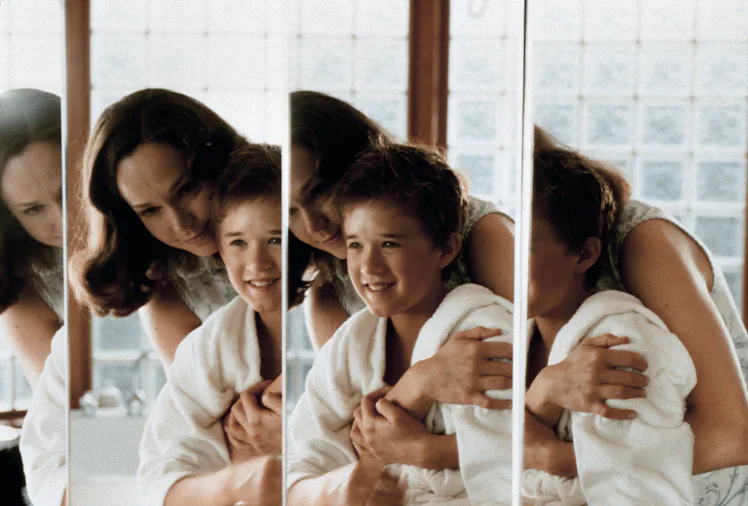
The film’s “sentimental” ending is bleaker than you think.
David James/Amblin/Dreamworks/Wb/Kobal/ShutterstockFor David, it's a happy ending. It's also an existentially dreadful one. Alone (except for Teddy) in the far-flung reaches of the future, an unaging eternal child exists in a recreation of his childhood home for eternity. A shade of his mother, the one person he loved and the one person who ever loved him — though that's complicated — was summoned back into existence for one day. The things they did together during that day were mundane; a glossy version of average interactions that any mother and child might have together. But for David, they were everything. Spielberg's mastery of wonder and emotion has been used to disquieting ends. Imagine if, somehow, the endings of Hook and 2001: A Space Odyssey could be fused together. That's what A.I.'s climax is.
Some viewers, somehow, miss the horror in A.I.'s ending. There's a widespread, erroneous belief that Kubrick would've ended his movie (had he made it) with David and Teddy stuck underwater for eternity, and it was Spielberg, being a softy, who came up with the happy ending. "They certainly assume that that’s how I wrecked Stanley’s movie," Spielberg has said of this rumor. "Stanley’s treatment, along with ["Supertoys Last All Summer Long" author] Ian Watson, went right into the 2,000-year future. This was where Stanley was going to take the movie had he lived to direct it, and this is where I was obligated to take the picture."
Spielberg also added that, even if it hadn't been Kubrick's vision for the ending, it's the one he would have had as well. It's a testament to both filmmakers that they saw where A.I. needed to go. Perhaps no other combination of artists could have made something as effective.
A.I. Artificial Intelligence is now streaming on Hulu.Learn Something New Every Day