
Remember me





A bizarre radio galaxy discovered by a citizen scientist has left astronomers puzzled, revealing a never-before-seen "bow-and-arrow" structure that could offer rare insight into how galaxies are reshaped by colossal shock waves as they plunge through galaxy clusters.
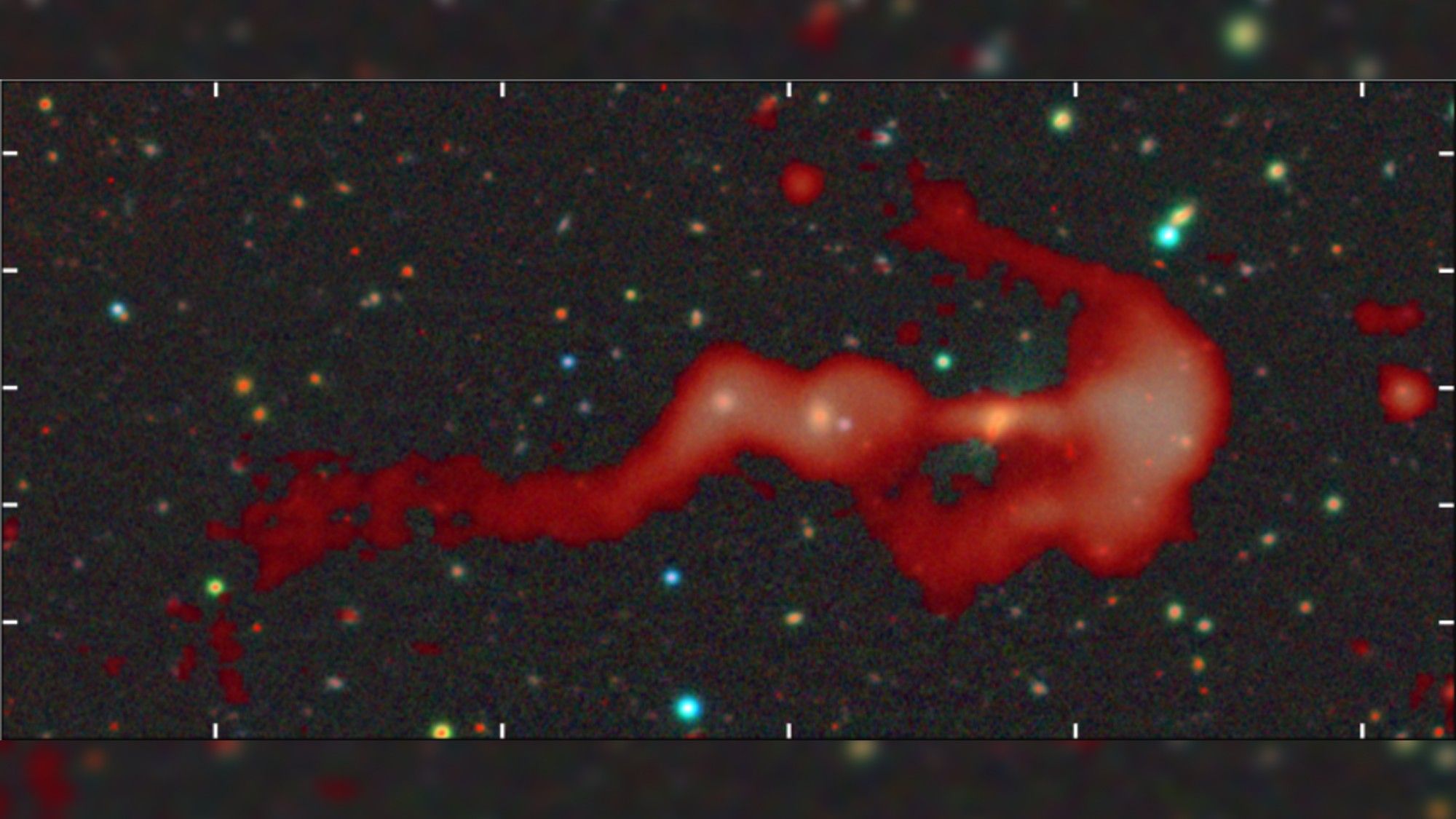
Named RAD-BAARG (short for Radio Bow-And-Arrow Radio Galaxy), the object spans nearly 1.8 million light-years across, making it almost 18 times wider than the Milky Way. Its unusual structure was first identified by a citizen scientist participating in the RAD@home Astronomy Collaboratory, which allows volunteers to review telescope data and flag unusual features that might otherwise be missed.
Astronomers say they haven't seen anything like it. "The structure of this source is unlike that of any radio galaxy I have seen in the last 25 years," the University of Mumbai's Ananda Hota said in a statement published by the Royal Astronomical Society. The statement adds that astronomers believe the structure may be "one of the clearest known radio signatures of a giant bow shock generated by a galaxy falling supersonically into a cluster environment."
Following its discovery, researchers studied the object using observations from the LOFAR (Low Frequency Array) Two-meter Sky Survey (LoTSS), one of the deepest low-frequency radio surveys ever conducted and particularly well suited to detecting faint, diffuse radio emissions.
Unlike typical radio galaxies, which produce two relatively symmetrical jets of charged particles powered by supermassive black holes, RAD-BAARG has a dramatically lopsided appearance. One jet feeds a wedge-shaped region that curves backward into an enormous arc, while the other twists into an S-shaped structure before fading into a long tail. Together, the features resemble a bow with an arrow drawn across it, according to the statement.
You may like The universe's 'most relaxed' galaxy cluster was shaped by cosmic violence, new study finds
 Record-breaking 'space laser' erupts from merging galaxies 8 billion light-years away
 Shockwaves from dying stars may sculpt 'cosmic wagon wheel' stellar nurseries, simulations reveal
The radio-emitting plasma from RAD-BAARG appears to illuminate an otherwise extremely faint, extended feature. At these low radio frequencies, aged and diffuse electron populations become more visible, allowing astronomers to trace structures that are otherwise invisible at optical or higher radio frequencies, making surveys like LoTSS especially powerful for identifying and confirming such diffuse emission.
Researchers believe the extreme asymmetry may be linked to the galaxy's motion through a dense galaxy cluster. As it falls toward the cluster's center, it likely moves at supersonic speeds through the hot, diffuse gas that fills the space between galaxies. This motion is thought to generate a bow shock that compresses magnetic fields and charged particles, reshaping the radio-emitting plasma into large-scale structures.


The team also found that RAD-BAARG resides in a complex "multi-halo" environment containing several overlapping reservoirs of hot gas, making it an especially valuable system for studying how galaxy clusters influence radio galaxies.
"LOFAR allows us to see this faint, low-surface-brightness emission in remarkable detail," Pratik Dabhade, co-lead author of the study from the National Center for Nuclear Research in Poland, said in the statement.
"With LoTSS DR3 and the future Square Kilometre Array Observatory (SKAO), we may find many more systems where radio galaxies reveal otherwise invisible interactions between jets, galaxies, and their environments."
If confirmed, RAD-BAARG could become a key example of how extreme cluster environments reshape radio galaxies, providing new insight into how supermassive black hole jets interact with their surrounding environments.
The findings were published June 22 in the journal Monthly Notices of the Royal Astronomical Society: Letters.