
Remember me




There is a simple, ancient idea behind everything Terra Ananta is: care for the land so that the land cares for those who come after. Deepanker Khosla puts it plainly when he tells me that, for his daughter’s first birthday — instead of a tricycle or a savings account — he decided to buy her a piece of farmland. “I wanted to explain to my daughter that what matters in a few years from now is our ability to replenish the land, to nurture nature, and to grow,” says the chef.
On that patch of earth, years later, a place has taken shape — one he has given a Sanskrit name, Terra Ananta, boundless earth — that says more than any definition about what it sets out to be.
Terra Ananta sits in the shadow of the Tenasserim Hills, in a spot where the river mist drifts across the terracotta soil at dawn. And though it may sound similar, Terra Ananta is not a restaurant with a farm; it is a farm with a house inside it. Khosla, the Michelin-starred chef behind HAŌMA Bangkok, has turned it into his private retreat — though one that can be visited, intimately and closely, since by arrangement a handful of guests can share the table with the chef and his family. The philosophy is nothing new. “It marries right into the philosophy of HAŌMA,” says Khosla of the project he founded almost ten years ago. What changes is the scale of the gesture: here sustainability stops being an argument on the menu and becomes the very ground beneath one’s feet.
 Royal palms mark the way in: a farm with a house inside it. Photo courtesy of Terra Ananta.
 Inside, the hall opens towards the kitchen at the back, the heart of the house. Photo courtesy of Terran Ananta.
Khosla chose Wang Dong, in Kanchanaburi province, after a great deal of research. The village sits at the confluence of ancient waterways and the fertile floor of the river valley, with forested limestone ridges rising to the north. It is a generous, largely uncontaminated land where farmers still grow things the old way. The region yields ingredients that almost no kitchen in the country can reach. “Kanchanaburi is considered the green belt of Thailand, where the soil is much more robust and productive. It’s also where over 70% of Thailand’s fruit is grown,” explains Khosla.
For a chef whose entire cooking is built on hyper-local sourcing, it was the ideal place. With four national parks within a twenty-kilometre radius, Wang Dong is the epicentre of biodiversity in this part of Thailand. The farm sits in a mountain valley, some 450 metres above sea level. “In the Bangkok farm, with the weather and the flooding, we could barely manage a few vegetables and mostly chickens and quail. We had our limitations,” he admits.
But it was not only the natural wealth that convinced the chef this was the place. The community weighed just as much, if not more. The village runs as a cooperative and under Thailand’s royal projects, which supply farmers with quality seed and fertiliser at subsidised prices, and every farm around irrigates with the same misting systems he has installed on his own. His neighbours are a banana and a durian farm on one side, a papaya and a mango farm on the other. “Everyone here moves in the same direction, using organic, sustainable practices. It’s all there in the community,” says the chef.
A land full of abundanceThe farm spreads across ten rai of working biodynamic land — some 1.6 hectares. With no chemicals and composting that follows the rhythm of the seasons, the philosophy is the same one that gave rise to HAŌMA ten years ago, only here Khosla takes it somewhere far more personal. “I didn’t want to grow only as a business grows, but to grow for real — grow more produce, grow more ideas. That’s why we’ve set up a whole biodynamic orchard here,” he explains.
And a great deal grows. More than a hundred mango trees of Thai and Indian varieties, fifty-odd coconut palms, lychees, longans, avocados, rose apples, jackfruit and a young grape terrace the chef has been planting since last autumn. All those fruit trees reveal an intimate motive, too: Khosla dreams of giving his wife an ice-cream and sorbet company — her favourite treat — made with the fruit of his own orchard. The land that began as a gift for his daughter thus extends into another for her.
 As night falls, the house mirrored in the chemical-free natural pool, built with the land rather than against it. Photo courtesy of Terra Ananta.
A house open by Arrangement
As night falls, the house mirrored in the chemical-free natural pool, built with the land rather than against it. Photo courtesy of Terra Ananta.
A house open by Arrangement
On Sundays, when HAŌMA closes its doors in Bangkok, Khosla drives an hour and a half west and opens his own at Terra Ananta. Far from being a day off, it is the continuation of what he already does during the week: if HAŌMA is his way of caring for the land from the kitchen, Sundays are his way of doing it from the field. In both, the same thing drives him — to build something and watch it grow. The villa does not aspire to more beds or more tables than it has. “It will stay like this. It’s for people who come to experience the farm and enjoy my cooking,” he says.
The day then becomes more of a visit among friends. “When you arrive, I welcome you with some canapés by the pool. You swim, have a drink, and then you have dinner cooked by me,” says the chef. That dinner is a feast of eight or ten dishes to share, family-style, built from whatever the farm and the valley have given that week: the fish the lifelong fishermen pull from the Kwai, such as red-tail catfish; the termite mushrooms that appear on the hillside after the first rains; the black chicken and wild boar from the farming families nearby. Food that does not arrive from a supplier, but from neighbours.
When the plates are cleared, the evening carries on. “They sit with me and listen to my favourite music on my gramophone, drink wine and listen to my stories,” says Khosla, who then uncorks bottles from his personal cellar as the turntable comes to life. It is an intimate close to the kind of night that reconciles you with life. The next morning, Deepanker returns to the stove to cook them breakfast. In that sequence — cooking for strangers as if they were family — lies his most domestic way of understanding hospitality.
 Through the window, the living room where the evening unfolds, long after the plates are cleared. Photo courtesy of Terra Ananta.
 The centrepiece Khosla brought back from a tribe in Sumba, Indonesia. Photo courtesy of Terra Ananta.
 The turntable comes to life when the plates are cleared, and a single album can become the whole night. Photo courtesy of Terra Ananta.
A house with a tree inside
The turntable comes to life when the plates are cleared, and a single album can become the whole night. Photo courtesy of Terra Ananta.
A house with a tree inside
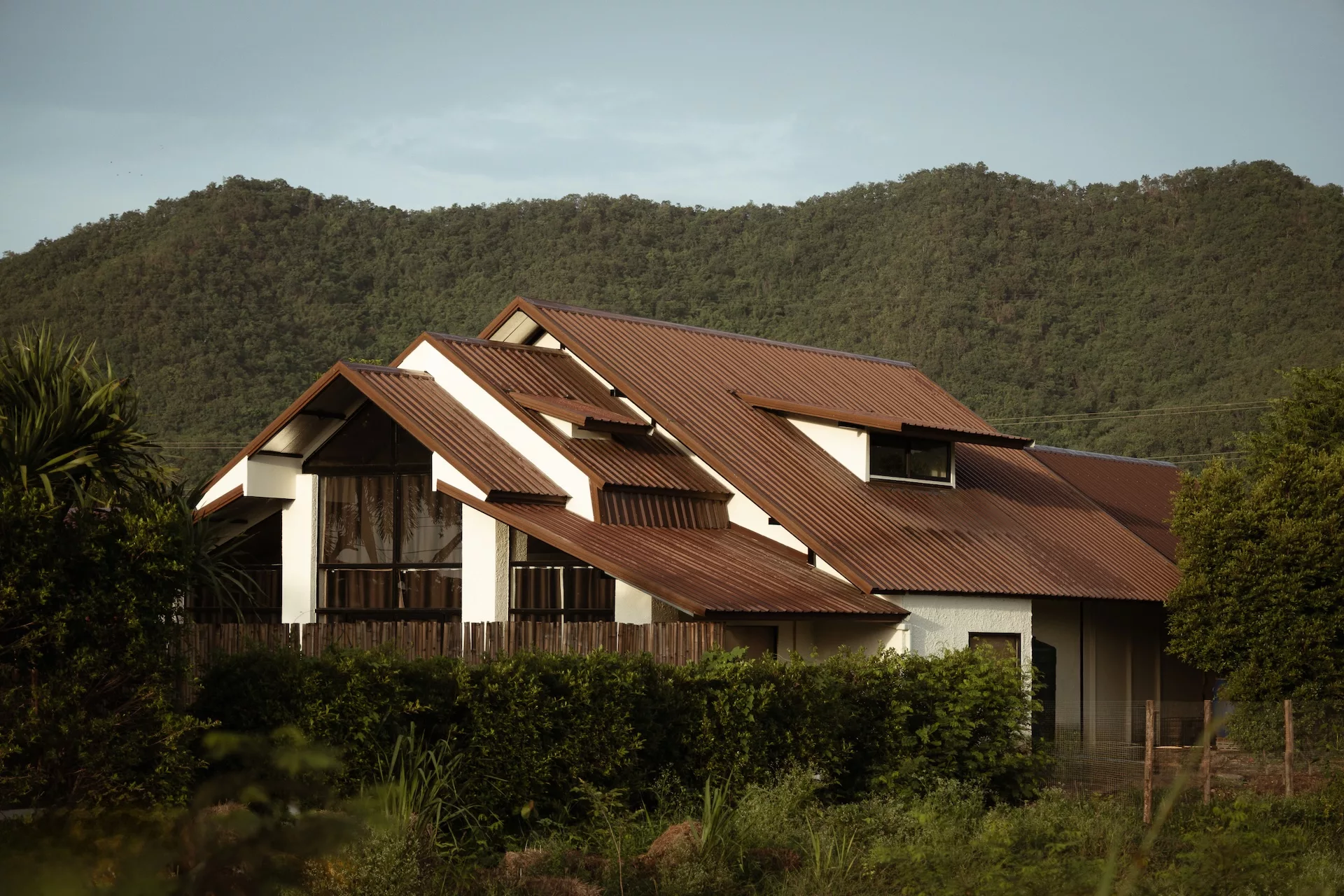
From afar, Terra Ananta is recognisable by its silhouette: steeply pitched gable roofs, weathered corrugated-iron roofing and white lime-rendered walls set against the Tenasserim ridge, with royal palms marking the way in. But what defines it is not only its shape; it is the consistency with which it applies, in every corner, the same thing it defends out in the field: here nothing was built against the land, but with it. The proof lies at the heart of the compound, in a pool that gives up almost everything an ordinary pool has. “It’s a natural eco swimming pool — no chlorine, no tiles, no cement, just rocks from the river and a plant filtration system,” explains Khosla. And when the building works ran into a large tree right where the house was to stand, the decision was in keeping with everything else. “The big tree inside the house was already there. We didn’t cut it down when we built — we relocated it,” he says.
Indoors, the same principle holds. “Everything inside is made from reclaimed sustainable materials. The centrepiece I brought back from a tribe in Sumba, Indonesia,” says the chef. The great hall — with its gramophone and long dining table — the billiards room and the garden carry you into a house that is truly lived in: that of a man who here welcomes, cooks and puts on music. Around it, a discreet infrastructure sustains the will to self-sufficiency, with solar panels on the roof, rainwater harvesting and the composting of kitchen and garden scraps, which return to the soil they came from.
 A guest room pared back to its essentials: natural materials, daylight and little else. Photo courtesy of Terra Ananta.
 From the tub, the valley itself becomes the view. Photo courtesy of Terra Ananta.
Beyond the beaches
From the tub, the valley itself becomes the view. Photo courtesy of Terra Ananta.
Beyond the beaches
Terra Ananta is, above all, an immersion in a Thailand few visitors see: the green, mountainous interior, far from the bustle of the coast. “Everyone is crazy about Koh Samui and Phuket. I want to shine a light on this — the reserve, the eco-tourism, a safari experience where you also get to stay in a beautiful place,” says Khosla.
And there is plenty to do nearby. Five kilometres from the villa, a sanctuary shelters more than twenty-five elephants rescued from the slave trade, where you can swim with them, shower them or eat by their side. Not far off, a conservation centre cares for rescued giraffes and zebras, and the farm itself sits within a national park threaded with mountain trails.
Because, at heart, this is the home of a chef who set out to buy his daughter a piece of land to teach her to care for it, and who has ended up turning it into an open house where a fortunate few will have the privilege of living, eating and sleeping as one of the family. The land that began as a gift becomes table, orchard and valley. Boundless earth.
Terra AnantaWang Dong, Kanchanaburi, Thailand