Microwave Oven Market Poised for Steady Growth as Smart Kitchens and Convenience Cooking Redefine Modern Living
Introduction: The Kitchen Appliance That Changed Everyday Cooking
Few household appliances have transformed daily life as significantly as the microwave oven. Once considered a luxury item, the microwave has evolved into a kitchen essential found in millions of homes, offices, restaurants, hotels, and food service establishments worldwide.
As lifestyles become increasingly fast-paced, consumers are seeking solutions that save time without sacrificing convenience. The modern microwave oven has successfully adapted to these changing expectations by offering faster cooking, energy efficiency, smart connectivity, and multifunctional capabilities.
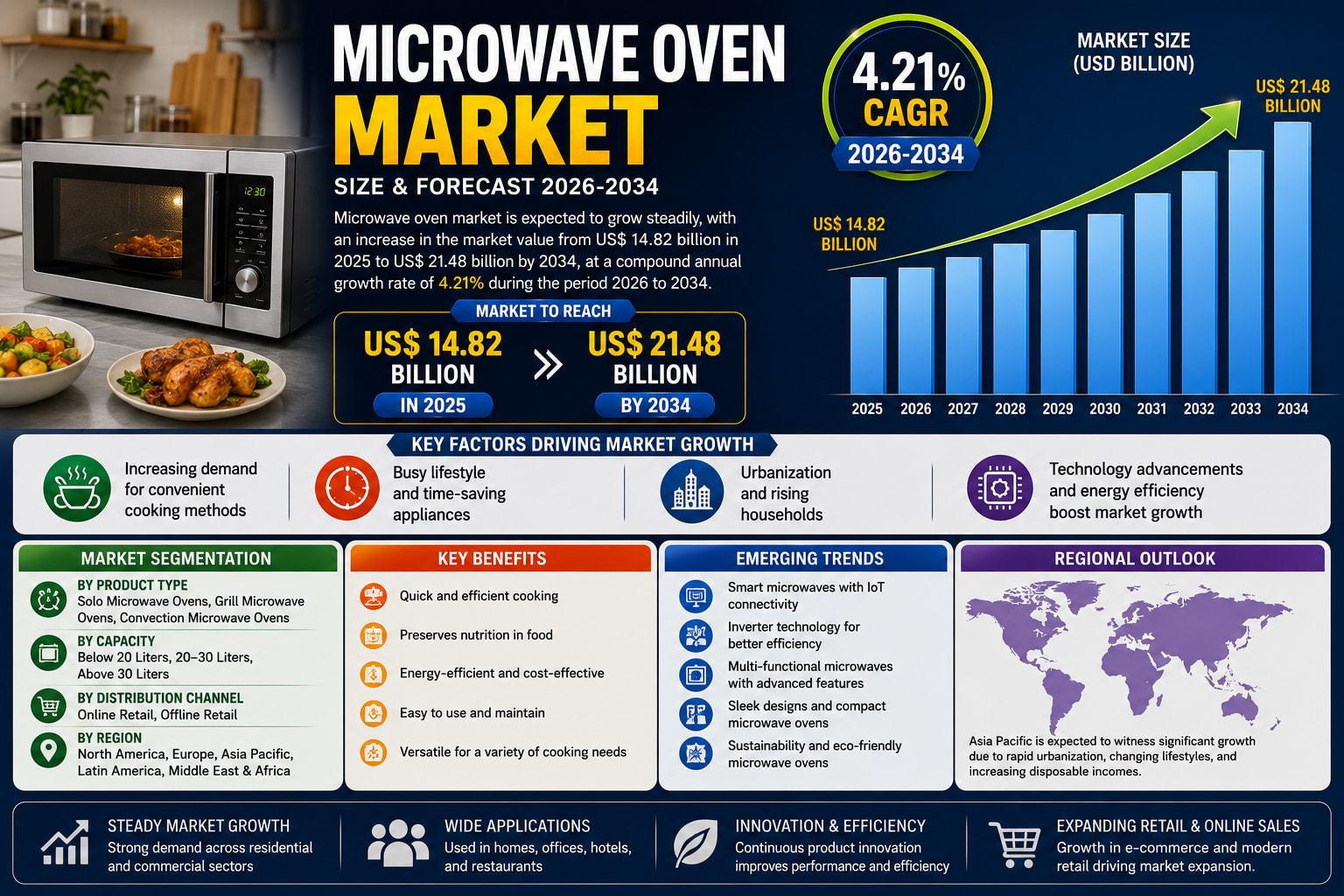
According to Renub Research, the Global Microwave Oven Market is expected to grow from US$ 14.82 billion in 2025 to US$ 21.48 billion by 2034, expanding at a compound annual growth rate (CAGR) of 4.21% between 2026 and 2034. The market's growth is being driven by rising urbanization, increasing demand for convenient food preparation, growing consumption of ready-to-eat meals, and technological innovations that continue to enhance user experiences.
As consumers embrace smart homes and modern kitchen solutions, microwave ovens are becoming more sophisticated and indispensable than ever before.Download Free Sample Report
Understanding the Role of Microwave Ovens in Modern Households
A microwave oven is an electrical kitchen appliance that uses electromagnetic waves known as microwaves to heat, cook, and defrost food. These microwaves cause water molecules within food to vibrate rapidly, generating heat that cooks or warms the food efficiently.
Unlike traditional cooking methods that rely on external heat sources, microwave ovens heat food directly, significantly reducing cooking time. This speed and convenience have made microwave ovens one of the most widely used kitchen appliances globally.
Today, microwave ovens are available in several formats, including countertop models, built-in designs, over-the-range units, grill microwave ovens, and convection microwave ovens. Modern models often incorporate advanced features such as sensor cooking, touch-screen controls, voice commands, and smart home integration.
The appliance's versatility and ease of use continue to support strong consumer demand across both residential and commercial markets.
Convenience Remains the Industry's Biggest Growth Driver
One of the primary reasons behind the continued success of microwave ovens is the growing consumer preference for convenience.
Modern lifestyles leave many individuals with limited time for meal preparation. Working professionals, students, and busy families increasingly seek kitchen appliances that simplify cooking while maintaining efficiency.
Microwave ovens address these needs by allowing users to heat, cook, and defrost food quickly without extensive supervision. Compared to conventional cooking methods, microwaves significantly reduce preparation time and energy consumption.
Consumers appreciate the ability to prepare meals rapidly, especially during busy weekdays when time constraints are greatest. This trend has become even more pronounced as urban populations continue growing and household schedules become increasingly demanding.
As convenience remains a top priority for consumers worldwide, microwave ovens are expected to maintain strong relevance within modern kitchens.
Ready-to-Eat Foods Are Driving Appliance Demand
The growing popularity of ready-to-eat and packaged foods has become a major catalyst for microwave oven sales.
Food manufacturers increasingly design products specifically for microwave preparation, making the appliance an essential tool for consuming frozen meals, instant snacks, ready-to-cook products, and ready-to-heat food items.
Changing dietary habits, expanding urban populations, and rising demand for convenience foods are contributing to this trend. Working professionals and students often rely on microwave-compatible meals because they offer quick preparation without requiring extensive cooking skills.
The report highlights the significant growth potential within the ready-to-eat and ready-to-heat food segments, particularly in rapidly urbanizing markets where convenience and efficiency play an increasingly important role in purchasing decisions.
As packaged food consumption continues to rise globally, demand for microwave ovens is expected to grow alongside it.
Smart Technology Is Transforming Microwave Ovens
Technological innovation is reshaping the microwave oven industry in exciting ways.
Modern microwave ovens are no longer limited to basic heating and cooking functions. Manufacturers are incorporating advanced technologies that enhance performance, convenience, and connectivity.
Features such as sensor cooking, automatic cooking programs, touch-screen interfaces, energy-efficient operation, and artificial intelligence are becoming increasingly common. Smart microwave ovens can now connect with mobile applications and smart home ecosystems, allowing users to control appliances remotely and receive cooking guidance.
The report highlights a notable example from February 2025, when Panasonic partnered with Fresco to launch the HomeCHEF™ 4-in-1 Multi-Oven alongside the Panasonic Kitchen+ App. This system allows users to microwave, bake, broil, and air fry while benefiting from enhanced digital cooking support.
As smart home adoption accelerates worldwide, connected microwave ovens are expected to become increasingly popular.
Multifunctional Appliances Are Gaining Market Share
Consumers increasingly prefer appliances that perform multiple functions within a single device.
Traditional microwave ovens were primarily used for reheating food. Today's consumers, however, expect greater versatility from kitchen appliances. Manufacturers have responded by introducing microwave ovens capable of grilling, baking, roasting, air frying, and convection cooking.
Multifunctional appliances help consumers save kitchen space while reducing the need for multiple cooking devices.
This trend is particularly strong among urban households where kitchen space may be limited. Compact, multifunctional appliances offer an attractive combination of convenience, efficiency, and versatility.
As consumer expectations continue evolving, multifunctional microwave ovens are expected to capture an increasingly larger share of the market.
Grill Microwave Ovens Continue to Grow in Popularity
Grill microwave ovens represent one of the most dynamic segments within the market.
These appliances combine traditional microwave functionality with grilling capabilities, allowing users to prepare a wider variety of meals. Grill microwave ovens are particularly popular among consumers seeking appliances that deliver both convenience and enhanced cooking performance.
The ability to grill foods while also performing standard microwave functions makes these products highly attractive for households looking to maximize utility from a single appliance.
Urban consumers, in particular, appreciate grill microwave ovens because they support diverse cooking styles without requiring additional kitchen equipment.
As demand for multifunctional appliances continues increasing, this segment is expected to maintain strong growth momentum.
Built-In Microwave Ovens Reflect Modern Design Trends
Kitchen design trends are playing an increasingly important role in shaping consumer purchasing decisions.
Built-in microwave ovens are becoming more popular as homeowners embrace modular kitchens and modern interior designs. These appliances are integrated directly into cabinetry or walls, creating a sleek and organized appearance.
Consumers increasingly view kitchen appliances as part of overall home aesthetics rather than purely functional tools. Built-in microwave ovens contribute to contemporary design themes while offering advanced features and efficient use of space.
The growing popularity of luxury housing developments and premium kitchen renovations is expected to further support demand for built-in microwave solutions.
Manufacturers are responding by introducing stylish designs that combine performance, convenience, and visual appeal.
Commercial Food Service Industry Supports Market Growth
Beyond residential kitchens, microwave ovens play a critical role in commercial food service operations.
Restaurants, hotels, cafes, catering businesses, and institutional kitchens rely on commercial microwave ovens to improve efficiency and reduce food preparation times. These appliances are designed for heavy-duty use and offer greater power, durability, and performance than household models.
The growth of the global hospitality and food service sectors is creating strong demand for commercial microwave ovens. Businesses increasingly require equipment that helps maintain food quality while supporting faster service.
As tourism, quick-service restaurants, and food delivery services continue expanding, commercial microwave ovens are expected to remain an important contributor to overall market growth.
High-Power Microwave Ovens Are Becoming More Popular
Microwave ovens with power ratings above 1000 watts are gaining popularity among both residential and commercial users.
These appliances offer faster heating and more efficient cooking compared to lower-powered alternatives. Consumers who frequently use microwave ovens appreciate the time savings associated with higher-power models.
Commercial kitchens also favor high-power microwave ovens because they can handle larger food volumes and support higher operational efficiency.
As consumers increasingly prioritize convenience and performance, demand for high-power microwave ovens is expected to continue rising.
Manufacturers are responding by introducing products that combine speed, energy efficiency, and advanced cooking capabilities.
Offline Retail Continues to Play a Major Role
While e-commerce continues growing, offline retail channels remain highly important within the microwave oven market.
Many consumers prefer purchasing appliances from electronics stores, appliance retailers, supermarkets, and hypermarkets because they can physically evaluate products before making purchasing decisions.
Retail stores also provide product demonstrations, expert guidance, and after-sales support, which many consumers value when purchasing household appliances.
The strength of traditional retail networks remains particularly important in regions where online shopping adoption is still developing.
As a result, offline sales channels continue contributing significantly to overall market performance.
Regional Markets Offer Diverse Growth Opportunities
United States
The United States remains one of the world's largest microwave oven markets. Strong consumer spending, widespread adoption of modern appliances, and growing demand for smart kitchen technologies continue supporting market growth.
The report notes that GE Appliances introduced its latest GE Profile appliance range featuring voice control, artificial intelligence, and smart technologies designed to simplify daily life.
United Kingdom
The United Kingdom market continues expanding due to increasing demand for convenient cooking solutions and energy-efficient appliances. Growing interest in smart kitchens and built-in appliance designs is also contributing to growth.
Samsung's 2024 launch of new smart microwave ovens featuring voice command functionality demonstrates the growing importance of connected appliances in the region.
India
India represents one of the fastest-growing opportunities in the microwave oven industry. Urbanization, rising disposable incomes, expanding middle-class populations, and increasing adoption of modern kitchen appliances are driving demand.
Growing consumption of packaged foods and the rise of modern housing developments are further strengthening market prospects.
Saudi Arabia
Saudi Arabia's microwave oven market is benefiting from lifestyle modernization, increasing disposable incomes, and investments in smart home technologies.
The report highlights Samsung's introduction of Bespoke AI appliances and advanced kitchen solutions that reflect the growing demand for intelligent home appliances within the region.
Challenges Facing the Industry
Despite positive growth prospects, the microwave oven industry faces several challenges.
One major concern is increasing competition from alternative cooking appliances such as air fryers, induction cooktops, convection ovens, and multifunctional cooking devices. Many consumers prefer appliances that offer broader cooking capabilities, including crisping, frying, and baking.
Consumer perceptions regarding food quality also remain a challenge. Some individuals believe microwave-cooked food lacks the texture, flavor, or nutritional quality associated with traditional cooking methods.
Although scientific evidence supports the safety of microwave cooking, misconceptions continue to influence purchasing decisions in certain markets. Manufacturers must continue educating consumers while improving product capabilities to address these concerns.
Leading Companies Shaping the Industry
The microwave oven market remains highly competitive, with several global manufacturers investing heavily in innovation, smart technologies, and product development.
Key companies highlighted in the report include Illinois Tool Works Inc., Sharp, LG Electronics, Whirlpool Corporation, GE Appliances, Panasonic Corporation, Samsung Electronics, and Midea Group.
These organizations continue introducing advanced appliances that combine energy efficiency, connectivity, automation, and multifunctionality.
As competition intensifies, innovation is expected to remain a key differentiator across the industry.
Final Thoughts
The global microwave oven market continues to evolve as consumers embrace convenience, smart technology, and modern kitchen lifestyles.
With the market projected to grow from US$ 14.82 billion in 2025 to US$ 21.48 billion by 2034, microwave ovens remain one of the most essential and adaptable appliances in contemporary households. Rising demand for ready-to-eat meals, expanding urban populations, and ongoing technological advancements are creating favorable conditions for sustained growth.
As manufacturers continue integrating artificial intelligence, smart home connectivity, and multifunctional capabilities, microwave ovens are likely to play an even greater role in the future of food preparation. While challenges from alternative cooking technologies remain, the appliance's unmatched convenience and ongoing innovation ensure its place at the center of modern kitchens for years to come.