Why is the US saying it secretly shipped crude oil through Hormuz? What could be Trump’s game plan?
A pair of dramatic social media posts attributed to US President Donald Trump has reignited debate over Washington’s long-term strategy in the Persian Gulf.
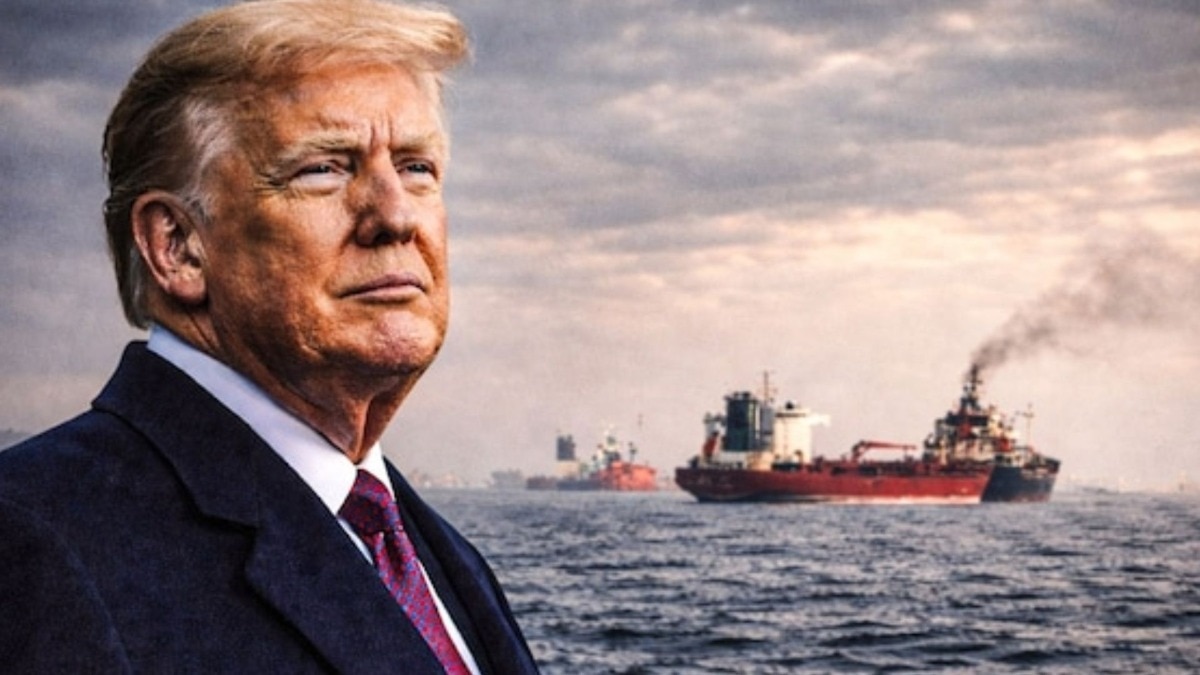
In one message, Trump claimed he had ordered a “secret mission” by the US military to support oil tankers and commercial shipping through the Strait of Hormuz, adding that the effort had enabled more than “100 million barrels of oil” and over 200 commercial vessels to safely pass through the strategic waterway.
In another, he suggested that after crippling Iran’s military capabilities, the United States could eventually “take” Kharg Island — Iran’s primary oil export terminal — and “assume total control” of the country’s oil and gas markets.
MUST READ | US-Iran peace deal likely on Trump's 80th birthday? Pakistan drops big hint
The remarks, shared alongside references to a covert operation in Hormuz, have sparked questions about whether the administration is signaling a broader doctrine that goes beyond Iran’s nuclear program and instead centers on control of energy flows and maritime security.
More than a military strategy
According to a policy strategist who analyzed the posts on X (formally twitter), Trump’s rhetoric is not a sudden reaction to the latest tensions with Tehran. Instead, it reflects an idea he has consistently articulated for nearly four decades: if the United States spends blood and treasure protecting global trade routes, it should receive a direct economic benefit.
The strategist argued that the intellectual roots of Trump’s current messaging can be traced back to 1987, when the then-businessman purchased full-page advertisements in major American newspapers under the headline, “There’s Nothing Wrong With America’s Foreign Defense Policy That a Little Backbone Can’t Cure.” In those advertisements, Trump questioned why the United States was paying to secure Persian Gulf oil routes that primarily benefited allies such as Japan and Saudi Arabia.
His argument was blunt: America should not shoulder the cost of defending shipping lanes unless allies contribute more or the US gains something tangible in return.
The forgotten 1987 blueprint
That same year, in a widely discussed television interview with journalist Barbara Walters, Trump expanded on the concept during a conversation about the Iran-Iraq “Tanker War,” when attacks on oil tankers in the Gulf threatened global energy supplies.
When Walters challenged his aggressive rhetoric, asking whether it implied sending troops into another Middle Eastern conflict, Trump reportedly responded that if Iran attacked American interests, Washington should “grab one of their big oil installations and keep it.” He also questioned why the U.S. was spending billions to protect shipping without compensation, asking, “Why couldn’t we go in and take over some of Iran’s oil?”
At the time, those comments were viewed largely as the provocative observations of a New York real estate developer. But analysts note that the same themes have repeatedly resurfaced throughout Trump’s political career — whether in his calls for allies to “pay their fair share” for US security guarantees, his emphasis on controlling strategic resources, or his transactional approach to foreign policy.
Why mention a “secret” Hormuz operation?
The Strait of Hormuz is one of the world’s most critical energy chokepoints, with roughly a fifth of global oil consumption passing through the narrow corridor connecting the Persian Gulf with international markets. Any disruption there can send energy prices soaring and rattle financial markets worldwide.
By highlighting a purported covert effort to escort tankers and facilitate oil shipments, Trump appears to be framing the US military not merely as a security provider, but as the guarantor of global energy stability. The implicit message is that American naval power — not Iran — ultimately controls access to the Strait.
His assertion that “the United States of America controls the Strait of Hormuz — not Iran” fits squarely into a narrative that maritime dominance is both a strategic asset and a bargaining chip. It also reinforces his longstanding complaint that Washington’s allies have benefited disproportionately from US military protection.
Kharg Island: Why it matters
Trump’s reference to Kharg Island is particularly striking. Located in the northern Persian Gulf, the island handles the overwhelming majority of Iran’s crude oil exports and is among the country’s most strategically important pieces of energy infrastructure. Any threat to Kharg Island would carry enormous geopolitical and economic consequences, potentially disrupting Iranian export revenues and affecting global oil markets.
For decades, Iranian oil infrastructure has been viewed by military planners as a critical point of leverage in any conflict. Trump’s suggestion that the U.S. could one day “assume total control” over Iran’s oil and gas markets echoes his decades-old belief that economic assets should be used to offset the cost of military intervention.
“America First” through an energy lens
Foreign policy scholars have long argued that Trump’s worldview is less ideological than transactional. Research by Brookings Institution scholar Thomas Wright, cited by the X post, traces a consistent pattern in Trump’s thinking from the late 1980s onward: allies should pay for US protection, military power should generate measurable returns, and strategic resources can be used as leverage against adversaries.
Viewed through that lens, the latest Truth Social posts are less about unveiling a new doctrine than reviving an old one. The “America First” approach, in this interpretation, is not only about reducing foreign commitments but about ensuring that any American deployment produces a concrete economic or strategic dividend.
Whether the comments represent an actual policy blueprint or political messaging remains open to interpretation.