Who will win the World Cup? Scientists calculate the chances for all 48 teams - with Spain the clear favourites to take home the trophy
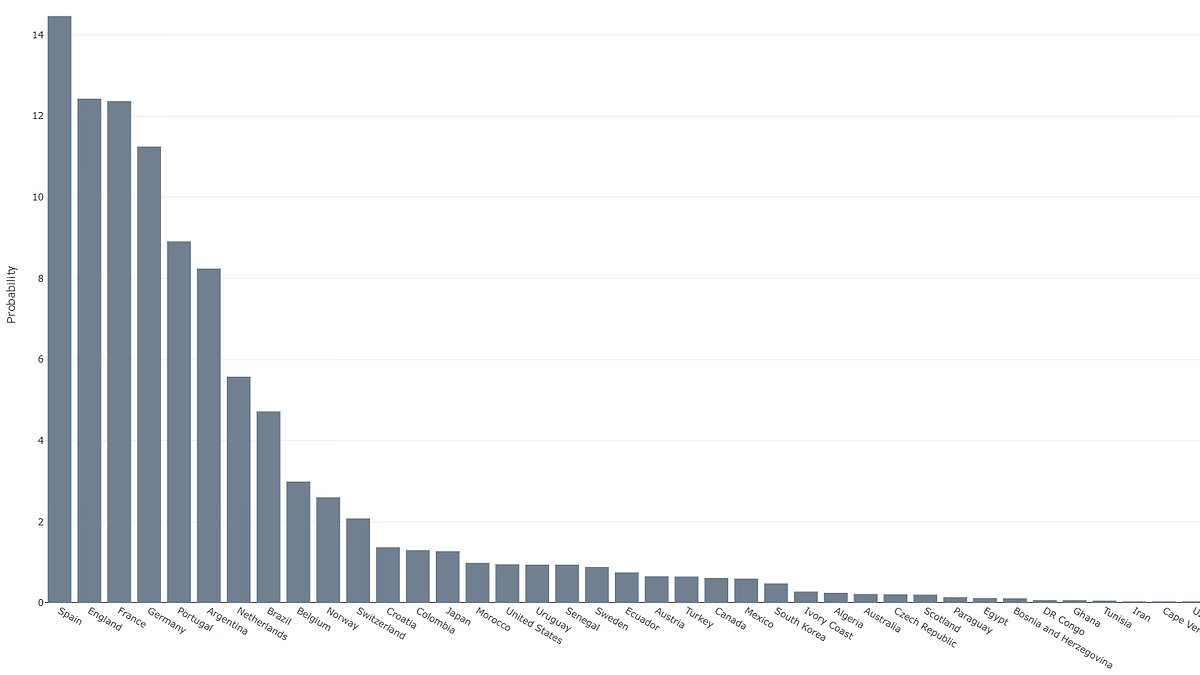
The FIFA World Cup is just a matter of weeks away now, with matches set to be held in Canada, Mexico and the US from June 11 to July 19. Now, scientists have revealed which teams are most likely to take home the trophy. Experts from the University of Innsbruck have calculated the chances of winning for all 48 participating teams. And their findings will come as good news for Spain fans. According to the researchers' calculations, Spain is the favourite, with a 14.5 per cent chance of winning the tournament. However, England fans will be relieved to hear that England is close behind (12.4 per cent), just ahead of France (12.4 per cent) and Germany (11.2 per cent). 'Compared to previous tournaments, this year's title race is very tight,' said co-lead author, Achim Zeileis. In contrast, Jordan is the least likely to win the World Cup, according to the researchers – while Scotland has just a 0.2 per cent chance of winning.
Experts from the University of Innsbruck have calculated the chances of winning for all 48 participating teams According to the researchers' calculations, Spain is the favourite, with a 14.5 per cent chance of winning the tournamentTo come up with the odds, the researchers used a broad range of data. This included the teams' performance in past international matches, bookmaker odds for the upcoming tournament, player ratings from club and international matches, and the average market value of the squads.This information was then combined using a machine learning algorithm.'More specifically, the algorithm estimates the predicted number of goals for all possible matches between all 48 teams in the tournament,' the researchers explained. The algorithm reveals that Spain, England, France and Germany are the clear favourites to win the tournament. Somewhat further back are Portugal (8.9 per cent), and Argentina (8.2 per cent), as well as the Netherlands (5.6 per cent) and Brazil (4.7 per cent). At the other end of the list, the algorithm suggests Jordan are the least likely to win, ahead of Qatar, Iraq, South Africa, and Curacao. The researchers highlight that the forecasts are probabilistic, and are 'by no means certain'.
This heatmap shows for each possible combination of teams the probability that one team beats the other team in a knockout match. The color scheme uses green vs. purple to signal probabilities above vs. below 50%, respectively England fans will be relieved to hear that England is close behind Spain in the researchers' rankings (12.4 per cent chance of winning), ahead of France (12.4 per cent) and Germany (11.2 per cent) The teams most and least likely to win the World Cup Most likelySpain England FranceGermanyPortugalArgentinaNetherlands Brazil BelgiumNorway Least likelyJordanQatarIraqSouth AfricaCuracaoSaudi ArabiaNew ZealandHaitiPanamaUzbekistan 'The probability that the top favorite will actually win the tournament is usually no more than 20%, which conversely also means that some other team wins with a probability of 80%,' explained co-author Andreas Groll of TU Dortmund University.'As a statistician, I'm therefore more interested in whether, on average, many of the teams we predict to go far will actually do so.'However, the researchers have a track record of getting it right. Their previous predictions at the 2010 World Cup, Euro 2012, and the 2019 Women's World Cup were bang on. 'The probabilistic forecasts leave a lot of room for surprises and excitement during the 2026 FIFA World Cup,' they added. 'But what is absolutely certain is that we look forward to an entertaining tournament as football fans (much more than as professional forecasters).'The predictions come shortly after researchers warned that players and fans will be subject to unbearable heat during many of the games.In the study, experts from World Weather Attribution modelled the conditions during every one of the 104 matches.
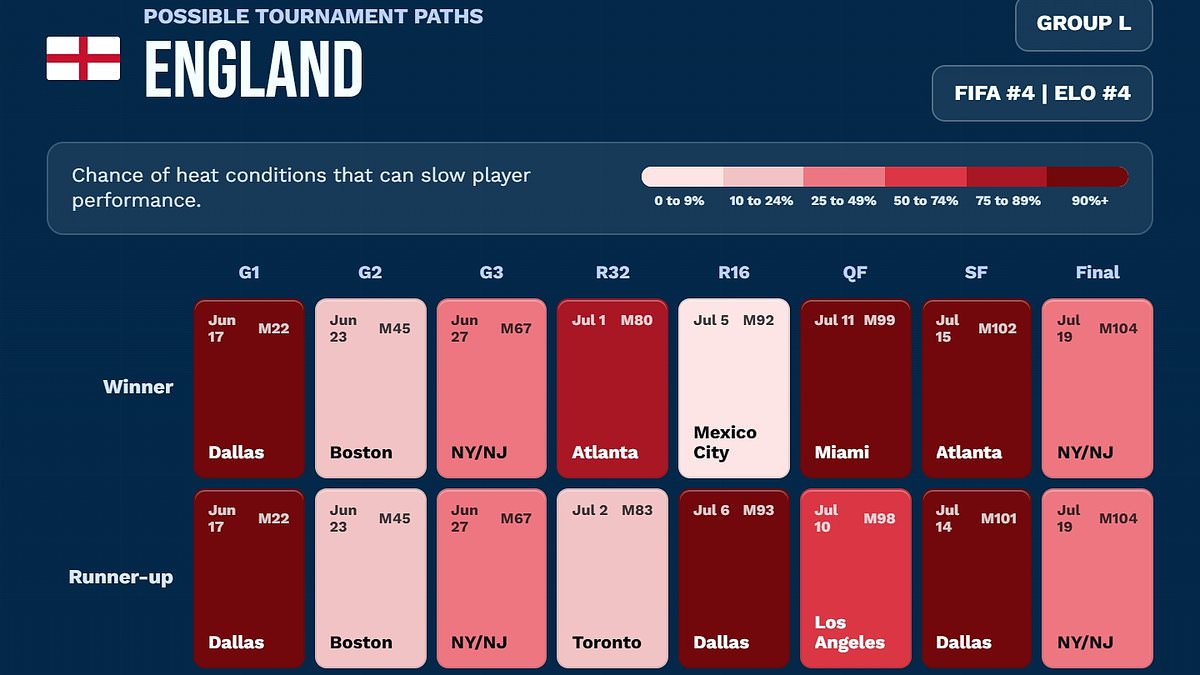
The researchers were able to simulate the entire tournament, providing 'survival' probabilities for each team across the different stagesTheir results suggest that a quarter of the matches will be played in unsafe conditions, while five will be so hot that experts advise postponing them entirely.Worryingly, many of these matches are scheduled in venues without air conditioning – including Miami, Kansas City, New York, and Philadelphia.Unfortunately for some British fans, this includes Scotland's clash with Brazil, which is scheduled to take place in Miami on June 24. 'The climate that the tournament is being played in today has fundamentally shifted in just 32 years,' warned Dr Joyce Kimutai, an author of the study from Imperial College London. 'While organisers have attempted to reduce the risk by scheduling some games in high–risk – uncooled – locations like Miami and Kansas City later in the day, there's a very real risk that we'll be faced with games taking place in conditions that are unsafe for players and fans.'