Virgin Galactic to launch 'Operation Period' in 2027: Groundbreaking mission will be the first to study menstruation in space
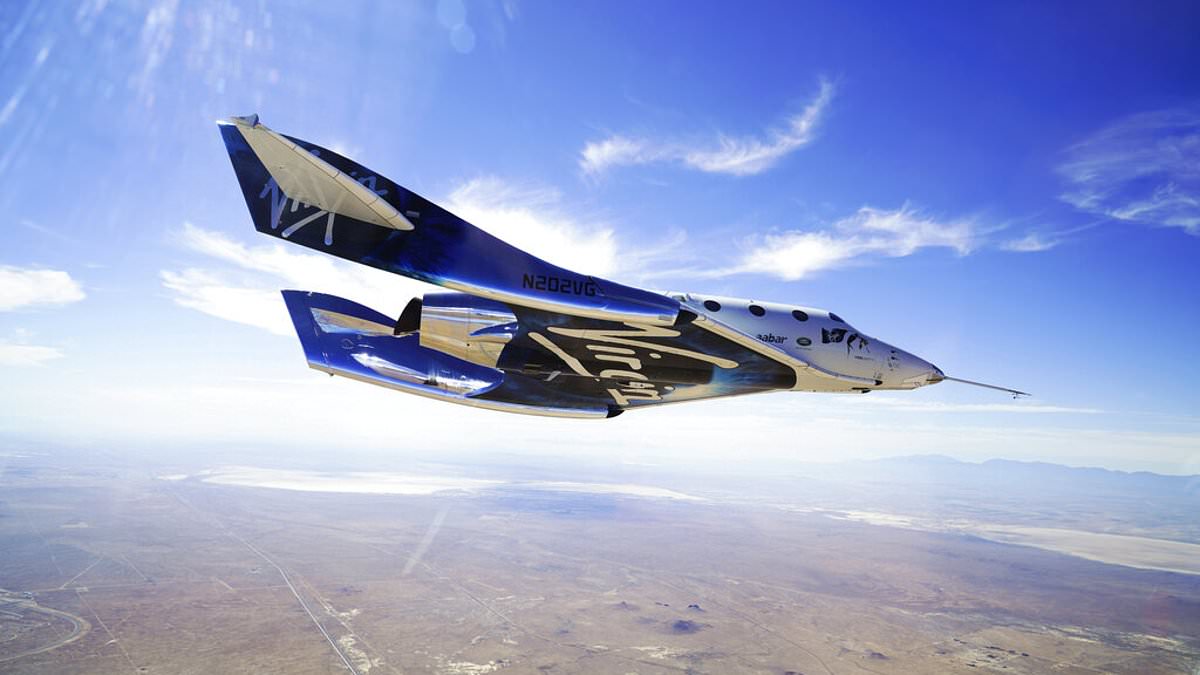
Virgin Galactic has announced plans for a new mission in 2027, which it has named 'Operation Period–01', or OP–01 for short.As you might have guessed from the name, the mission will be dedicated to studying menstruation in microgravity.OP–01 will be led by Manju Bangalore and Priya Abiram, the founders of Gen Z–led organisation, Operation Period.Ms Abiram said: 'By studying menstruation in microgravity, we have the opportunity to potentially unlock insights for astronauts, as well as help inform future biomedical research on Earth, from reproductive science to chronic conditions that remain under–researched and under–funded.' This marks the first dedicated research mission to study menstruation in microgravity – despite the fact that over 100 women have already been to space. 'This mission is about more than a scientific first, it's about correcting a fundamental design gap,' Ms Bangalore added.'Human spaceflight has historically been built around a narrow definition of the human body.'We are working to expand that definition and ensure that future space exploration reflects the full diversity of human experience.' Virgin Galactic has announced plans for a new mission in 2027, which it has named 'Operation Period–01', or OP–01 for short. Pictured: VSS Unity in 2018 OP–01 will be led by Manju Bangalore (right) and Priya Abiram (left), the founders Gen Z–led organisation, Operation PeriodDetails on the mission remain sparse at this stage.However, Virgin Galactic has confirmed that it will be suborbital, meaning the spacecraft will travel into outer space, but will not go fast enough to enter orbit around Earth.A spokesperson told the Daily Mail: 'This mission will fly aboard our new spaceships which are expected to fly to space in Q4 of this year.'Mission duration for a suborbital flight is approx. 90 mins - the same as our other commercial spaceflight missions.'The research design is being led by Ms Bangalore and Ms Abiram, who Virgin Galactic describe as 'emerging voices at the forefront of reproductive health and space innovation.'Ms Bangalore is an engineer with a B.S. in Physics and Mathematics from the University of Oregon and a M.S. in Astronautical Engineering from the University of Southern California, who has already conducted research on multiple parabolic flight campaigns.Meanwhile, Ms Abiram holds a B.S. in Mechanical Engineering and an M.Eng. in Aerospace Engineering from Cornell University, and has already worked with NASA, Blue Origin, VAST, and Boeing.During the mission, the research will have two key focuses – menstrual fluid dynamics and menstrual product performance. Details on the mission remain sparse at this stage, including the spacecraft, the launch date, and mission duration. Pictured: VSS Unity during a flight in 2020According to Virgin Galactic, the findings could not only pave the way for period products in space, but also 'broader medical innovations'.'At Virgin Galactic, we are committed to enabling human–tended research that expands the scope of what can be studied in space,' said Amber Favaregh, Director, System Analysis & Research, Virgin Galactic.'This mission with Operation Period is a powerful example of how Virgin Galactic can continue to support real–time, in–flight scientific investigation into long–overlooked areas of human health, helping advance more inclusive and innovative exploration that delivers insight for both space and life on Earth.'Further details on the research payloads, and additional collaborators will be announced in the coming months. Currently, NASA does not have any rules for how female astronauts manage their periods in space. While some use sanitary products like pads or tampons, others opt for hormonal pills to stop their periods entirely. However, as missions become longer, this could become an issue, according to space gynaecologist at King's College London, Varsha Jain. 'An issue is that, for a three–year mission (say, to Mars and back), you'd need about 1,100 pills to keep periods away – and the flight needs to cope with carrying and disposing of all the packaging, including the cost of launching any extra payload into space. The same problem applies to sanitary products,' she explained in an article for The Conversation. In 2022, a research group called AstroCup sent two menstrual cups into space, and found that they held up with no damage.This suggests they could offer female astronauts a reusable solution on future missions.On the Operation Period website, the team explained: 'Astronauts should ideally have informed choices regarding whether they menstruate during missions, what products or suppression methods they use, and how those decisions intersect with operational systems and personal health considerations.'OP–01 should be understood as part of the natural maturation of human spaceflight research and human–centered systems design as space becomes more accessible, not as evidence that menstruation is inherently incompatible with spaceflight.'Artemis II: Key facts Launch date: April 1Mission objective: To complete a lunar flyby, passing the 'dark side' of the moon and test systems for a future lunar landing.Total distance to travel: 620,000 miles (one million km)Mission duration: 10 days Estimated total cost: $44billion (£32.5billion)NASA Space Launch System rocket: $23.8billion (£17.6billion)Orion deep–space spacecraft: $20.4billion (£15billion)Crew: Commander Reid WisemanPilot Victor GloverMission Specialist Christina KochMission Specialist Jeremy HansenMission Stages:Launch from Kennedy Space Centre Launch Pad 39BManoeuvre in orbit to raise the perigee using the Cryogenic Propulsion StageBurn to raise apogee using the Cryogenic Propulsion StageDetach from Cryogenic Propulsion Stage and perform translunar injectionFly to the moon over four daysComplete lunar flyby at a maximum altitude of 5,523 miles (8,889 km) above the moon's surfaceReturn to Earth over four daysSeparate the crew module from the European Service Module and the crew module adapterSplashdown in the Pacific Ocean